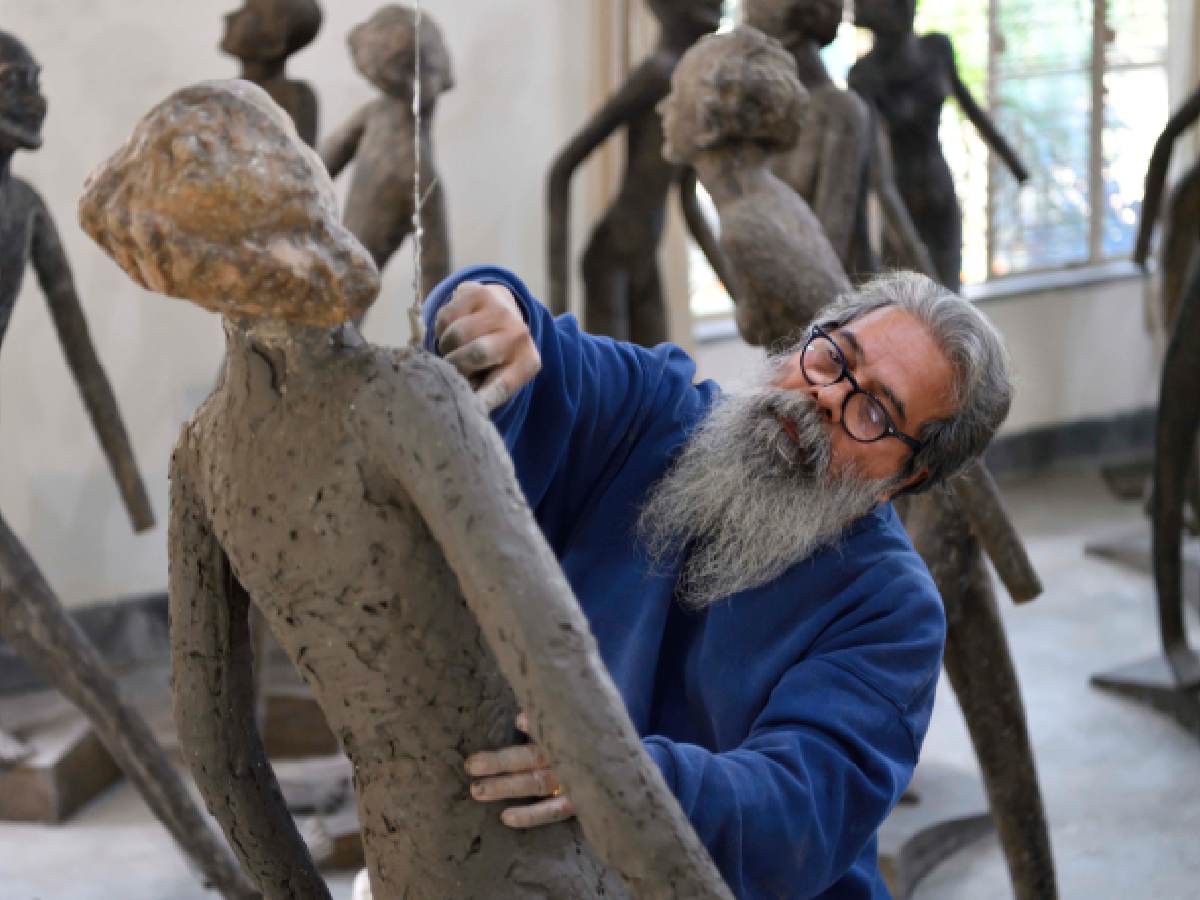
KS Radhakrishnan
As visitors step into Chawla Art Gallery in Saket, they are greeted by a world shaped in bronze—fluid, expressive, and deeply human. Once Upon a Sculptor, a curated exhibition of works by KS Radhakrishnan, unfolds as both a visual and intellectual journey, tracing the artist’s evolution across decades of sculptural practice.
Curated by Shibani Chawla, the exhibition brings together a significant body of work, ranging from Radhakrishnan’s early explorations to his later, more refined creations. The show offers a rare opportunity to witness the continuity and transformation in his artistic language, where form, posture, and gesture become vehicles of emotional and philosophical expression.
“Once Upon a Sculptor brings together an oeuvre of works that traces Radhakrishnan’s artistic journey—from his early sculptural expressions to the later iconic Maiya and Musui figures—reflecting distinct emotional and philosophical states that together chart the evolution of his practice,” Chawla said.
Exploring form, movement and identity
Widely regarded as one of India’s most significant contemporary sculptors, Radhakrishnan is best known for his recurring figures—Maiya and Musui. These anthropomorphic forms, often depicted in dynamic movement, embody a spectrum of emotions, from introspection and longing to joy and transcendence.
Each iteration of these figures carries a unique sensibility, with posture and expression capturing distinct states of being. The sculptures invite viewers to engage with them beyond their physicality, drawing attention to the inner worlds they represent.
“The exhibition offers both a visual and academic journey,” Chawla noted, adding that it allows viewers to trace the evolution of the practice “from its formative years to the present”.
Memory, migration and metaphor
A central thread running through Radhakrishnan’s work is his engagement with themes of migration, nostalgia, and memory. His Maiya and Musui figures, representing anima and animus, function as metaphors for human experience, negotiating movement through time and space.
“Sculpting taught me the importance and relevance of ‘looking around’ though ‘looking back’ is unavoidable,” Radhakrishnan said, reflecting on the philosophy that informs his work.
Through fluid body movements and sensuous forms, his sculptures evoke a sense of continuity—bridging past and present while remaining rooted in lived experience.
A journey across decades
Spanning multiple phases of the artist’s career, the exhibition maps a trajectory that moves from early, powerful sculptural expressions to later, more mature works. This evolution is not merely stylistic but deeply conceptual, revealing shifts in the artist’s engagement with form and meaning.
“Each phase reflects a different emotional and philosophical state, and together they create a comprehensive narrative of the journey,” Chawla said.
The exhibition also highlights Radhakrishnan’s long engagement with public art. Since the 1980s, he has installed open-air sculptures across India and abroad, embedding his works within everyday landscapes and extending their dialogue beyond gallery spaces. This sensibility translates into the exhibition as well, where the sculptures seem to carry an inherent sense of motion, as though they exist in transition.
Voices from the gallery
Visitors to the exhibition have responded strongly to its emotional depth and visual language, often finding personal connections within the sculptural forms.
Ritika Sharma, a fine arts student from Delhi University, said, “What struck me most was how alive the sculptures feel. Even though they are cast in bronze, there’s a sense of movement and emotion that makes them almost human. It made me think about how form alone can convey such complex feelings.”
Art enthusiast Arjun Mehta said the themes felt universal. “The Maiya and Musui figures feel like they belong everywhere and nowhere at the same time. They carry a sense of migration and memory that resonates deeply, especially in today’s world where movement and displacement are so common.”
For practising artist Neha Verma, the exhibition offered both inspiration and introspection. “Radhakrishnan’s work reminds you that sculpture is not just about material but about thought and emotion,” she said, adding that the use of posture and gesture to express states of being is “incredibly powerful”.
Sanjay Kapoor, a corporate professional, said the works were accessible even to those outside the art world. “I’m not from an art background, but the sculptures are very engaging. You don’t need prior knowledge to feel something. There’s an immediacy to them that draws you in.”
Cultural researcher Aditi Rao highlighted the philosophical undertones. “There’s a quiet meditative quality to these works. They seem to exist between stillness and motion, past and present. It feels like the artist is exploring not just physical movement but also psychological and emotional journeys,” she said.
An enduring artistic association
The exhibition also marks a significant moment in the long-standing relationship between Radhakrishnan and the Chawla family. Over the years, the gallery has showcased his work across several group exhibitions, presented his solo at the India Art Fair in 2015, and continues to house key sculptures within its private collection.
“There has been a longstanding association with the artist’s practice, and this exhibition becomes a meaningful culmination of that journey,” Chawla said.
A Delhi court denied bail to a former DU professor accused of raping a student,…
Delhi Police charged seven dhaba workers in the fatal beating of a Manipuri musician who…
Seven Delhi STPs failed DPCC standards in September, dumping high levels of faecal coliform and…
AISA chief Neha Bora petitioned the Delhi HC against a police notice requiring a peace…
Average AQI of 171 in the first week of this month; falling temperatures and stubble…
Delhi Police dismissed claims of disrupting CR Park Durga Puja, stating actions strictly enforced court-mandated…

