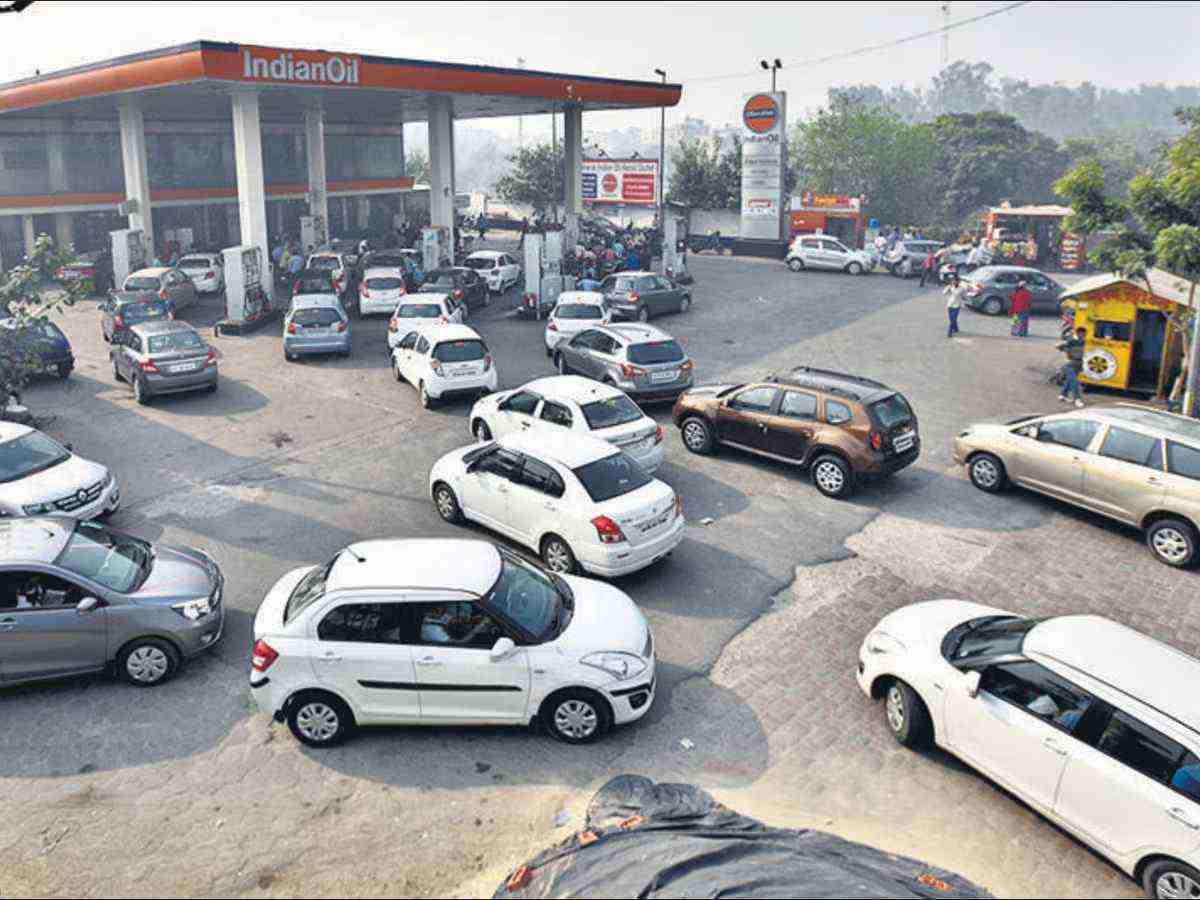
Though the Commission for Air Quality Management (CAQM) has put on hold on ban the End Of Life (EOL) vehicles from refuelling in Delhi until November 1 following the requests by the Delhi Government, retired bureaucrats, senior officials, and environmentalists voice strong support for the policy, even as they raised concerns over its ground-level implementation.
Last month, CAQM issued a directive banning all diesel vehicles older than 10 years and petrol vehicles older than 15 years from fuelling in Delhi, regardless of their state of registration. Petrol pumps were equipped with automatic number plate recognition (ANPR) technology to detect these vehicles, and 350 teams comprising officials from various departments were deployed to intensify the crackdown.
The move, however, triggered widespread public outrage, prompting the city government to urge CAQM to suspend the policy just three days after its implementation.
Still, retired civil servants and Delhi government officials have clarified that the crackdown was long overdue and essential for improving the Capital’s deteriorating air quality. They also emphasised that the Delhi government is merely implementing a Supreme Court order—it did not formulate the policy.
“Not a new policy”: Former IAS officer backs crackdown
Speaking to Patriot, a retired Indian Administrative Service (IAS) officer who previously worked closely with the Delhi Transport Department welcomed the crackdown, calling it a “long-overdue” measure.
“This is not a new policy. The Supreme Court passed the order banning diesel vehicles older than 10 years and petrol vehicles over 15 years long ago. Unfortunately, the authorities failed repeatedly to enforce it on the ground,” said the former bureaucrat.
He added that the lack of implementation over the years allowed lakhs of outdated and polluting vehicles to continue operating on Delhi’s roads, contributing significantly to the city’s worsening air quality.
According to him, the recent drive to impound such vehicles and prevent their refuelling is a much-needed step toward addressing the Capital’s persistent pollution crisis.
“As the capital of India, Delhi should set an example in environmental responsibility. But instead, it has become infamous for its toxic smog, especially during the winter months. This isn’t just an environmental issue; it’s a public health emergency. Taking EOLs off the roads is an essential step,” he added.
Government defends rollout amid operational hurdles
Addressing questions about what happens after a vehicle is seized, a senior official from the Delhi Transport Department said the government has empanelled authorised vendors to handle the scrapping process.
“After the vehicle is impounded, the administration estimates its value and compensates the owner. The vehicle is then put up for auction. Registered vendors place their bids, and the highest bidder takes possession of the vehicle for scrapping,” the official explained.
He added that the process ensures transparency and is economically viable for both the administration and the vendors.
One of the biggest logistical challenges now confronting the administration is where to store the increasing number of impounded vehicles. Delhi currently has only two official malkhanas—designated yards for seized vehicles.
A senior official acknowledged the concern, saying, “It’s true that we only have two official malkhanas. But in case the number of seized vehicles exceeds capacity, we are prepared to convert open grounds in various parts of Delhi into temporary storage sites.”
The administration is also exploring ways to fast-track the scrapping process so that impounded vehicles do not pile up and occupy space for extended periods.
After facing strong public backlash, Delhi Environment Minister Manjinder Singh Sirsa on July 3 wrote to CAQM, seeking a rollback of the order citing logistical and technological limitations.
“In view of significant operational and infrastructural challenges, implementing this order at this stage is not feasible,” Sirsa wrote, adding that “rushing its enforcement could be premature and potentially counterproductive.”
On July 6, Lieutenant Governor Vinai Kumar Saxena publicly criticised the policy, calling it “irrational and unfair.”
He noted that the EOL ban disproportionately affected middle-class families and small business owners. The LG recommended filing a review petition before the Supreme Court and advocated for a fitness-based approach rather than a rigid age-based ban. He also called for coordination with the Union Ministry of Road Transport and Highways to develop a uniform national policy.
Later the same day, Chief Minister Rekha Gupta announced plans to approach the Supreme Court, stating that enforcement only in Delhi was unfair and impractical. She criticised previous governments for failing to act on the issue, saying their negligence had led to judicial intervention.
Environmentalists: “Policy good, implementation flawed”
Environmentalists have welcomed the policy as a necessary move to reduce pollution but have sharply criticised the lack of vision and planning in its execution.
Also Read: Delhi’s ‘Safe City’ drive: Thousands of CCTV cameras defunct
Bhavreen Kandhari, an environmentalist, said, “This crackdown on End-of-Life Vehicles is a much-needed step to reduce Delhi’s dangerous air pollution levels. But the government’s approach lacks vision and long-term planning.”
“Merely relying on the age of a vehicle as a marker of pollution is flawed. A car that’s rarely used—say, by an elderly couple—may pollute far less than a newer car stuck in traffic for hours each day. The real issue isn’t just what kind of cars we drive, but how many are on the road, how long they run, and how our cities are planned.”
“Instead of forcing people to scrap well-maintained vehicles to push new purchases, the policy should aim to reduce overall car use. Delhi needs to explore systemic solutions like congestion pricing, low-emission zones, steep parking charges, and strict no-parking enforcement. Cities like London, Beijing, and Berlin have improved air quality by adopting targeted, behaviour-based interventions—not blanket bans,” she stated.
“What Delhi really needs is a shift from reactive bans to proactive planning. We must invest in clean, reliable public transport and make the city walkable and bike-friendly. Urban planning that favours cars over commuters will only worsen pollution and traffic—regardless of whether the vehicles are old or new,” Kandhari asserted.
“Yes, the goal of cleaner air is urgent and shared by all. But our methods must be grounded in science, equity, and sustainability. Real progress will come when we reduce our dependence on private vehicles—not through arbitrary age-based bans lacking alternatives,” Kandhari concluded.
Citizens caught off-guard by sudden enforcement
The first week of July saw widespread panic in Delhi as vehicle owners scrambled to sell or scrap their cars—not because they were unfit or unsafe, but simply because they had crossed the 10-year or 15-year threshold.
Amit Khurana, 38, Sales Executive, Dilshad Garden — Sold his 2014 Maruti Swift diesel:
“My Maruti Swift diesel was just about 10 years old—a 2014 model. It had no major problems, gave great mileage, and I had all the service records in place. I even renewed insurance last month thinking I could use it for a couple more years.
“But with this EOL rule, I realised diesel vehicles over 10 years old are now considered illegal in Delhi. I had to sell it quickly, and I got barely Rs 60,000 for a car worth so much more. I still had an emotional attachment to it—it was my first car, bought after getting promoted at work. I feel like I’m being punished for owning a diesel car even though it passed fitness tests.”
Meena Kumari, 41, School Teacher, Janakpuri — Scrapped her 2013 Hyundai i10 petrol:
“We had a 2013 Hyundai i10 petrol—just 11 years old, but we were forced to let it go. It had low mileage, no dents, and was regularly serviced. We used it mostly on weekends and school runs.
“When we heard about the fuel station restrictions and impounding rules, we got scared and approached a local dealer. We ended up scrapping it for Rs 28,000. My children were shocked—they used to call it ‘our red car’. It’s not fair to take vehicles off the road purely based on age. Why not check emissions or roadworthiness instead?”
Sameer Khan, 35, E-commerce Delivery Manager, Jamia Nagar — Sold his 2015 Ford Figo diesel:
“I had a 2015 Ford Figo diesel—exactly 10 years old. I was hoping to use it for at least another two or three years. It was in top condition—even the tyres were new.
“But now, with this EOL crackdown, I was told that a 10-year-old diesel car is no longer allowed in Delhi. The resale value dropped overnight. I had to sell it to a scrap vendor for Rs 45,000.
“I still can’t believe a car that barely runs 70,000 km and is mechanically sound has to be destroyed because of a policy. Why doesn’t the government give us the option to shift the car outside Delhi or run it on CNG?”
Kajal Mehta, 33, Homemaker, Laxmi Nagar — Forced to sell her 2014 Honda Amaze diesel:
“Our Honda Amaze diesel was a 2014 model and in excellent condition. We had no plans to sell it, but we started seeing social media posts and news about vehicles being refused fuel or getting towed. It created panic.
“We asked dealers and even they were offering very low rates, saying it’s now a ‘scrap car’. We sold it for Rs 50,000. It felt humiliating. Ten years is not that old for a car—it’s not like it was rusting or abandoned. It still had value, but policy doesn’t seem to care about that.”
Ravi Taneja, 45, Small Business Owner, Paschim Vihar — Sold his 2013 Tata Indigo:
“My 2013 Tata Indigo was more of a workhorse for my business. I used it for deliveries, client meetings, and travel. I had taken good care of it, and it never failed an emission test.
“Suddenly, I was told it’s now an illegal vehicle in Delhi because it’s diesel and has been for over 10 years. There was no warning, no compensation plan—just a looming threat of seizure. I had to sell it off quickly before July, and the buyer knew I was desperate. I got just Rs 35,000. For small business owners like me, this is a real financial blow.”
At least 50 cases have already been reported this month; NCPCR guidelines mandate help desks,…
DMRC says zero reduction in train trips, attributes decline to security measures and public apprehension…
A Delhi court denied bail to a former DU professor accused of raping a student,…
Delhi Police charged seven dhaba workers in the fatal beating of a Manipuri musician who…
Seven Delhi STPs failed DPCC standards in September, dumping high levels of faecal coliform and…
AISA chief Neha Bora petitioned the Delhi HC against a police notice requiring a peace…
