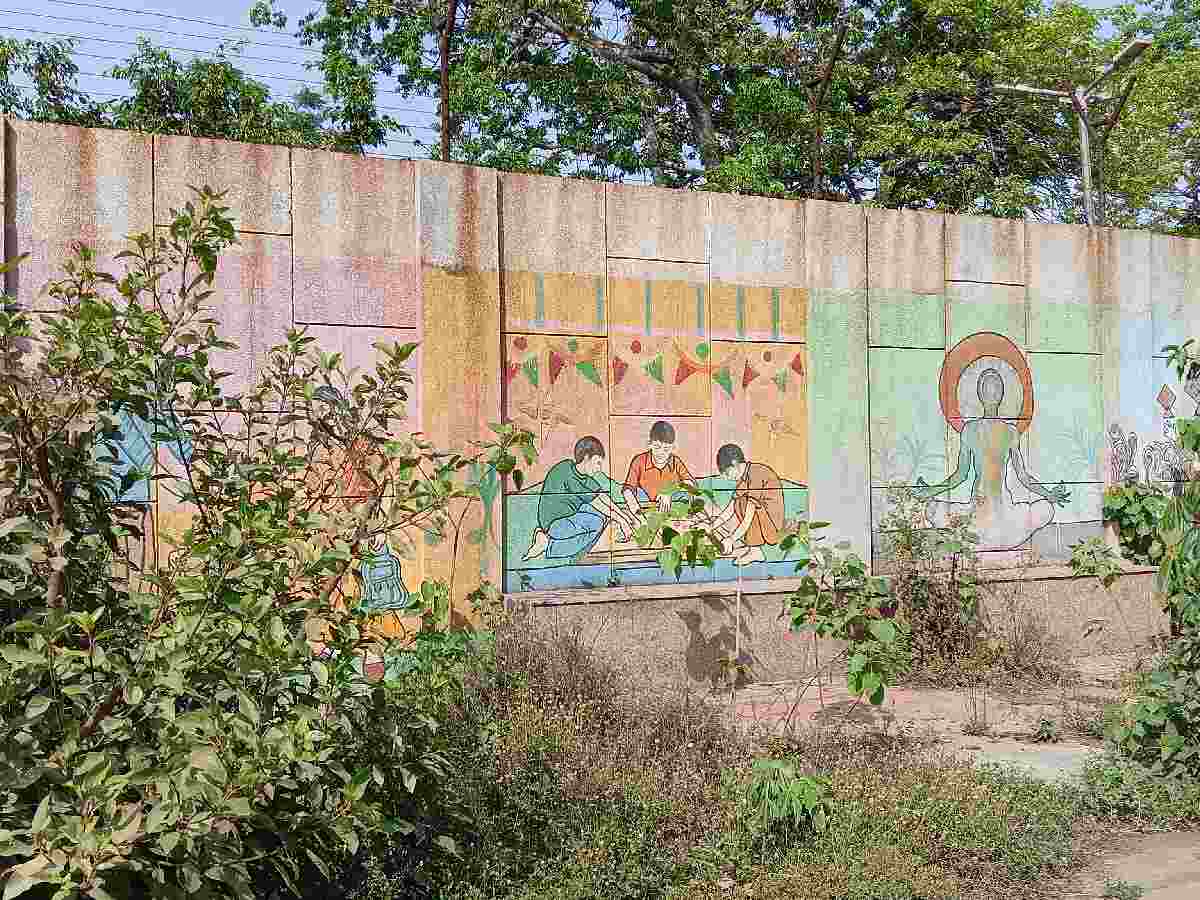
Murals at the de-addiciton centre at Sewa Kutir have become enveloped in wild shrubbery
An empty lot with a couple of dogs loitering in search of the next visitor lies in disarray at Kingsway Camp. Once home to a de-addiction centre for juveniles, the site now stands abandoned. According to reports from 2011, it was the first facility exclusively meant for juveniles and, for a time, among the largest of its kind.
However, the centre eventually shut down after a prolonged struggle to remain functional. While the facility has faded into disuse, substance abuse has continued to rise steadily.
Security guards remain stationed at the site, expecting operations to resume, but are left safeguarding an empty structure with a few chairs and tables yet to be cleared. “We were told that this would start again. Ab toh teen saal ho gaya hai (It has been three years now),” a guard said.
They said they had been assured that the institution would reopen, but over the past three years, hope has steadily diminished.
Rising demand, expanding network
In 2025, the government informed Parliament that the number of individuals seeking de-addiction treatment at government-supported facilities had risen by 295% over the past five years.
The Union Ministry of Social Justice and Empowerment, in a reply to the Rajya Sabha, stated that 2.08 lakh people were treated in 2020–21. This number increased to over 8.23 lakh in 2024–25. The rise has coincided with the establishment of approximately 288 new de-addiction facilities.
The Ministry is also preparing to launch a nationwide survey on substance use, building on findings from the 2017–18 study conducted by the National Drug Dependence Treatment Centre at the All India Institute of Medical Sciences, New Delhi.
At present, the Ministry supports 696 facilities, including Integrated Rehabilitation Centres for Addicts, Outreach and Drop-in Centres, District De-Addiction Centres, Community-based Peer Led Interventions, and Addiction Treatment Facilities. Of these, 288 ATFs and DDACs have been established in the past five years.
The data was shared in response to a parliamentary question by Aam Aadmi Party MP Swati Maliwal. Minister of State for Social Justice BL Verma stated that Rs 170.26 crore was released in 2024–25 to NGOs and voluntary organisations managing these facilities.
Children at risk
The 2017–18 survey found alcohol to be the most commonly used substance, with an estimated 15 crore users, including about 30 lakh minors aged 10–17. Other substances included cannabis, opioids, sedatives, inhalants, cocaine, stimulants such as amphetamines, and hallucinogens.
In a 2023 reply to Congress MP Imran Pratapgarhi, the government stated that around 5% of children aged 10–18 were affected by some form of addiction. Alcohol was the most widely abused substance among children (1.3%), followed by opioids (1.8%) and inhalants (1.17%).
Delhi currently has 11 Integrated Rehabilitation Centres for Addicts, of which only one is dedicated to children and is managed by the Society for Promotion of Youth & Masses. With just two centres in the capital offering structured rehabilitation, progress remains limited.
Overcrowding and enforcement gaps
Many centres, including those for children, are operating beyond capacity. Experts say that instead of directing young users towards treatment, law enforcement often defaults to punitive action.
“India needs more free rehab centres, counsellors, mental health professionals, and former addicts as life coaches, rather than young people behind bars,” said Fazle Haque, in-charge at the Delhi Gate centre.
Inside his office, a whiteboard lists 56 children. The facility is operating at 86% above capacity. Haque said that while occupancy fluctuates due to hospital visits for withdrawal symptoms, “if all of them are ever here at the same time then we are looking at a rather difficult situation at hand.”
A senior police official said enforcement alone has had limited impact. “We keep going after drug abusers and peddlers, but we fail to see the underlying issues… It can only be solved through education, sensitisation and employment,” he said, adding that policing has its limitations.
He further noted that arrests often depend on circumstance. “If the peddler does not have any substance on them then we cannot really arrest them… even if we detain them… we will have to let them go,” he said.
Changing patterns of substance use
Delhi Police has flagged the growing use of industrial solutions commonly found in automobile repair shops. “Solution is widespread and very accessible… usually these go for Rs 20 a tube but… children get it for Rs 70 a piece,” the officer said, adding that users often become dependent on them.
He added that intervention is limited unless the Women and Child Development department initiates action through the Juvenile Justice Board.
Many affected children come from migrant households. Mannan, a volunteer with the Society for Promotion of Youth & Masses, said, “This is a pattern we have noticed time and again… absent parents, poverty-driven anxiety, and lack of awareness.” He added that while the causes remain the same, methods of intoxication have evolved after the pandemic.
Also Read: Smack, inhalants grip central Delhi as homeless battle addiction and exclusion
Haque noted that many children are runaways from Bihar, Rajasthan and West Bengal. “They run away to escape abusive parents, or sometimes it is the drugs taking the action for them. We cannot scare them into rehabilitation,” he said.
Police officials also pointed to a shift towards over-the-counter drugs and injectables. “After the pandemic, there has been an increased availability… once they get a higher share, it will be difficult to rehabilitate the children,” an officer warned.
Questions over policy approach
Medical experts have raised concerns about the current approach. A senior doctor at the National Drug Dependence Treatment Centre at AIIMS said, “The government seems focused on sending a message—drug use leads to prison. But where is the plan to prevent it? What resources are allocated for rehabilitation?”
As demand for treatment rises and facilities struggle to cope, the gap between policy intent and on-ground realities continues to widen.
DU officials oppose HEFA loans for hostel expansion, warning repayment could raise student fees and…
Delhi Police summons Congress MP Akoijam following his sacking from JNU over sexual harassment allegations…
IYC marches to Jantar Mantar against its denotification, asserting the constitutional right to peaceful assembly…
Delhi CM Rekha Gupta transfers Rs 1,370 DBT to MCD school students for uniforms and…
Delhi Police dismisses viral video of attack at Rahul Gandhi's residence as fake, warning legal…
SFI and DYFI activists were stopped at police barricades while marching to Jantar Mantar to…
