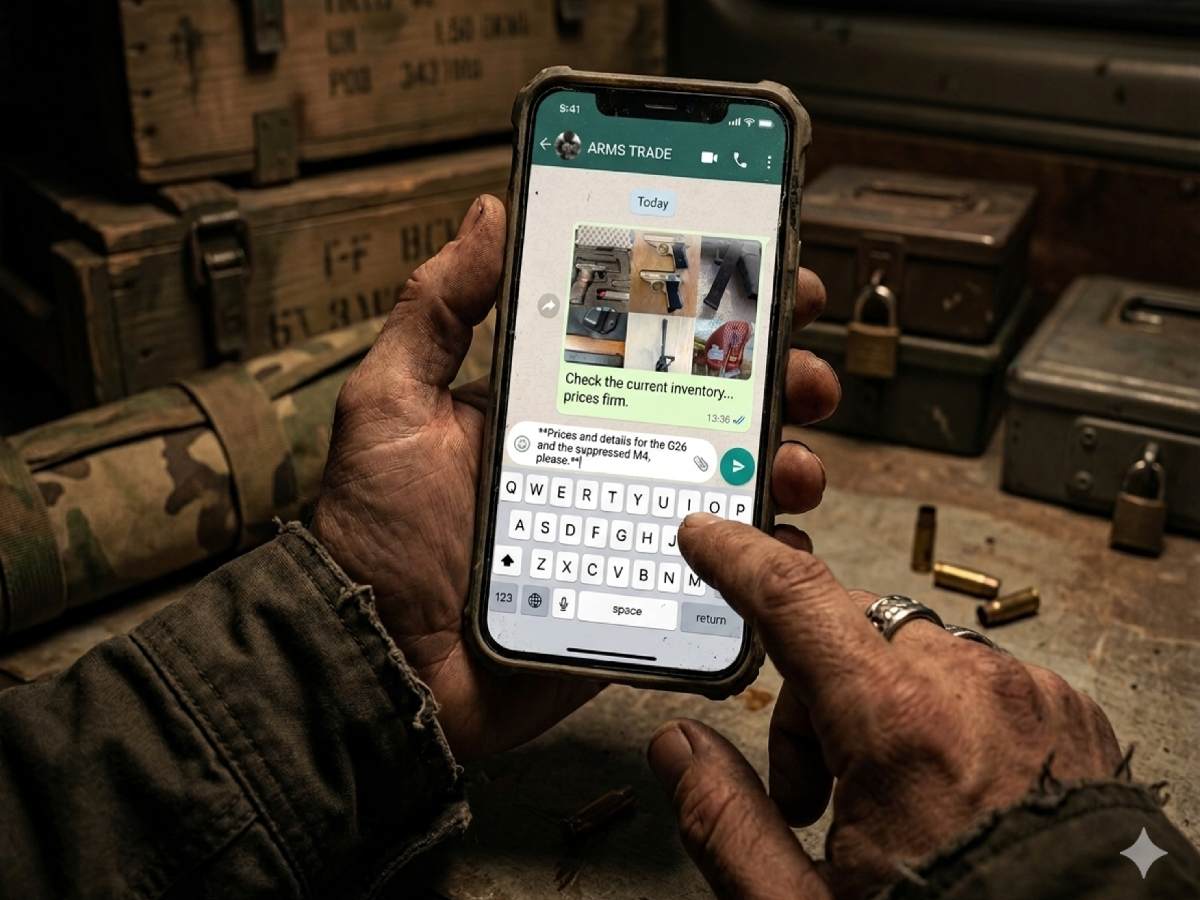
A foreign phone number, photos of firearms, and a direct message on WhatsApp appeared sufficient to initiate contact for a potential purchase, suggesting how initial conversations around such transactions may now be moving online, based on interactions observed during this reporter’s investigation.
During its investigation, Patriot identified multiple groups on the Meta-owned messaging platform WhatsApp that appeared to be used by individuals offering firearms for sale across India. Around seven such groups were identified, though most remained dormant over the course of a week.
Patriot has withheld the names of groups and accounts identified during this reporting to avoid directing readers to potentially illegal networks.
Access-controlled groups
While these groups are private, joining is relatively simple, with administrators controlling access through invite links. Once inside, the nature of the activity becomes clearer. Images of firearms — ranging from Kalashnikovs and carbines to pistols — were shared, with prices discussed and negotiations taking place.
Within a week of joining one such group, there were frequent exchanges involving users attempting to sell firearms. The group had around 30 members, with phone numbers from India, Pakistan, and the United Arab Emirates. Most users appeared to be buyers.
Business across subcontinent
The group’s activity was seen to be coordinated by a number linked to Nigeria. The individual, who spoke to this reporter posing as a buyer, claimed that he manages the export and delivery of firearms to clients across the Indian subcontinent. During the interaction, he said he deals in multiple types of weapons, including pistols such as Glocks and Berettas.
“Kindly enter your name and location for delivery,” he said during the exchange. The reasons for such purchases were not asked.
A similar pattern was observed in the group, where a photograph of an AK-47 was shared along with a price indication — “4 lac,” a user wrote, adding that prices were negotiable. The identities of users on such groups could not be independently verified.
To put matters into perspective, illegal firearms have been reported across the country, including in Delhi.
What law says
The Arms Act, 1959, categorises firearms into two groups: Prohibited Bore (PB) and Non-Prohibited Bore (NPB). PB firearms include automatic and semi-automatic weapons (except pistols), as well as firearms of specific calibres such as .303, 7.62 mm, .455, .45 mm rimless, and 9 mm. Smooth-bore firearms with barrel lengths under 20 inches are also categorised as PB and are illegal for civilian possession.
Several of the firearms being advertised in these groups appeared to fall under the PB category, while interest in NPB firearms appeared lower. Only NPB firearms can be licensed by state governments, whereas licences for PB weapons require Central Government approval.
Arms Act cases
The Act also regulates bladed weapons, restricting civilian possession of implements longer than nine inches, including swords and large knives. Between January 1 and March 31, 2025, 1,049 cases were registered under the Arms Act, compared to 957 during the same period in 2024.
According to the National Crime Records Bureau’s Crime in India report, none of the arms recovered under the Arms Act in Delhi in 2023 were licensed. The data shows that 4,358 arms and 4,316 rounds of ammunition recovered in the national capital that year were unlicensed.
The presence of such activity online is also reflected in a study by Princeton University’s Digital Witness Lab in 2025. Between April 2024 and January 2025, researchers identified over 8,000 messages advertising firearms across 234 WhatsApp groups in India.
Patriot reached out to WhatsApp for comment. No response was received till publication time. The online version of the story will be updated if a response is received.
Publicly accessible
According to researchers involved in the study, many such groups are publicly accessible, with some having hundreds of members. Surya Mattu, the data journalist who led the lab during the study, said these figures are “almost certainly an undercount” and demonstrate “the ease and pervasiveness through which these groups exist in India”.
He added that such activity has scaled significantly with the growth of digital platforms.
However, the use of social media for such activity is not limited to WhatsApp. Observations during this reporting suggest that similar patterns exist on other platforms as well.
20 accounts identified
On Instagram, several accounts were observed sharing videos related to firearms, including their display and alleged manufacture. During the course of this report, Patriot identified at least 20 such accounts that appeared to be showcasing or offering firearms.
One such account posted videos showing the assembly of firearms. In a recent video, multiple weapons were seen being unpacked and displayed.
Access to direct communication on such accounts appeared restricted, as only approved users could send messages. In some cases, accounts had reportedly been flagged by the platform.
In comment sections, users were seen directing price queries to WhatsApp, often sharing phone numbers in their usernames.
Police monitoring
The Delhi Police regularly monitors such activities on social media, said an officer. “We routinely monitor such incidents that happen across the board on all social media to keep a check on illegal and online gun runners. However, owing to their use of fake numbers and the Dark Web to operate, tracking them directly becomes difficult,” he said.
Also Read: Delhi’s juvenile de-addiction crisis deepens as centres shut down
Special Commissioner of Police (Crime) Devesh Chandra Srivastava said enforcement efforts focus on larger networks. “We normally depend on tip-offs to ascertain the functioning of a group. Most of our work is dependent on tracking the operations of groups trying to radicalise, gangs, and gunrunners, which function on a more extensive range. On the other hand, we have also started focusing more on cyber fraud groups,” he said.
Verifying claims
He added that officers sometimes join such groups to verify their functioning. “An officer becomes a part of the group and is placed there for a couple of days, where they report the happenings. After that, we place an order through the group to verify their legitimacy, and then take action. Much of the work is owed to a lack of transparency since these groups can only be joined through invites, and are private,” he said.
Investigations into such activities are ongoing. Meanwhile, incidents of gun-related violence in the national capital continue to be reported, including those linked to gang activity.
However, according to Srivastava, it remains unclear whether such online networks are directly linked to organised gangs. “Some are run by private gunrunners as well, so it remains to be seen,” he said.
Supreme Court advocate Abhishek Pawar alleges women were denied washroom access for seven to eight…
Each day of closure costs shops in Khan Market and Connaught Place between Rs 60,000…
Delhi generates nearly 15,000 tonnes of waste daily, prompting the government to deploy 1,000 mechanical…
Delhi Police has issued an NOC for the Congress rally at Ramlila Maidan on November…
CJP chief Abhijeet Dipke received conditional bail following his arrest for participating in a Connaught…
The DPCC has floated ₹104 crore tenders to test pilot pollution-control technologies across 40 key…

