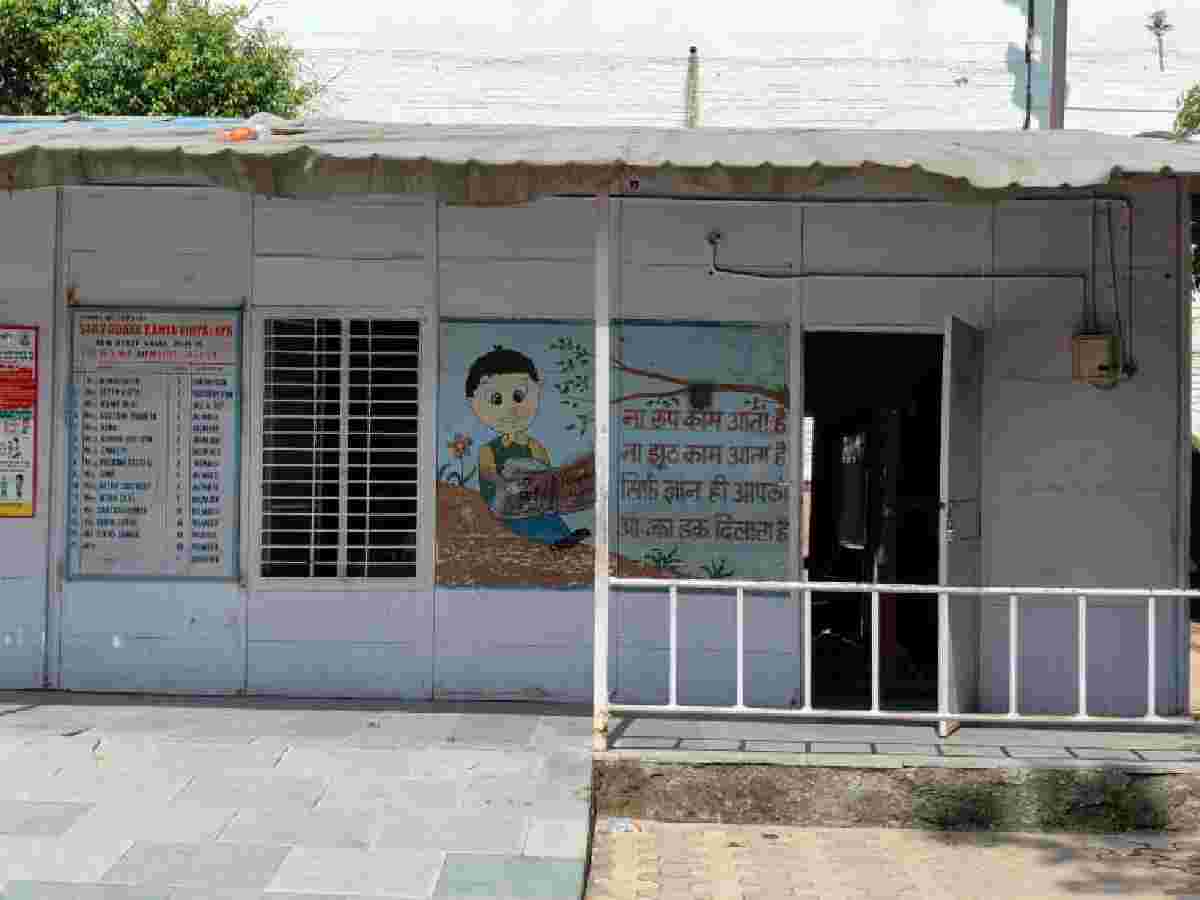
Students attend classes inside makeshift porta cabins at the Government Boys Senior Secondary School, Ashok Vihar
Classrooms in disrepair
Delhi’s much-publicised education model is faltering under bureaucratic apathy, with government schools left in alarming neglect. Students are compelled to study in classrooms with peeling walls, broken benches, inadequate washrooms or open urinals, and unhygienic surroundings—conditions that hinder learning and expose children to health risks.
The Delhi High Court has strongly criticised the city government for running schools from tin sheds, directing it to provide state-of-the-art infrastructure. The rebuke came during the hearing of a Public Interest Litigation (PIL) that revealed nearly 1,400 students from three schools—Sarvodaya Kanya Vidyalaya (Zeenat Mahal, Kamla Market), Government Girls Secondary School, and Government Boys Secondary School in Ashok Nagar—are being forced to attend classes in makeshift tin-shed rooms.
To examine the situation, Patriot visited several government schools and found most struggling to maintain even the most basic infrastructure.
Dallupura school in crisis
At Rajkiya Sarvodaya Kanya Bal Vidyalaya in Dallupura, East Delhi, the grim reality of neglect was apparent. Students study in unhygienic conditions marked by open urinals, broken tiles, peeling walls, and exposed electrical wiring that directly threaten their safety.
Tiles outside classrooms are cracked and unattended. Overcrowding worsens the situation—nearly 60 students are packed into a single room. Benches are old and broken, forcing many to sit uncomfortably on damaged furniture.
Sandhya Sharma, a class 10 student, said, “Most of the classrooms do not have proper benches. Some of us have to share or adjust on broken ones. It becomes very hard to focus on studies when we’re worried about where to sit.”
Another student, Aarti Verma from class 9, complained that toilets were often dirty and unusable. With so many students in one classroom, it became suffocating, she said, adding, “The school is supposed to be a safe place to learn, but instead, we feel neglected here.”
The school operates in two shifts, with girls in the morning and boys in the evening. But the lack of facilities affects all students equally.
Sushant Kumar, a class 8 student, said, “The school does not have the proper washroom facility for students as we have to use the open urinals situated at the back of the building.”
Behind the school building, unattended waste and moss have created a mosquito-breeding ground, posing a severe health hazard. The principal was unavailable for comment.
Makeshift cabins in Ashok Nagar
Similar problems plague the Government Boys Secondary School in Ashok Nagar. Here, a shortage of classrooms has forced the administration to install porta cabins as makeshift rooms.
A senior official said the classroom capacity was far below the number of students enrolled, making new buildings a dire necessity.
Kanika Singh (name changed), a class 10 student, added, “The building of the school is very old. The paint is peeling off the wall; the benches were also in a deplorable condition.”
Rajesh Kumar, father of a class 9 student, said his daughter was “compelled to sit in the porta cabin in sweltering heat as the school lacks the basic facility—classroom.” The school management declined to comment.
Capital-wide neglect
Other institutions such as Sarvodaya Kanya Vidyalaya in J-Block, Sangam Vihar, and Government Boys’ and Girls’ Senior Secondary Schools in Sonia Vihar, reflect the same picture—students struggling for the most basic facilities while aspiring for quality education in the national capital.
Also Read: Promises of a world-class model falter in Delhi schools
The Directorate of Education refused to respond to queries from Patriot.
Aparajita Gautam, President of the Delhi Parents Association, sharply criticised the government, saying promises of world-class facilities remained only on paper.
“It is deeply disturbing that in the national capital, children are still forced to study in classrooms that resemble sheds rather than schools,” Gautam said. She added that parents send their children to government institutions hoping for safe, dignified environments, but instead they encounter broken walls, tin sheds, exposed wires, overcrowded rooms, and a lack of clean drinking water and sanitation.
She stressed that this was not merely an infrastructure issue but one of dignity and health. “No child should have to sit in sweltering tin-roofed classrooms during Delhi’s scorching summers or brave freezing conditions in winter.”
Gautam further said the government’s repeated claims of transforming schools into ‘world-class models’ were at odds with reality. Parents felt cheated, she argued, demanding urgent intervention, accountability, and a time-bound plan to replace unsafe structures with proper classrooms. “Anything less is a betrayal of the children of Delhi,” she concluded.
Delhi High Court intervention
The Delhi High Court has also condemned the practice of conducting classes in tin sheds, calling it “very bad” and a serious risk to students in 2025. The remarks came during a PIL filed by Social Jurist, a civil rights group, demanding that temporary structures be replaced with permanent infrastructure.
Chief Justice DK Upadhyaya and Justice Tushar Rao Gedela questioned how government schools could compete with private ones while still operating from such rudimentary facilities. The bench directed the Delhi government and the Director of Education to respond, with a status report due by September 17.
Petitioners demanded dismantling of temporary structures and immediate construction of proper classrooms. Until then, students should be shifted to safe and adequate facilities, they argued.
This problem is not new. In July 2024, the court had already directed the Education Department to meet deadlines for classroom infrastructure, desks, textbooks, uniforms, and writing materials. The latest PIL highlights that despite such orders, a wide gap remains between policy and implementation on the ground.
At least 50 cases have already been reported this month; NCPCR guidelines mandate help desks,…
DMRC says zero reduction in train trips, attributes decline to security measures and public apprehension…
A Delhi court denied bail to a former DU professor accused of raping a student,…
Delhi Police charged seven dhaba workers in the fatal beating of a Manipuri musician who…
Seven Delhi STPs failed DPCC standards in September, dumping high levels of faecal coliform and…
AISA chief Neha Bora petitioned the Delhi HC against a police notice requiring a peace…

