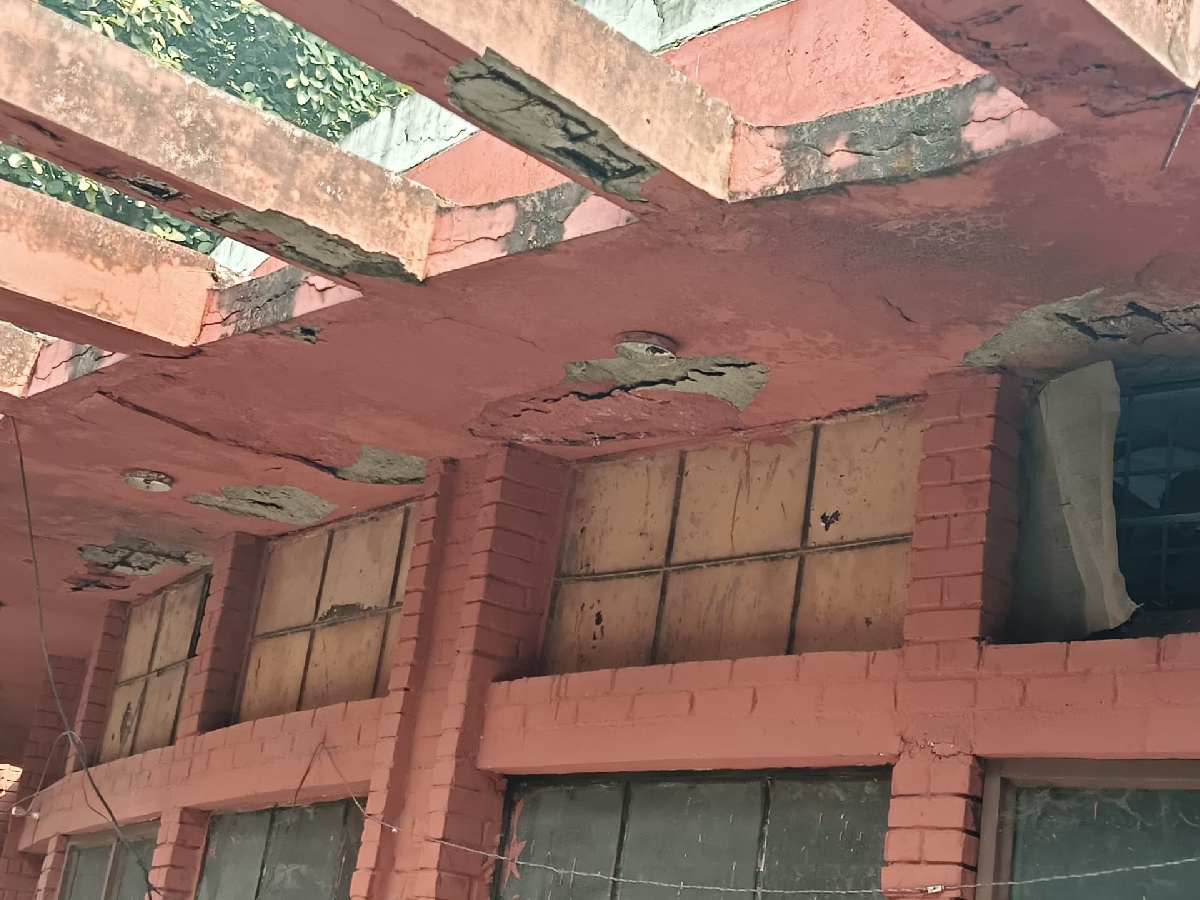
Students at Jawaharlal Nehru University (JNU) have raised concerns over the condition of Mahi-Mandavi and Tapti hostels and TEFLAS, the student community centre, citing damaged ceilings, water seepage, crumbling plaster and poor maintenance.
The concerns have drawn attention to the Central Public Works Department (CPWD) findings and the university administration’s response to complaints about the safety of these buildings.
The issue gained attention after a ceiling fan fell inside a room in the women’s wing of Tapti Hostel on September 15. No student was present when the incident occurred.
Following the incident, the Jawaharlal Nehru University Students’ Union (JNUSU) demanded a structural audit of all hostels and other buildings on campus.
The students’ union also claimed that a former Associate Dean of Students had informed its representatives that Tapti and Mahi-Mandavi hostels were unfit for accommodation. It alleged that the university continued to allot rooms to students despite these concerns.
Damaged walls, ceilings
At Mahi-Mandavi Hostel, students have reported damaged walls, water seepage and falling plaster.
An official told Patriot that rooms affected by severe seepage had been closed and declared unfit for living. The official also said an infrastructure audit was planned.
The hostel also faces accommodation shortages. Students have been staying in temporary dormitories set up inside the mess hall and kitchen area while waiting for regular rooms.
A postgraduate student from Allahabad, who was staying in temporary accommodation, told Patriot that he had expected better facilities after joining JNU.
“I didn’t expect this kind of facility in JNU. I am disappointed, but I have no option but to adjust. Because rented rooms are very expensive and I am unable to afford one,” the student said.
The room shortage has added to the difficulties faced by students who depend on university accommodation.
Safety concerns
The condition of Tapti Hostel has also drawn attention following the ceiling fan incident in September.
Students have reported broken windowpanes, damp walls, damaged plaster, rusted emergency exits and poor sanitation.
A student who has lived in Tapti for the past few years told Patriot that a portion of the roof in the women’s wing collapsed in 2025 and was later repaired.
The student also said complaints about broken windowpanes led to repairs in only some rooms. Other residents continued to cover windows with cardboard, mosquito nets and curtains.
Ranvijay, a JNU PhD scholar and AISA activist, criticised the hostels’ maintenance.
“If something major happens, minor repairs are carried out. But no steps are taken for overall maintenance and renovation. The only persistent response the administration gives us is that there’s no fund. I ask them what you will do if anything like Satya Niketan occurs? Who will be blamed then?” Ranvijay said.
JNUSU Joint Secretary Danish Ali also raised concerns about sanitation in Tapti. She told Patriot that some washrooms had non-functional flushes and students had to use water containers.
Ali said, “Imagine how female students have to suffer because the administration isn’t providing the basic facilities on campus. Students who are studying here come from very marginalised backgrounds, thinking JNU will give them something, but when they all arrive, they see a new picture.”
Students demand repairs
Students have also raised concerns about the condition of TEFLAS, which houses the students’ union office and other facilities used for recreational and cultural activities.
While reporting on this matter, Patriot documented loose ceiling plaster, rusting fans and tube-light fittings, broken window panels near the tennis court, and a beehive inside the drama room.
Anil (name changed), a PhD scholar at JNU who regularly visits TEFLAS to play sports, said students have long complained about the facility’s condition.
“The condition of Teflas is very poor. I go there regularly to play, and the damage is clearly visible. Students have been asking for repairs for a long time, but the administration has not taken adequate action. We have been told that the condition is not so bad that an accident could happen. But students are concerned about their safety, and the building needs repairs before something serious happens,” Anil said.
He said students continued to use the facility despite concerns about its maintenance.
Repair funds
The concerns have also raised questions about the university’s handling of repair work and the findings attributed to CPWD.
CPWD operates under the Union Ministry of Housing and Urban Affairs and undertakes construction, maintenance and other engineering work for government institutions.
In September 2025, The Times of India reported that JNU’s Buildings and Works Committee had expressed dissatisfaction with the quality and pace of repairs undertaken by CPWD.
The committee reviewed projects under a Rs 56 crore University Grants Commission grant and approved an additional Rs 13.6 crore for urgent repairs.
Also Read: Delhi: Proposed e-rickshaw rules spark livelihood concerns
The proposed work included waterproofing, drainage improvements, balcony repairs, replacement of leaking water tanks and electrical upgrades.
Hardik, a PhD scholar in German Philosophy at JNU and Democratic Students’ Federation activist, questioned the university administration’s response to the reported safety concerns.
“Students are living in Mahi-Mandavi, and many of them come from economically weaker families. They depend on university hostels because they cannot afford private accommodation. If the buildings are unsafe, their lives are at risk. CPWD is a central government department, not an outside organisation. If its report raises concerns about the condition of these buildings, the administration and the Vice-Chancellor must explain why the necessary repairs have not been carried out. There are also questions about where university funds are being spent when basic infrastructure needs attention,” Hardik said.
Hardik also raised concerns about how university funds are allocated and called for greater accountability in repair work.
Structural audits
The JNUSU has repeatedly demanded repairs and structural assessments of university buildings.
Following the September incident at Tapti, the union renewed its demand for a campus-wide audit.
On October 20, the JNUSU ended its 17-day hunger strike after reaching an agreement with the university administration on several demands.
According to Hardik, the administration agreed to initiate structural audits of Mahi-Mandavi and Tapti hostels and TEFLAS. It also agreed that renovation work would follow the prescribed procedure.
However, the status of the proposed audits and the repair timeline remain unclear.
Patriot contacted the JNU administration for its response to students’ concerns about hostel conditions, the CPWD report, and the status of repair work. However, no response had been received from the university administration at the time of publication.
NDMC will plant 3 lakh tulip bulbs across Lutyens Delhi this season, with 40,000 grown…
Liquor sales in Delhi rose 13 per cent during the festive fortnight ahead of Diwali,…
DU's Ramanujan College suspended a student for allegedly luring female students to Diljit Dosanjh's Ahmedabad…
A four-year-old boy fell into a sewer in outer Delhi’s Baprola area, with police, fire…
Delhi’s air quality deteriorated to the ‘very poor’ category, with the AQI rising to 303…
From griddled babru to fermented bhaturu, chefs say adapting cooking methods for hotel kitchens raises…
