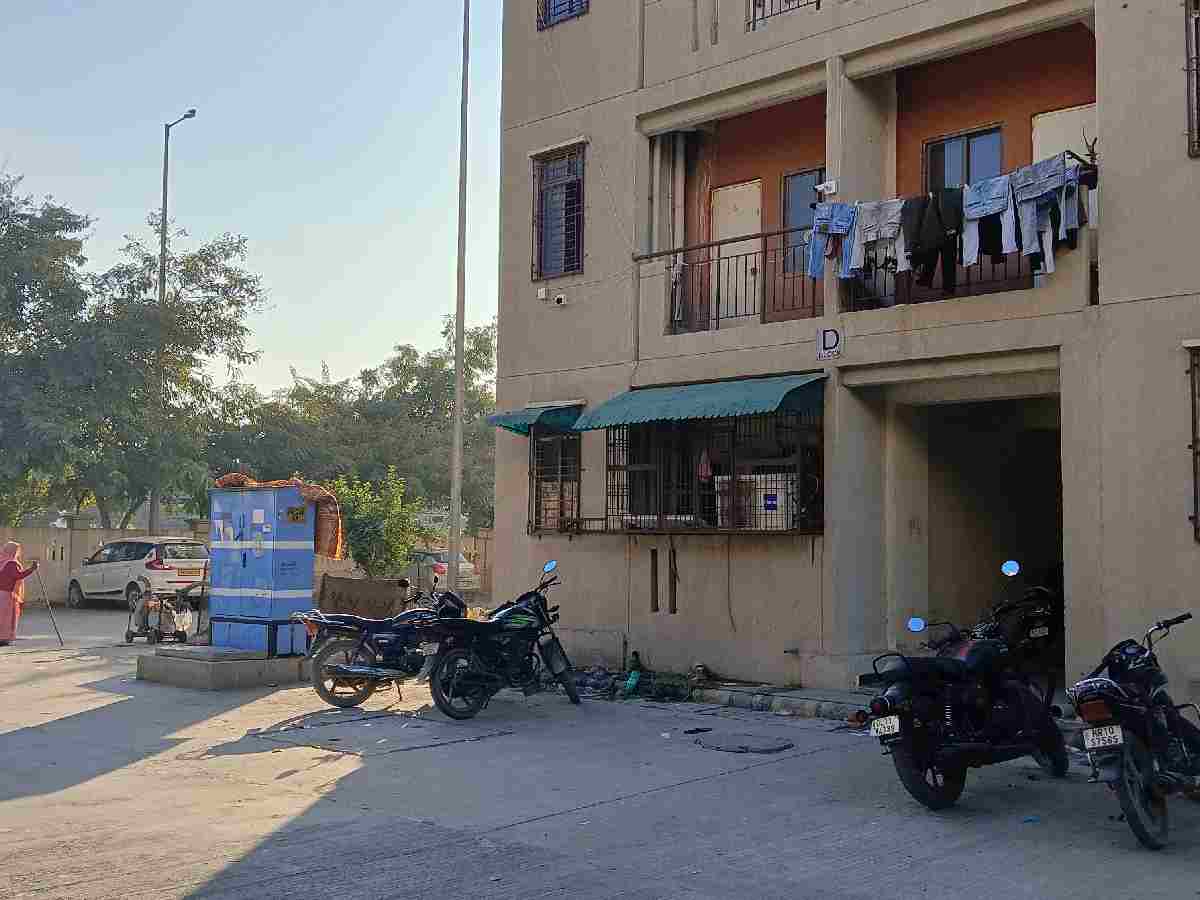
Returning from almost a two-hour ride from her workplace, Seema Devi readies herself for the next round of duties waiting at home. Despite the exhausting journey, her work never really ends. While taking care of her children, she has seldom had enough time to care for herself.
Leaving the Narela flats at around five in the morning, she takes on a multitude of challenges — the first always being to prepare her child’s breakfast and tiffin.
Ever since Seema moved to the Narela flats under the jurisdiction of the Delhi Development Authority (DDA), life has remained exceptionally difficult for her entire family. It is not just her; many others have also been left to fend for themselves. Several residents were moved from Jhuggi Jhopri clusters across Delhi, especially those demolished in south Delhi.
Before the demolitions, eligible residents were given the option of shifting to DDA flats in Narela, effectively leaving their old lives behind. More often than not, however, the transition has proved far from simple.
Distance from work
While some families moved into the flats, a significant number found it easier to lease them out or take up accommodation elsewhere in the capital, closer to their workplaces. Those without alternatives have been left to contend with the situation on their own.
Seema leaves for work at the earliest possible hour, boarding a bus to Rithala and then taking the Delhi Metro to Sarita Vihar, where her former slum was located. She currently works as a domestic help in a four-person household in the area. Initially, she tried to find work in Narela itself, but opportunities were scarce.
“I spend a significant amount of time just working. My hands have worn thin working almost the entire day, but I have to. There’s not a lot of choice that we have, since much of my work is spent in travelling itself, with around four hours being spent in that, at the very least,” she said.
Her “formal” workday ends around seven in the evening when she enters her apartment complex. The informal, unpaid labour, however, continues.
“My husband helps as much as can be possible. He has told me to leave my job but we know that it is not possible. Karza bhi toh chukana hai (we have to repay the loan as well). We share a couple of the household chores but taking care of the child is my duty. According to him, I am better at it,” she said with a smile.
Few options for women
Like Seema, many men in the area work nearby at the Narela Industrial Area or travel slightly farther to Bawana’s industrial zone. While most men have found relatively stable sources of income close to home, the situation for women is markedly different.
Revathy, once a resident of the now-demolished Madrasi Camp, has taken to rag picking because of the lack of sustainable work in Narela. Earlier, she worked in Jangpura, managing multiple households. Since relocating, her circumstances have worsened.
“I told the DDA officials at the Community Centre that I need work. They said to go around and check if anybody was hiring for a house help. I went there but nobody wanted to hire me due to my age. I went around looking for work near the factories as well, without any luck. I have finally just taken to rag picking, especially since there is barely any work here,” the 60-year-old said.
With no dependents, Revathy has only herself to think about. Even that, she said, is difficult. “I have a roof over me but without food, it’s not worth a lot,” she said.
A contrasting model
In contrast, the Jailorwalah Bagh in-situ slum rehabilitation apartment complex has enabled many residents to continue working without major disruption. Its location next to both residential and industrial areas has proved crucial. While most residents are from nearby slums, some have relocated from Wazirpur and Golden Park Rampura.
Rampura is the farthest, but residents say the commute remains manageable despite the six-kilometre increase in distance. Many women now leave home earlier to reach work on time.
“Some work as house helps, while some work in formal offices. It’s just that their workplaces were around the Golden Park area, but it’s not too bad. Moreover, some have already found places to work here itself,” said Rakhi Kumari, a resident.
Yet, even where access to work is easier, women continue to shoulder a disproportionate share of unpaid labour at home.
“The work is always disproportionate, where I am left to my wits to do much of the household chores. My husband normally just says that he does not know how to do something, and I have to work reluctantly. It has become the norm now,” said Asifa Begum, a resident of the Narela DDA flats.
What the data shows
The 2025 Time Use Survey conducted by the National Statistics Office points to a gradual shift in how Indians spend their time between 2019 and 2024. Employment participation among those aged 15 to 59 has risen steadily, with male participation at 75% and female participation at 25%.
On average, working individuals spend 440 minutes a day on paid work. Men spend 473 minutes, while women spend 341 minutes.
The survey also notes a decline in the time women spend on unpaid domestic services, from 315 minutes in 2019 to 305 minutes in 2024. The Ministry of Statistics and Programme Implementation said this suggests a slow transition from unpaid household labour to paid employment.
Despite this, domestic work remains unevenly distributed. Women still spend 289 minutes a day on unpaid household services, compared to just 88 minutes for men.
Care work shows a similar divide. About 41% of women aged 15 to 59 are engaged in caregiving for an average of 140 minutes a day. Among men, only 21.4% participate in caregiving, spending about 74 minutes daily. The Ministry said these figures reflect social norms where caregiving responsibilities largely fall on women.
Beyond work, the survey found that people aged six and above spend an average of 171 minutes a day on culture, leisure, and media, with men spending slightly more time than women. Children aged six to 14 spend about 413 minutes a day on learning activities, while the average individual spends 708 minutes on self-care and maintenance.
A global pattern
According to the United Nations Programme for Gender Equality and the Empowerment of Women (UN Women), women globally carry a disproportionate burden of unpaid care work. Those from low-income, migrant, and racialised backgrounds perform more than three-quarters of all unpaid domestic work worldwide.
Current trends suggest the gap will persist for decades. By 2050, women are still expected to spend nearly two and a half hours more per day on unpaid care work than men. If assigned a conservative monetary value, this labour would account for up to 40% of the gross domestic product in several countries.
In the formal economy, women also dominate the paid care workforce across health, education, and domestic services. Despite its essential nature, this work is often categorised as unskilled, leading to low wages and job insecurity. Among domestic workers, 80% are women. Around 90% lack access to social security, and more than half work without any legal limit on weekly hours.
‘Not our duty’
DDA officials said employment considerations are not part of the relocation process when demolitions take place.
“Our primary job is to relocate them and demolish the structure that they are encroaching upon. Providing them with a job is not our duty, as such. If an official does it, they are doing it on the pretext of goodwill,” an official said, speaking on condition of anonymity.
As a result, women workers, whose livelihoods often depend on nearby employment, are pushed to the margins after relocation. Even a year after a large number of families were shifted to the DDA apartments in Narela, occupancy levels remain as low as ever.
Elected to the Delhi Golf Club general committee, Mansher Singh says he wants to build…
A $780 million market built on pavements, where the pleasure of reading meets the price…
Supreme Court advocate Abhishek Pawar alleges women were denied washroom access for seven to eight…
Each day of closure costs shops in Khan Market and Connaught Place between Rs 60,000…
Delhi generates nearly 15,000 tonnes of waste daily, prompting the government to deploy 1,000 mechanical…
Delhi Police has issued an NOC for the Congress rally at Ramlila Maidan on November…

