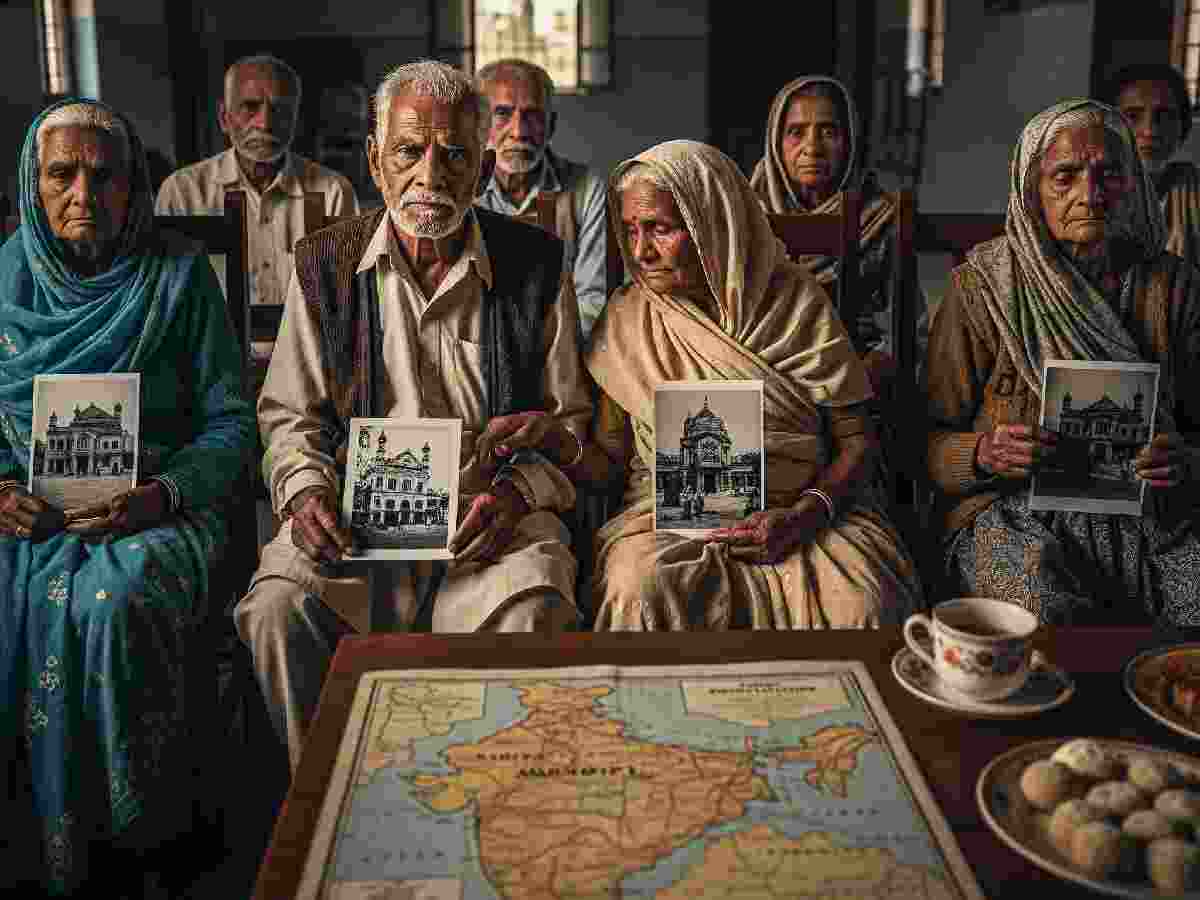
Photo: AI
As India prepares to celebrate 79 years of independence on August 15, the fervour of festivities often overlooks the harsh realities endured by the survivors of Partition. While the country was declared independent at “the stroke of the midnight hour”, residents from what are now Pakistan, Bangladesh, and mainland India fled in fear, seeking safety from the violence and chaos that upended their lives.
The 1947 Partition of British India, which created Pakistan as a Muslim-majority state, was driven by rising religious and political tensions. It triggered one of the largest mass migrations in history, displacing millions from their homes. Hastily drawn borders, with little regard for the human cost, left communities uprooted. The upheaval brought riots, massacres, abductions, and assaults, claiming countless lives and leaving lasting trauma.
While many Hindus and Sikhs fled Pakistan, numerous Muslims left India to escape the violence. The Partition reshaped the geopolitical map of South Asia and etched a deep scar into its collective memory. Prime Minister Narendra Modi’s designation of August 14 as Partition Horrors Remembrance Day offers a moment for reflection, urging future generations to learn from this dark chapter.
Borders without ground truth
The boundary lines were drawn by Cyril Radcliffe with confidence but little understanding of the terrain, as he had never visited the areas he was dividing. His decisions split villages, even houses, in two. This arbitrary demarcation not only created India and Pakistan but also fractured communities that had once shared culture, traditions, and customs.
Fleeing Lahore
Manjeet Singh, now around 80, counts himself fortunate to remember little of the ordeal. “I was very protected by my family,” he said. “When I was around three, we had to flee Lahore. Before that, we had a thriving business. We had to leave it all behind, even the little we had, as my parents had to bribe their way for passage to India. Eventually, we settled in Jalandhar, starting anew with nothing but resilience and the weight of those dark days.”
Also Read: Partition refugees remember how they sought shelter in Delhi’s historic tombs
Singh later secured a government job and has lived in Delhi’s Defence Colony for the past 50 years.
Escaping Karachi in darkness
Some fled with bribes; others endured far greater hardship. Gursimran Kaur, 79, recalls her parents’ harrowing escape from Karachi. “My parents kept the house in complete darkness at night to avoid attacks. Crying babies, including me, were placed in a chest to muffle sounds. They escaped in the dead of night with only the clothes they wore, boarding a freight ship. My mother, seasick and vomiting constantly, could not breastfeed me. My father left his thriving barristership in Pakistan and became a newspaper delivery person in Delhi. Later, he rebuilt his legal practice.”
Punjab’s shifting demography
For some families, the journey was less about displacement and more about witnessing a changing landscape. Sarbjit Gill, 35, recounted what his great-grandmother told him about their village in East Punjab. “The area, predominantly Hindu and Sikh, once had many Muslim residents. Most fled during Partition. Two abandoned mosques and several Sufi shrines remain, which Hindus and Sikhs still visit. My great-grandmother said gold and other valuables were found later, hidden by those who fled, perhaps hoping to return one day.”
Hope and doubt for the future
For survivors, independence remains bittersweet. Gurmeet Kaur, a Jangpura resident whose family fled Rawalpindi, said, “I feel anxious talking about independence. It is tied to so many deaths in my family and among friends. People showed their worst selves then. But seeing how far India has come, I hope for a country without such divides, where friends do not become enemies overnight.”
Also Read: The forgotten refugees who landed in Delhi after Partition
Others, like Rajbeer Ghosh, 80, are less hopeful. Born in Jessore, now in Bangladesh, he fled to Kolkata with his family in a crowded train. “We rebuilt our lives from scratch. I thought such times would never return. But with the way communities in India are at odds now, I see little hope. Everyone seems ready for conflict. The only solace is that I did not grow up amid such hostility,” said Ghosh, now living in Vasant Vihar with his son.
At least 50 cases have already been reported this month; NCPCR guidelines mandate help desks,…
DMRC says zero reduction in train trips, attributes decline to security measures and public apprehension…
A Delhi court denied bail to a former DU professor accused of raping a student,…
Delhi Police charged seven dhaba workers in the fatal beating of a Manipuri musician who…
Seven Delhi STPs failed DPCC standards in September, dumping high levels of faecal coliform and…
AISA chief Neha Bora petitioned the Delhi HC against a police notice requiring a peace…

