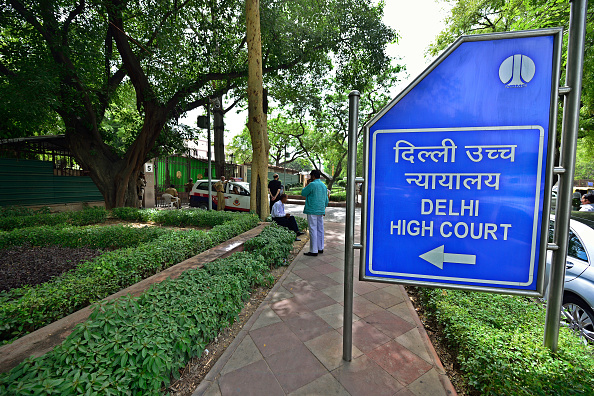
(File Photo: Getty)
The Delhi High Court has recorded a gradual increase in the overall number of pending cases this year, with figures showing a steady rise till August 31, 2025.
Although the year began with a lower count, civil cases have continued to add weight to an already long list of pendency.
According to data released by the High Court, a total of 1,23,072 cases were pending as of August 31. At the beginning of the same month, on August 1, the number stood at 1,22,500. This represents a 0.4% increase in pendency within a single month.
Glimmers of relief in criminal cases
Amid this rising trend, a small measure of relief emerged in the criminal side. On August 1, there were 34,572 pending criminal cases. By the end of the month, the figure had dropped to 34,016.
During August, the court received 2,176 new criminal cases and disposed of 2,732, resulting in a net reduction of 556 cases. While this amounts to an overall improvement of just over 1%, the disposal rate for the fresh cases filed in August alone was 20%, a significant figure in relative terms.
Criminal appeals and major categories
The criminal caseload is spread across distinct categories. The largest segment, Criminal Appeals (Single Bench), accounted for 11,101 pending cases on August 31.
During the month, 129 new cases were filed while 270 were disposed of. These appeals, which involve challenges to decisions of lower courts and require detailed scrutiny by a single judge, tend to move slowly due to the volume and complexity involved.
The second-largest category was Criminal Miscellaneous Cases, which had 9,388 pending matters. The court disposed of 1,079 such cases during August while 966 new ones were filed, showing a marginal reduction.
These cases include varied applications such as those seeking quashing of proceedings or interim relief, which differ widely in complexity and urgency, thereby adding to the overall burden.
Criminal Revision Petitions stood at 4,059 pending cases. In August, 56 new petitions were filed and 80 were resolved, reflecting a slower rate of disposal.
Criminal Writ Petitions, however, fared better. Out of 372 new filings in August, 418 were resolved, bringing the total pendency down to 2,850. Writ petitions typically deal with urgent constitutional or legal questions, which often leads to quicker prioritisation.
Bail applications and leave to appeal
Bail applications, which directly impact personal liberty, were dealt with relatively efficiently. During August, 474 new applications were filed and 479 were disposed of, keeping pendency stable at 1,466 cases.
This reflects the High Court’s commitment to resolving bail matters swiftly so that individuals are not detained for long periods while awaiting judicial review.
The Leave to Appeal category also recorded progress. Only 14 new cases were filed in August, while 338 were disposed of. This reduced pendency from 2,378 to 2,054 cases.
As these matters involve requests for permission to appeal to a higher court, the significant reduction points to effective case management.
Specialised categories show little change
In certain specialised categories, activity was minimal. Death Sentence References, which require the High Court to confirm capital punishment awarded by trial courts, remained unchanged at three pending cases with no new filings or disposals.
Criminal References, which deal with points of law referred to the High Court, also stayed steady at eight cases.
Criminal Revision Petitions under the Narcotic Drugs and Psychotropic Substances (NDPS) Act rose slightly from seven to ten, reflecting the complicated nature of drug-related offences.
Meanwhile, Civil Writ Petitions, though outside the criminal docket, continued to form the single largest group overall, with 36,459 pending cases, followed by 34,016 criminal cases.
Delays across the system
The marginal reduction in the criminal backlog, while positive, reflects the deeper structural issues facing India’s judiciary.
Like many other High Courts, Delhi struggles with a heavy caseload, limited judicial strength, and procedural hurdles.
In May, the National Judicial Data Grid (NJDG) pointed out that 1.78 crore cases in the lower courts face delays for identifiable reasons, out of a total of 4.7 crore pending. Of these, 81% are criminal and 19% are civil. For about three crore cases, no reasons have been recorded. Comparable data for the Supreme Court and High Courts is not available.
The NJDG has flagged 15 key causes of delay. The most common is the unavailability of counsels, which affects more than 62 lakh cases. Other major hurdles include absconding accused (over 35 lakh cases), missing witnesses (around 27 lakh), and stays issued by various courts (23 lakh).
Additional delays arise from awaiting documents (14 lakh cases), lack of interest from parties (nearly 8 lakh), frequent appeals, missing records, and requests for additional witnesses. In some cases, the absence of legal representatives for deceased parties also obstructs progress.
A stark example of the systemic backlog is a subordinate court case filed in 1952 that remains unresolved after 73 years.
Supreme Court directions
In a bid to address these delays, the Supreme Court issued an order on September 22, 2025, directing all High Courts to circulate instructions to district judicial authorities.
It ruled that trials should not be adjourned merely because a counsel is unavailable, except in cases of bereavement.
Courts were told to consider cancelling bail if accused and counsels are found to be deliberately delaying proceedings, and to appoint amicus curiae when necessary to ensure trials continue daily.
The bench of Justices Pardiwala and Viswanathan noted: “It is almost a common practice and regular occurrence that trial courts flout this mandate with impunity. Even when witnesses are present, cases are adjourned on far less serious reasons or even flimsy grounds.”
The Chief Justice of India, too, has urged law students to contribute to reform by using global exposure and best practices to tackle systemic problems.
Shortage of judges worsens pendency
In May, the Delhi High Court itself pointed to the “acute shortage of judges” as a key reason why not all cases in its daily cause list could be heard.
The comment, made during a hearing on a forgery case, underscored a persistent issue: judicial vacancies.
The Delhi High Court currently functions with only 36 judges, far below its sanctioned strength of 60. This means nearly 40% of posts are vacant.
The crisis is nationwide. India’s 25 High Courts have a sanctioned strength of 1,114 judges, but only 769 are in position. This leaves 345 vacancies, or more than 30% of posts, unfilled.
These judges face a combined backlog of 62,96,798 pending cases.
The Allahabad High Court is the most severely affected, with 81 vacancies out of 160 sanctioned posts and a pendency of 11,76,229 cases, according to NJDG data.
The Punjab and Haryana High Court has 32 vacancies out of 85 posts. Only the Sikkim and Meghalaya High Courts currently have no vacancies.
Filing trends exceed disposals
For most years, new filings in the High Courts have exceeded disposals. The only exception came in 2019, when 22,01,442 cases were filed and 23,53,736 were resolved.
In 2024, however, filings rose to 24,06,178 while only 22,57,971 cases were disposed of.
The latest data indicates that this trend persists, leaving India’s higher judiciary to grapple with an ever-expanding backlog.
Protests against CEC Gyanesh Kumar over the SIR of electoral rolls started on October 10.…
Delhi Police books journalist under SC/ST Act for casteist remarks against ACP during a Jantar…
Hindu College staff protests against principal, demanding DU takeover over financial and admission irregularities and…
Delhi Cabinet approves Industrial Policy 2026 with Rs 1,000 crore for top sectors to turn…
Delhi launches DJB command centre with GPS tanker tracking and AI tools to manage water…
ABVP protests at JNU against Congress MP Akoijam over sexual harassment claims, demanding the party…

