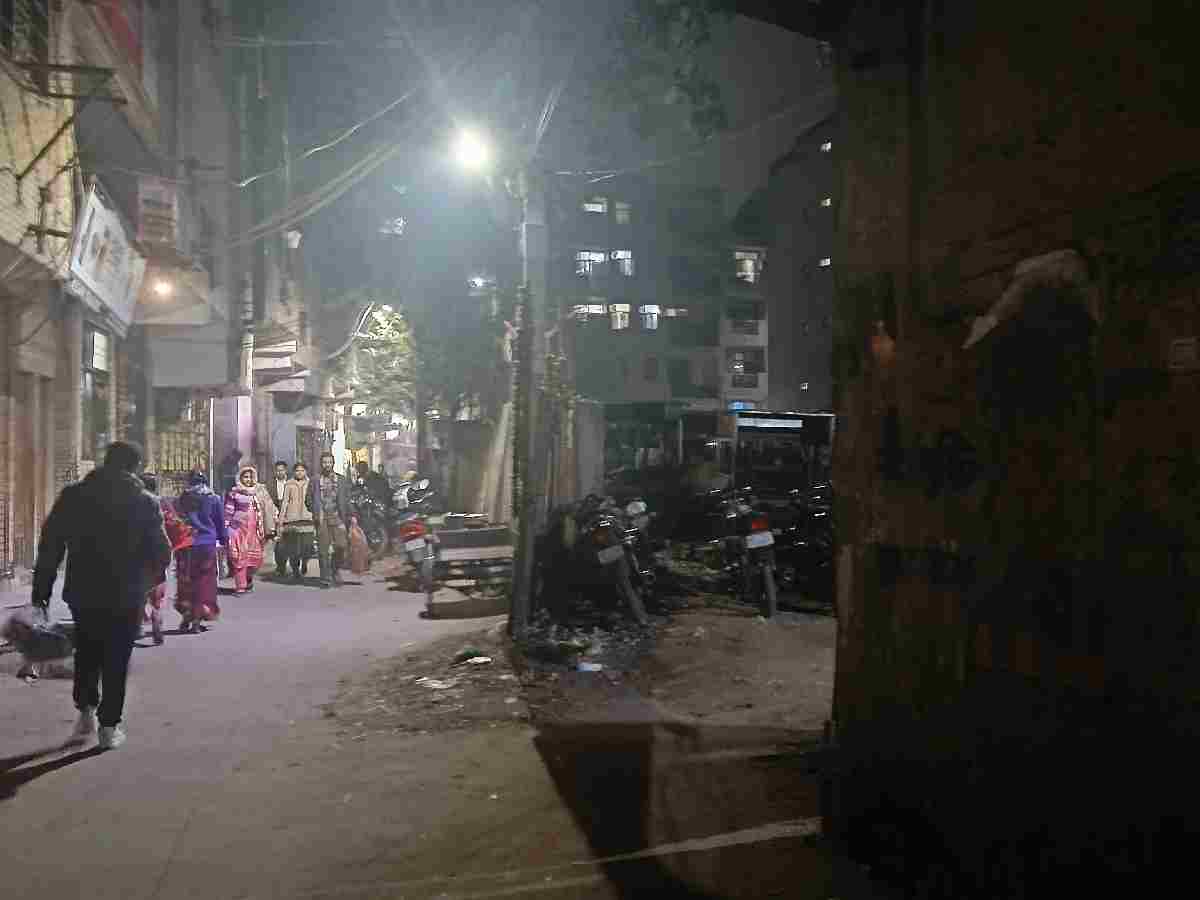
The e-rickshaw parking that doubles as a bootlegging hotspot in Mayur Vihar's Shashi Garden
Walking along a dimly lit path leading to a makeshift parking space reserved for e-rickshaws in the dead of night, the area turns into a daily thoroughfare for the city’s bootlegging operations. With a steady to-and-fro from a shed that serves as the centre of activity, the sale of contraband remains disarmingly simple.
Four people wait in line for their daily fix of alcohol, while others slip away from the sides after receiving their haul. By day, the parking space doubles as a children’s park; by night, it becomes a hotbed of frantic activity. From e-rickshaws lining up to park, to customers queuing in the hope of securing their preferred spirit, the goal is the same — to return home having completed the task at hand.
Operation Gang Bust-2026
Against this backdrop, Delhi Police recently launched one of their most extensive and coordinated crackdowns on organised crime, titled “Operation Gang Bust-2026”.
Additional Commissioner of Police (Special Cell) Pramod Kushwaha, along with Joint Commissioners Vijay Singh and Jatin Narwal, briefed the press at police headquarters. Kushwaha confirmed that this was the year’s first major offensive against gang culture, involving nearly 9,000 officers from various districts and specialised units. The operation involved simultaneous raids across Delhi and five neighbouring states, including Haryana, Punjab and Rajasthan.
The scale of the operation was vast. Police targeted 4,299 locations, rounded up nearly 6,500 suspects and formally arrested 854 individuals. As many as 690 new criminal cases were registered. Among those taken into custody were 280 prominent or “emerging” gangsters linked to syndicates such as the Gogi, Kala Jathedi and Goldy Brar networks. Members of more than 200 smaller criminal groups were also detained.
Over a 48-hour period, officers seized more than 300 weapons, 130 rounds of ammunition, 117 mobile phones and over Rs 25 lakh in cash. In addition, 118 kg of narcotics and tens of thousands of bottles of illicit alcohol were confiscated.
Police said the crackdown was particularly intense in the Northern Range, where high-profile criminals with dozens of prior cases were apprehended. In the South and West zones, the focus remained on dismantling inter-state networks involved in extortion and contract killings. Officials stressed that this was not a one-off exercise but part of a sustained strategy, with further developments expected as interrogations continue.
Bootlegging beneath the radar
Despite the scale of the operation, smaller bootlegging networks appear to remain largely untouched. Police officials acknowledge that many such operations are run by local gangs or strongmen themselves.
An e-rickshaw driver said passengers frequently use his vehicle at night to reach bootlegging hubs. “At night, I make at least two-three rounds each day. Sometimes I get some cut money from the boss, or some discount when I want to buy stuff,” he said, requesting anonymity.
The modus operandi, police say, remains largely unchanged across the city. One of the most troubling aspects is the routine use of minors to carry out much of the work.
A symbiotic ecosystem
Until it was shut down about a month ago, one bootlegging spot next to a biryani shop was among the most active areas late at night. After 10:00 pm, queues would form, often spilling over into the eatery across the road.
While some waited inside the restaurant, eating the day’s special until the queue thinned, others moved back and forth between the two establishments. The relationship was almost symbiotic, with the biryani shop staying open deep into the night and drawing a significant portion of its customers from the liquor black market.
“They would come here and buy some fried chicken or kebabs to go. However, ever since the raid in January, they have shut shop. They normally resume business again within a month or two,” a worker at the shop said, also on condition of anonymity.
Minors as shields
According to police, bootlegging operations are often supported by multiple gangs. “While most are local gangs, some get the patronisation of bigger gangs, which makes it easier for them to get back to business,” a senior police official said.
The main challenge, the officer explained, lies in identifying and arresting the leaders. “These organisations function as syndicates, where the seller directly dealing with customers will always be young, and some member or the other is always a minor. This makes official work much more difficult than it needs to be.”
A senior officer from the Special Cell said criminal gangs in Delhi are increasingly recruiting juveniles. “In many cases, juveniles are at the centre of heinous crimes, including murders. Gangs exploit the legal leniencies granted to minors, using them to commit crimes without fear of significant legal repercussions,” the officer said.
Many minors apprehended in such cases are sent to juvenile detention centres but return to the streets within months. “This creates a sense of invincibility among them,” the officer added, noting that financial hardship and difficult home environments often push young people towards gangs in search of belonging and protection.
Police say gangs employing juveniles include the Lawrence Bishnoi-Goldy Brar gang, Himanshu Bhau, Kapil Sangwan (alias Nandu), Manjeet Mahal, Neeraj Bawana and Hashim Baba, among others. A police study conducted between January 2022 and May 2024 found that 259 minors were involved in serious offences such as murder, attempted murder, rape, robbery and extortion. In 2022 alone, 3,002 minors were implicated in various crimes, including 152 murders. The figures for 2021 were even higher, with 3,317 minors involved in criminal activity, including 125 murders.
Demand driven by scarcity
At the same time, fluctuating availability of alcohol brands in Delhi has inadvertently fuelled the bootlegging trade. “There is nothing that can be done. I normally get my alcohol delivered from a bootlegger who keeps stock from Gurugram. He sends his delivery person, or we decide on a place in South Delhi to collect the bottle,” a customer said, requesting anonymity.
“If Delhi’s excise dearth was not this bad, maybe bootlegging could have been controlled,” the customer added, explaining that local sellers often source alcohol from Uttar Pradesh or Haryana.
Police concede that the intensely localised nature of these operations makes enforcement difficult. “It is not possible for us to keep track of everything across our jurisdiction, especially inside nooks and crannies,” a police officer said. “Usually, if we receive a complaint from a resident or an RWA (Residents’ Welfare Association), we take action after some reconnaissance.”
A recent seizure, lingering concerns
On January 29, officers from Anand Parbat Police Station dismantled an illicit liquor supply racket following a tip-off. The raid led to the seizure of 240 cartons of alcohol, amounting to 12,000 small bottles labelled for sale in Haryana only. Two individuals were arrested, including one classified as a “Bad Character” because of previous criminal involvement, and a case was registered under Section 33 of the Excise Act.
Despite such actions, residents allege that police remain largely blind to the deeper issue of substance abuse in lower-income areas, where bootlegging continues to flourish even amid high-profile crackdowns.
Delhi inaugurates the 70th National School Games, hosting over 14,000 participants in 14 sports across…
Delhi High Court asked "Doosra" filmmakers to respond to Sourav Ganguly's plea over alleged violation…
Delhi L-G appointed Paralympian Suvarna Raj as State Commissioner for PwDs following her gold win…
DDA is planning Delhi's longest 24-km cycling track along the Yamuna floodplain, linking key eco-projects…
Police detained several anti-SIR protesters heading to the ECI headquarters in Delhi as mass gatherings…
An exhibition that revisits the significance of Indian Modernism through works from earlier and defining…
