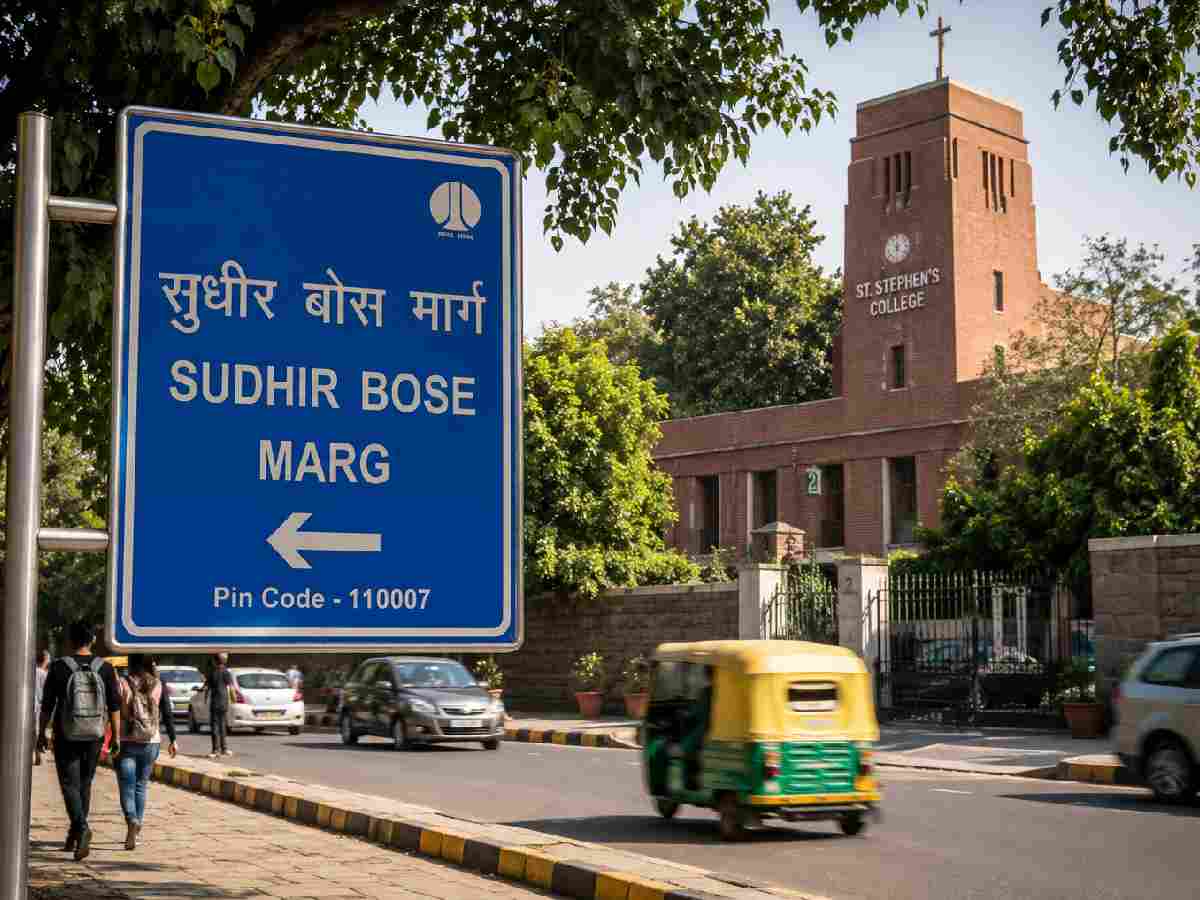
Sudhir Bose Marg
For the Delhi University North Campus community, the ever-busy Sudhir Bose Marg is a familiar road. Running between St Stephen’s and Hindu College, it is one of the landmarks of the area.
But who was the person after whom the road was named?
Sudhir Kumar Bose taught philosophy at St Stephen’s from 1937 to 1963, and is remembered as a teacher and a cricket man. He was President of games at the college for many years, helped raise money for the gymnasium and was closely associated with the Delhi and Districts Cricket Association (DDCA). He also founded the college’s Philosophical Society. Bose died in 1985, and in 1986, the old Imperial Avenue in front of St Stephen’s was renamed Sudhir Bose Marg in his memory.
A new lens on Urdu
Not far from Sudhir Bose Marg is GC Narang Marg, near Miranda House, named after Professor Gopi Chand Narang (1931-2022), a scholar, critic and theorist of Urdu. Born in Dukki in Baluchistan, he came to Delhi after Partition, completed his master’s and doctorate in Urdu at Delhi University, and began teaching at St Stephen’s in 1957-58 before joining the university’s Urdu department. He later taught at Jamia Millia Islamia as well, and was named Professor Emeritus by both Delhi University and Jamia.
“Narang’s work changed how Urdu was studied. He did not treat it as a communal marker, but as a civilisational gain of India’s mixed culture, and often said a language has no religion. His first major book, Karkhandari dialect of Delhi Urdu, studied the speech of the city’s artisans,” says Aslam Zaki, a reader of Narang’s work.
Over six decades, he wrote some 60 books in Urdu, Hindi and English, applying modern tools of linguistics, stylistics, structuralism and Eastern poetics to the ghazal, the masnavi and fiction. His studies of Mir Taqi Mir and Ghalib remain important, while in his book on the latter, he read the poet through Indian thought, including dialectics and the idea of shunyata, or emptiness. He also wrote on Amir Khusrau, Iqbal, Faiz, Manto and Rajinder Singh Bedi, as well as on the Indian roots of the Urdu ghazal.
Narang received the Padma Shri in 1990, the Sahitya Akademi Award in 1995 and the Padma Bhushan in 2004, and served as President of the Sahitya Akademi. Pakistan also honoured him, including with the President’s Gold Medal and the Sitara-e-Imtiaz. Recognition in both countries was unusual. He spent his last years in the United States and died in Charlotte, North Carolina, in June 2022.
Names on the map
North Campus also has NV Thadani Marg, named after NV Thadani, a long-serving principal of Hindu College (1917-1928 and again 1935-1950) and the first proctor of Delhi University. He played a role in the college’s early growth.
Professor ND Kapoor Marg runs by Kirori Mal College near Kamla Nagar, although public records do not offer a full published account of ND Kapoor’s life. He should not be confused with Seth Kirori Mal of Bhiwani after whom the college itself is named.
Professor Ram Nath Vij Marg runs through New Rajinder Nagar, near Sir Ganga Ram Hospital. Ram Nath Vij was a local public figure who represented Rajinder Nagar in the Delhi Assembly twice: first in 1977 on a Janata Party ticket, and again in 1983 as a Bharatiya Janata Party member. The road that bears his name still runs through the colony he served.
Detailed published accounts of any academic career behind the title “Professor” are scarce, but the name shows how a neighbourhood can preserve a local leader’s memory on its streets.
The wrestling Gurus
Meanwhile, wrestling has left its mark on North Delhi in a different way. The names of Guru Hanuman and Master Chandgi Ram live on more through their akharas than through long arterial roads.
Guru Hanuman (1901-1999) was a wrestling coach who had a major influence on the sport in India. He received the Padma Shri in 1983 and the Dronacharya Award in 1987. Around 1925, with land support from the Birla family, he set up what became the Guru Hanuman Akhara, first known as Birla Mills Vyayamshala, in the Malkaganj-Subzi Mandi-Shakti Nagar belt near Roshanara Bagh.
“The akhara, at Hanuman Galli in the Roshanara Park-Shakti Nagar area, became a nursery for Indian wrestlers. Its alumni include Guru Satpal, Subhash Verma, Sushil Kumar and many others. A statue of Guru Hanuman was unveiled at Kalyan Vihar Sports Stadium in 2003,” says sports writer Rajinder Sajwan.
From champion to coach
Master Chandgi Ram (1937-2010) came from Sisai in Hisar, Haryana. He won gold in the 100kg class at the 1970 Asian Games, competed at the 1972 Munich Olympics and collected major Indian titles such as Hind Kesari, Bharat Kesari and Rustom-e-Hind. He received the Arjuna Award in 1969 and the Padma Shri in 1971.
Also Read: Lutyens’ bungalows: addresses that turned into legacy
“After his competitive career, he moved to Delhi and opened Chandgi Ram Vyayamshala in 1975 in Chandrawal, Civil Lines, near Sham Nath Marg. It is often described as India’s first dedicated centre for women’s wrestling. He trained his daughters and other girls despite strong social resistance. The site is still run by the family,” says Vijay Shankar Chaturvedi, who knew Master Chandgi Ram.
The name is also used for a well-known traffic node, Chandgi Ram Akhara T-point (also called Metcalf House crossing), on the Outer Ring Road between Civil Lines and the Majnu Ka Tilla-Signature Bridge stretch. The junction is chronically congested because it links North Delhi, the Yamuna bank, Vidhan Sabha and routes towards the ISBT.
Taken together, these names offer another map of Delhi: one shaped not only by power and politics, but also by classrooms, cricket grounds and wrestling pits.
Artist Ma Dev Ananti presents seven oil and acrylic works exploring meditation, silence, inner awareness…
Delhi LG Taranjit Singh Sandhu urged NDMC staff to maintain BRICS-level cleanliness year-round and involve…
A qawwali evening featuring Kabul Bukhari at Bharat Mandapam will raise funds for Mann Ka…
Delhi HC to urgently hear plea alleging CJP leaders created and shared AI deepfakes of…
Karan Bhasin was arrested after firing a country-made pistol during a birthday party at a…
Officials remain unaware of new rates as Duleep Trophy invoices were filed at old rates
