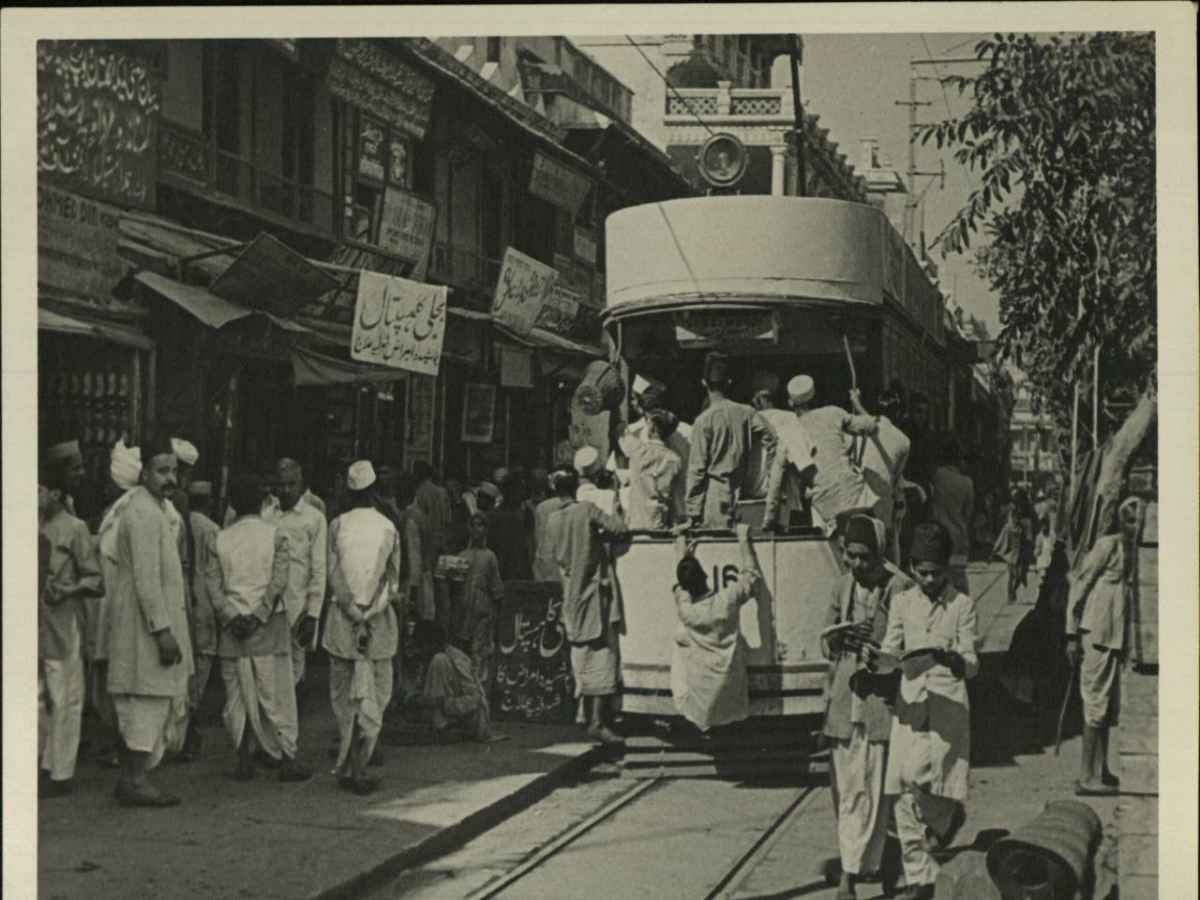
Trams first ran in Delhi on March 6, 1908
The Delhi Government is reportedly considering reintroducing trams in the Walled City as part of a wider redevelopment plan for Old Delhi.
At a review meeting on July 15, officials called for a feasibility assessment of a tram system that could provide sustainable, heritage-sensitive transport in the Walled City. The proposal is part of redevelopment work overseen by the agency formerly known as the Shahjahanabad Redevelopment Corporation, which was renamed the Indraprastha Virasat Punarvikas Nigam in July.
For author and journalist KN Gupta, reports of the proposal brought back memories of the 1950s and 1960s, when he travelled countless times by tram through the Walled City.
Old Delhi resident Dr Raj Kumar Jain, who taught at Delhi University, also remembers the journeys.
“The trams moved slowly through busy markets and residential areas,” Jain recalled.
He said they connected homes to workplaces, shops and railway stations. “People could easily hop on and off because the speed was low, often around 10 to 15 kilometres per hour,” he added.
How the service began
Delhi’s electric tram service began on March 6, 1908. The inauguration took place at Town Hall in the presence of the Director-General of the Archaeological Survey of India.
Electricity had arrived in Delhi only a few years earlier, around the time of preparations for the 1903 Delhi Durbar. The trams drew power from the city’s new electricity network and provided a modern means of travelling through Old Delhi.
The service was operated by the Delhi Electric Tramways and Lighting Company, later known as the Delhi Electric Supply and Traction Company. The private firm handled both electricity supply and tram operations in the early years. It laid the tracks and operated the open tramcars that became a familiar sight across the Walled City.
At its peak in the early 1920s, about 24 open tramcars operated along roughly 15 km of track. The network connected Jama Masjid, Chandni Chowk, Chawri Bazaar, Katra Badiyan, Lal Kuan and Fatehpuri with Sabzi Mandi, Sadar Bazar, Paharganj, Ajmeri Gate, Bara Hindu Rao and Tis Hazari.
Low fares and leisurely journeys
“I remember that fares were cheap and depended on distance. They ranged from half an anna (about three paise) to four annas. The trams had lower-, middle- and upper-class compartments,” Gupta recalled.
Most passengers travelled in the lower-class compartments. Bells warned pedestrians and signalled stops as the trams made their way through the densely populated streets.
People who travelled on the trams remember journeys from Ballimaran to Sadar Bazar and from Jama Masjid to the Fountain in Chandni Chowk. They also recall the low fares, the open cars and the sights and sounds of the crowded streets.
For many residents, the tram was an important means of commuting from their homes to markets, workplaces and railway stations.
A place in the city’s history
One frequently repeated account links the tram system with the wedding of India’s first Prime Minister Jawaharlal Nehru and Kamala Kaul. The two married in the Sitaram Bazar area on February 8, 1916, and some members of the wedding party are said to have travelled by tram.
The trams also appear in Ahmed Ali’s novel Twilight in Delhi, which depicts life in Old Delhi during a period of political and social change.
The end of the line
The service continued for more than five decades. After Independence, however, buses became more common, Delhi’s population grew rapidly and the number of cars and other vehicles increased.
As markets became more congested, the slow-moving trams found it increasingly difficult to negotiate the Walled City’s narrow roads. The service ended in December 1963. The tracks were subsequently removed and the roads opened fully to other traffic.
Those who travelled on the trams still talk about the leisurely journeys, the sound of the bells and how easily the service fitted into everyday life in Old Delhi.
A possible return
Proposals to bring trams back to Old Delhi have surfaced before, including plans for a short route near Chandni Chowk, but they did not proceed beyond the planning stage. The latest discussions have revived interest in the idea.
The Delhi Government is examining whether trams could reduce pollution and improve movement for residents, shoppers and tourists. Any modern network, however, would have to contend with narrow roads, heavy pedestrian movement, congested markets and the need to protect heritage buildings.
“A modern tram system would, of course, be different from the old open cars,” said former Railway Board member Dr Ravinder Kumar.
He said it would use new technology, better safety features and careful planning to ensure that it could operate on the narrow streets without damaging heritage structures.
“Yet the basic idea remains the same: A clean, shared form of transport that serves the dense old city without filling it with more cars and noise,” Kumar said.
The redevelopment of Old Delhi seeks to preserve the area’s character while improving daily life for those who live and work there. Whether trams can support that objective will depend on the findings of the feasibility assessment and how the system is adapted to the Walled City’s present-day conditions.
If the proposal advances, those who travelled on Delhi’s original trams could see a familiar form of transport return, while younger residents would encounter a largely forgotten chapter of the city’s history.
Read More: 75 years of Khalsa College: a legacy born of Partition
Railways cancelled select trains to New Delhi and Nizamuddin on Oct 10, citing road traffic…
Delhi Police registered 25 FIRs regarding SIR protests, naming Rahul and Priyanka Gandhi Vadra over…
Around 200 LHJP protesters gathered in Delhi to condemn abusive language against PM Modi and…
Delhi Police denied permission for the Cockroach Janta Party's Oct 10 protest at Jantar Mantar,…
CTI has urged PM Modi to ban large protests in central Delhi from Navratri to…
Delhi Police requested DMRC to shut 57 metro stations from Friday night till Saturday due…
