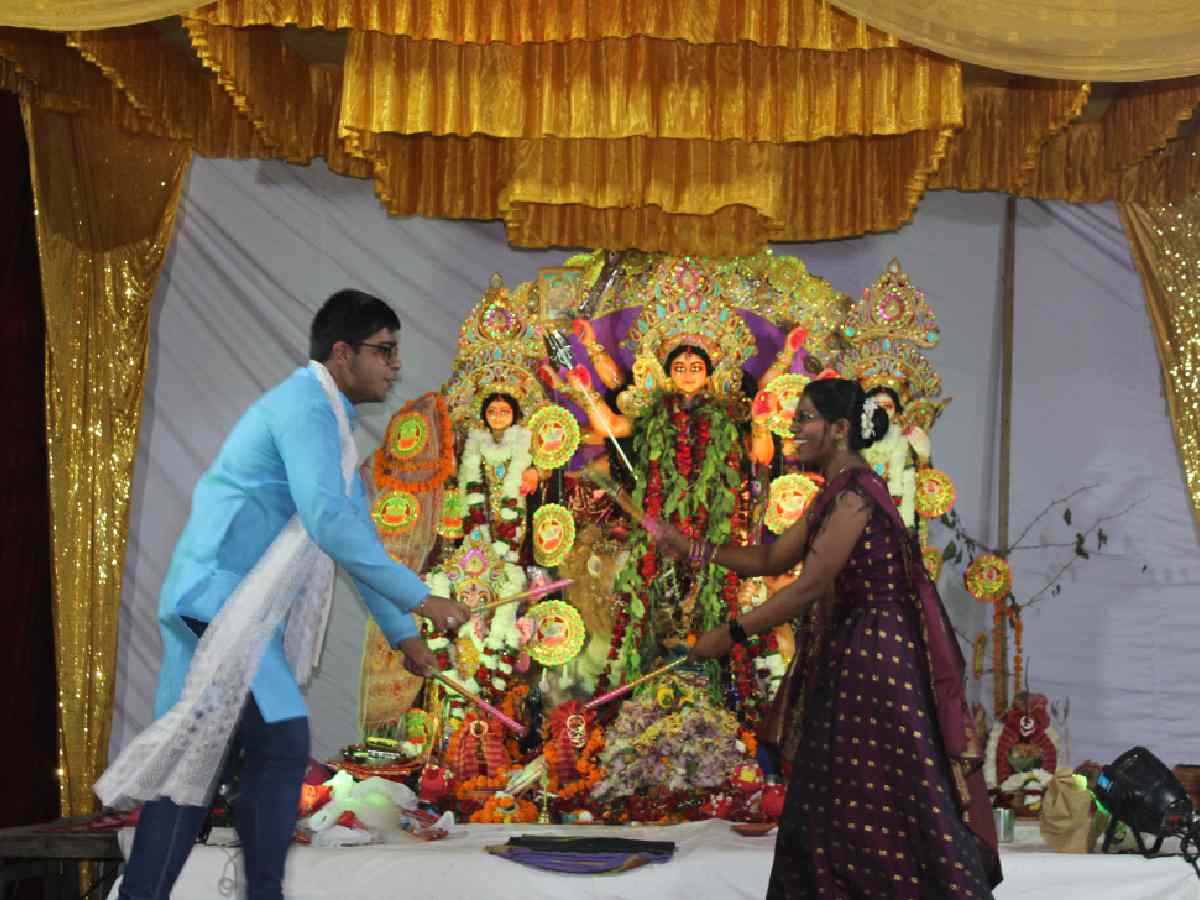
Every October, Delhi sheds its post-monsoon haze for a change in the air, carrying a chill that smells faintly of burning camphor and crisping jalebis. If you drive through the city on an October evening, you do not witness just one festival, but several secular traditions that interlock seamlessly.
Walking Delhi’s streets during this season brings up a fundamental question: whose festival is it, anyway?
Traditionally, in northern and western India, Navratri honours the nine manifestations of Goddess Durga through devotional fasting and vibrant nights of Garba and Dandiya Raas, culminating in Vijayadashami, or Dussehra. This marks Lord Rama’s victory over Ravana. In eastern India, Durga Puja commemorates Maa Durga’s triumph over the buffalo demon Mahishasura, celebrated through artistic pandals, rhythmic dhak drumming and dhunuchi dances. In Southern traditions, the focus often turns towards Goddess Saraswati to consecrate learning and tools of trade. In the Sikh tradition, Dussehra is intertwined with reverence for righteous defence.
Geography of belonging
In West Delhi, memories have long been anchored in the dramatic scale of the neighbourhood Ramleela grounds. For Jasmeet Singh, a resident of Tilak Nagar and a Sikh, childhood was measured not by quiet rites, but by the sheer altitude of effigies standing tall against the night sky.
“To be honest, for us October always meant Dussehra. We were never really into Navratri or anything else,” Jasmeet recalls.
“Our whole scene was—kaunsi Ramleela sabse badi hai; kahan ka Ravan sabse bada ban raha hai (which Ramleela is the biggest; which Ravan is being built the
largest). I used to go with my brothers to different grounds just to see them. That was our tradition.”
As he grew older, however, Jasmeet’s relationship with the season transitioned from youthful spectacle to theological reverence. “In Sikhism, during Dussehra we do Dashehra Mahtam da Paath. We do Shastar Puja because, for us, Shastar is Chandi ruup. My connection with October changed from just a mela to actual sewa and puja.”
For Jasmeet, the festivities were inseparable from a sense of
shared devotion. “When we all
celebrate together, it doesn’t feel
like you are from this religion or
that state. At that moment, we are
all just celebrating. Mazhab aur
state ka difference khatam ho jata
hai (The differences of religion
and state become invisible). We
are just connected through
bhakti. That’s the real unity of our
country, and it feels very special
to experience it with friends.”
For Jasmeet, the festivities were inseparable from a sense of shared devotion. “When we all celebrate together, it doesn’t feel like you are from this religion or that state. At that moment, we are all just celebrating. Mazhab aur state ka difference khatam ho jata hai (The differences of religion and state become invisible). We are just connected through bhakti. That’s the real unity of our country, and it feels very special to experience it with friends.”
A few Metro stations away in Dwarka, Anisha MacGreggor reflects on first encountering the grandeur of Durga Puja in life. “Experiencing Durga Puja has been something new for me; it has made me appreciate how every community has its own way of celebrating and how special it is to experience traditions that are different from what I grew up with,” she explains. “Even though our faiths and cultures may be different, celebrating Durga Puja together feels very special and for those few days, it doesn’t really feel like our differences matter and we’re all simply there to enjoy the celebrations, share the joy and be part of the same community.”
For 19-year-old hotel management student Rishabh Singh, who carries memories of his ancestral village alongside his life in Delhi, the seasonal joy of Dussehra and Durga Puja has always centred on open fairs and collective devotion. “A fair used to be organised in my village, and I would get very excited about going there, especially to enjoy the rides.”
Watching people adapt these traditional observances in Delhi has only increased his appreciation for how cultures and traditions come together. “It was really amazing for me to see people from different cultures celebrating the same festival in different ways,” Rishabh observes. “The essence of the puja was the same, but the way people celebrated it was different. I really enjoyed experiencing that diversity and celebrating together.”
Living at cultural crossroads
Dhanee Bawa, a master’s student from Delhi, was raised in an inter-cultural home bridging a Kashmiri Hindu mother and a Punjabi father, and experienced Navratri as a beautiful blend of two regions. “I got the best of both worlds,” Bawa explains. “Navratri for me used to be nine days of extreme religious devotion and a lot of positive vibes in the house. My grandmother always used to have incense in the house, and we used to listen to bhajans every day and worship Goddess Durga and her nine avatars.”
“It was also the time when in Punjabi tradition we used to have Kanjaks, where the girls of the household were worshipped, fed, and given really nice gifts, including halwa, poori and chana,” she recalls. “As you grow old, you sort of tend to grow away from cultural practices, but my family always made sure that I got my Kanjak, the money that I used to get from all of my older relatives.”
In another part of the city, Diya, a Malayali resident who grew up in Delhi, recounts how her family celebrated Navratri through traditions native to Kerala, “Basically, as a Hindu Malayali, I’ve grown up in Delhi witnessing a lot of festivals, and Navratri is one of the most prominent ones,” Diya says.
“What we do during this time is, we put away books right next to the temple of the goddess Saraswati and do not touch them or write anything on that day. After the day ends, we take some raw rice, put it on a metal plate, and write that phrase: Om Hari Sri Ganapataye Namah.”
Yet living in the Capital meant that home walls never enclosed Diya’s personal festival. “I have been to Durga Puja pandals in CR Park, and I’ve witnessed how crowded it is, and it’s a very lively experience where you see different idol forms. The food during Durga Puja that is being served is also delicious. Then during Dandiya nights, we all dance our hearts out during that time. It’s always been a very fun experience for me in Delhi and even in Kerala.”
Shared sanctuaries
Wafeeqa, a student from the Northeast, recalls observing Durga Puja in both Assam and Delhi’s web of festivities. While approaching festivities as a matter of personal choice, Wafeeqa recognises how the physical architecture of Durga Puja naturally fostered communal inclusion across social, caste and religious boundaries.
She talks about how these sacred grounds functioned historically and socially as spaces of democratic assembly: “Durga Puja for me has always been a very communal sort of festival, people from across different social and cultural locations. So Assamese people as well as non-Assamese people, such as Bengalis and Marwaris, and people from different locations would share the space.”
This shared space frequently spanned religious lines in unexpected ways.
“What I also remember is that there are particular localities where certain ethnic or caste groups are concentrated; they would have their own Durga Puja pandals, especially some of the Bengali migrant communities that were concentrated in the margins of the town,” Wafeeqa describes.
“They would have their own pandals, and we used to travel to those too. Those spaces would be toured, and they were shared by Muslims as well. One locality close to where I live is inhabited by Bengalis, and right next to it is a Muslim locality, and both the Bengali and the Muslim localities share a common pandal. They congregate in that same space. A recurring motif of every Durga Puja for me has been that communal aspect.”
By the tenth and final day, Delhi’s night sky bursts into light. The crackle of burning effigies in Ramleela maidans mingles with the aromatic smoke of dhunuchi dances before the immersion processions begin. The festival does not belong exclusively to the Punjabi household serving halwa-chana to Kanjaks, nor to the Bengali devotee escorting the goddess to the Yamuna. It does not belong solely to the Sikh resident performing Shastar Puja, the Malayali family inscribing invocations in rice grains or the diverse crowds gathering across community pandals.
The festival belongs to the act of gathering itself. In a city shaped by migration and movement, October turns public spaces into an inclusive hearth.
Here, the celebration has no singular, separate identity; instead, it is an enduring testament to what happens when varied traditions share the same ground.
A plea in the Supreme Court challenges restrictions on protests at Delhi’s Jantar Mantar and…
Delhi recorded an AQI of 138 in the moderate category on Tuesday, with the minimum…
A 29-year-old driver was allegedly beaten to death by nightclub bouncers in Delhi following a…
Delhi HC to hear pleas seeking regulation of protests in the capital on Tuesday, with…
CJP leaders Saurav Das, Ashutosh Ranka and others were detained near Jantar Mantar amid heightened…
After 12 years in theatre, the actor makes his international film debut with a role…

