Seventy-three residential societies in the Capital recently applied for fire no-objection certificates (NOCs), only to have their applications rejected by the department. Additionally, 724 societies across Delhi have either never applied for an NOC or have failed to renew their expired certificates.
According to Delhi Fire Services (DFS) data, nearly 90% of Delhi’s registered cooperative group housing societies lack a valid fire no-objection certificate (NOC). Of the 898 registered societies, 101 possess valid fire NOCs.
Many of the buildings that never applied for NOCs or failed to renew their expired certificates are located in affluent and densely populated pockets of Delhi. The highest concentration of such Housing Societies is in South-West Delhi (317), followed by East Delhi (227) and North-West Delhi (166).
The problem extends into the hospitality sector as well. DFS records show that only 1,244 guest houses in the city currently hold valid fire NOCs.
2,600 applications
Over the years, around 2,600 applications for fire clearances have been received from guest houses. Out of these, 421 NOCs issued earlier have since expired, while another 541 applications failed to meet the prescribed safety norms required for approval.
In addition, 233 guest house applicants were directed to reapply after rectifying specific deficiencies identified during inspections.
The records reveal that 129 establishments were found to violate the department’s NOC requirements, and 30 applications were closed. In two cases, applicants were issued detailed guidelines and asked to fulfil the necessary conditions before their files could be processed further.
Under the Unified Building Bye Laws (UBBL) 2016 and the Delhi Fire Service Rules, certain buildings in Delhi – hotels and guest houses with a height of 12 metres, residential buildings with a height of more than 15 metres, and educational and institutional buildings with a height of more than nine metres – must obtain an NOC from DFS before beginning construction or commencing operations.
Fire-safety norms
The mandate further applies to all assembly buildings, business buildings over 15 metres or with four upper storeys, and mercantile buildings over nine metres.
Industrial and storage buildings with a covered area above 250 square metres, hazardous buildings over 100 square metres, and all underground structures are also covered under this legal framework.
The formal submission process involves sending building plans to the local authority — such as the Municipal Corporation of Delhi, New Delhi Municipal Council, or Delhi Development Authority — which then scrutinises them and forwards them to DFS.
These submissions must be accompanied by a duly filled Common Application Form (CAF), as per clause 2.8 of UBBL 2016. Former DFS director Atul Garg noted that the process for granting clearances to hotels and guest houses is carried out entirely through a unified online portal. Based on the DFS report uploaded to this portal, the MCD takes the final call on whether to grant the NOC to the applicant.
For government buildings, a simplified process under clause 3.1.3 allows for direct submission.
Mandatory requirements
All plans must include fire and life safety systems in line with the National Building Code and Rule 33 of the DFS Rules. This includes clear provisions for access routes, exits, compartmentation, smoke management, extinguishers, sprinklers, hydrants and more.
The CAF must detail the occupancy type, building height, number of floors, covered area, staircase widths, and fire protection systems. All entries are subject to strict validation.
To obtain the NOC, applicants must submit a reference letter from the local authority. For government buildings, a copy of the approved layout plan and a letter from the competent authority are needed instead.
Additionally, two sets of architectural plans, including fire and life safety systems, layout and elevation drawings, and sprinkler and smoke management plans with calculations, must be included.
DFS’s Fire Prevention Wing reviews these documents for compliance with UBBL, NBC and international standards. If approved, one signed set of plans is returned to the local body, and the NOC is issued.
Yet, despite these clear legal frameworks, many buildings—including numerous CGHS complexes and commercial guest houses—fail to submit adequate documentation or implement fire safety measures on the ground.
When the fire brigade inspects any building over 15 metres in height, or guest houses exceeding 12 metres, they evaluate it against more than 24 stringent regulations. Recent inspections have highlighted several critical and practical shortcomings.
Fire audit
During these inspections and audits, officials examine several critical aspects. These include the availability and accessibility of emergency exits, ventilation arrangements, stair widths, evacuation routes, emergency lighting, signage, and the physical condition of firefighting equipment.
Special attention is paid to fire suppression systems, such as sprinklers, hose reels, fire extinguishers, water storage tanks and pumping systems, to determine whether they are functional and capable of operating effectively during an emergency.
In the event of a fire, staircases serve as the sole escape route. However, in most residential societies, these vital stairwells are heavily cluttered with junk and household scrap.
At many locations, terrace doors are kept padlocked. This effectively traps residents on the upper floors during a fire emergency, leaving them with nowhere to run.
Statistics show that 80% of fire-related fatalities are caused by asphyxiation from smoke inhalation rather than actual burns. Despite this danger, these complexes completely lack adequate smoke ventilation systems.
Dysfunctional sprinklers
An official noted that during inspections of establishments denied NOCs, several fire safety systems, including sprinklers, failed to function automatically. At the same time, hose reels were either missing or not properly maintained.
Blocked emergency exits
The inspections also revealed that fire pumps were completely non-operational, emergency exits were heavily obstructed, and vital firefighting equipment had not been serviced for long periods.
In several establishments, staff were either inadequately trained or entirely unaware of basic firefighting procedures, raising serious concerns about their ability to respond effectively during the crucial initial stages of a fire.
While fire hydrants and hoses are physically installed in many residential blocks, the dedicated water pumps or backup generators required to run them are broken down. The moment the power cuts out, the entire firefighting system grinds to a halt.
To make matters worse, the main electrical panels and high-tension wires are often positioned near doorways. A short circuit in these panels would block a building’s main exit route entirely.
The official added that if these systems are not maintained regularly, they simply will not work when needed. In many cases, owners take corrective measures only after a fire, rather than ensuring that safety mechanisms remain functional at all times.
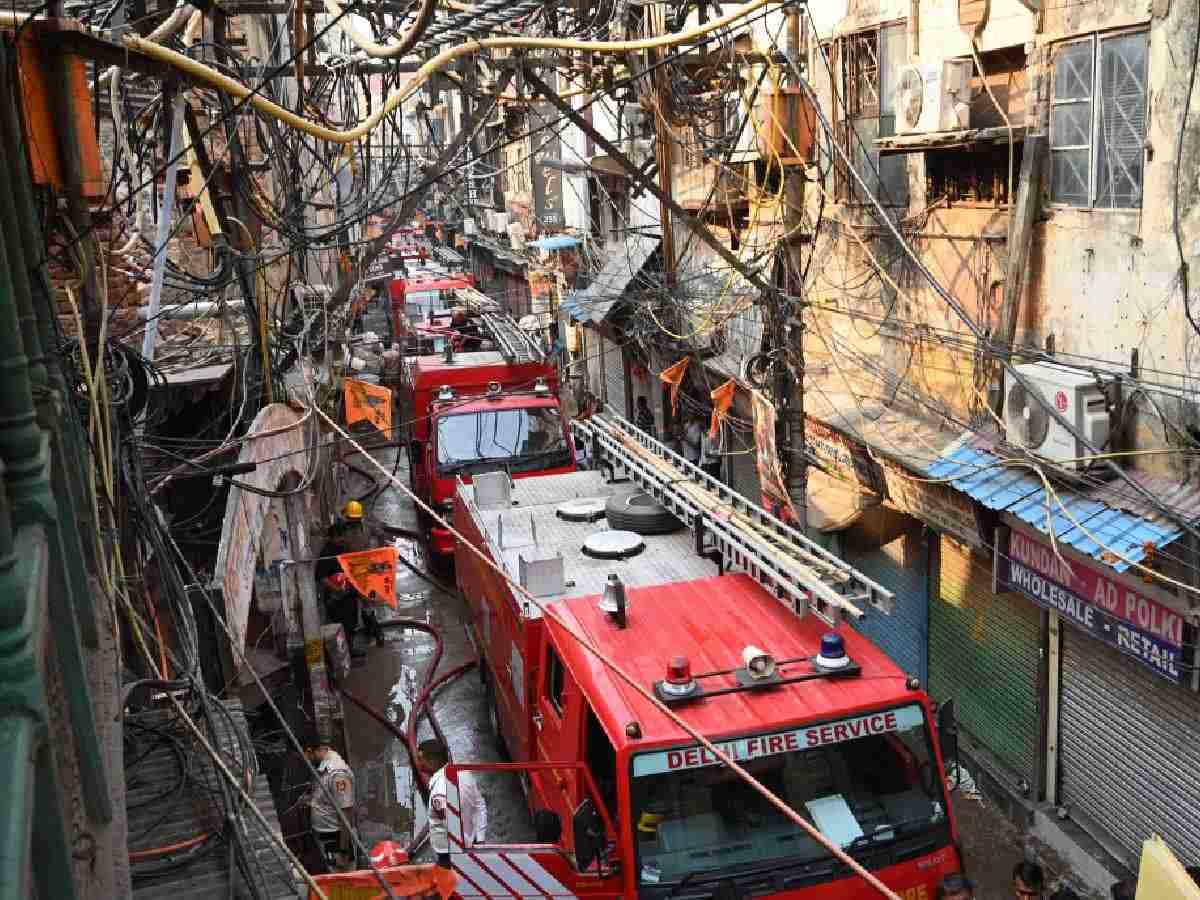
Several guest houses still operate entirely without fire NOCs, particularly in densely populated and congested localities. These areas feature narrow lanes and multi-storey buildings that pose severe additional challenges for firefighting operations.
However, another fundamental concern arises from the presence of mixed-use buildings that serve both residential and commercial purposes. These buildings—where ground floors and basements operate as commercial hubs while upper storeys house families—have created a persistent and growing fire safety crisis. While the Delhi Master Plan allows certain commercial activities in residential areas, many of these structures fail to meet essential safety protocols, effectively turning homes into high-risk zones.
Hazardous substances
In dense neighbourhoods, it is common to find four- to five-storey buildings where the lower levels are packed with flammable goods such as textiles, cosmetics, or electronics. This creates a vertical “tinderbox” effect; a blaze starting in a basement or shop floor can rapidly consume oxygen and fill the only available exit—usually a single narrow internal staircase—with suffocating toxic smoke.
Also Read: Delhi records spike in fire-related deaths
The risks are often compounded by illegal practices, such as using residential basements for bulk warehousing or small-scale manufacturing. These spaces frequently lack adequate ventilation and secondary emergency exits, which are mandated by the National Building Code but rarely enforced in older colonies and unauthorised settlements.
Palam fire
A tragic manifestation of these hazards occurred on March 18, 2026, in the Palam area of Southwest Delhi. A fire, suspected to have been caused by a short circuit in a ground-floor electrical board, ripped through a building housing a cloth and cosmetic showroom.
The blaze led to the deaths of nine members of a family due to asphyxiation, as smoke from the commercial goods trapped them on the upper floors.
While a fire audit has been announced and auditors are being empanelled, it is still a long way off.
Of the 237 spa centres across 10 zones with valid MCD licences, the South East…
CTI chairman Brijesh Goyal said the Rahul Gandhi rally could affect wholesale and retail markets…
Established to mark the university’s 25 years, Jubilee Hall has witnessed generations of student life.…
Delhi inaugurates the 70th National School Games, hosting over 14,000 participants in 14 sports across…
Delhi High Court asked "Doosra" filmmakers to respond to Sourav Ganguly's plea over alleged violation…
Delhi L-G appointed Paralympian Suvarna Raj as State Commissioner for PwDs following her gold win…
