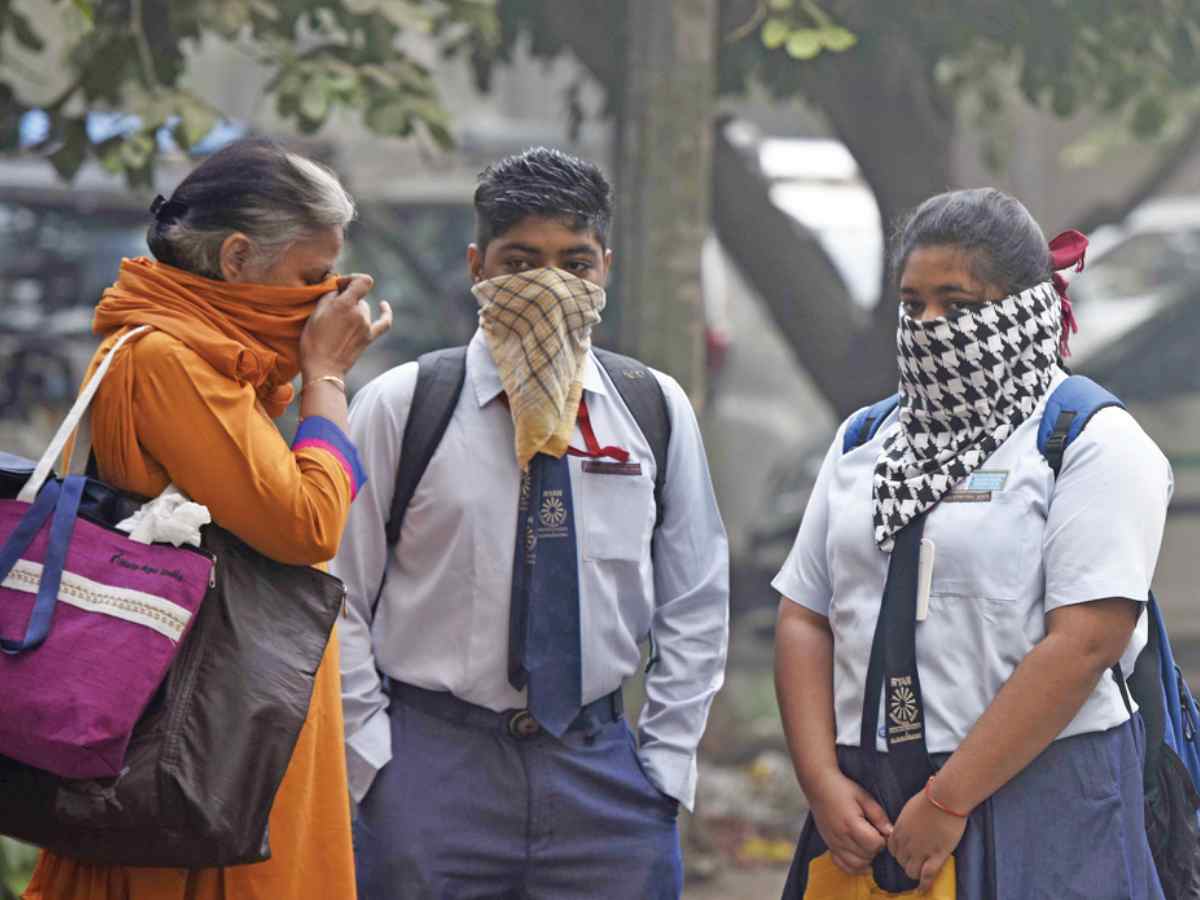
As Delhi vanishes behind a dense-grey curtain and toxic air continues to choke the National Capital Region, a new survey has found that 82 per cent of Delhi-NCR residents have one or more people in their close social network suffering from severe health conditions that they attribute to a long-term exposure to air pollution.
The survey, conducted by community platform LocalCircles, said 28 per cent of the respondents reported having four or more such individuals among family members, friends, neighbours or colleagues.
It said the health conditions include asthma, chronic obstructive pulmonary disease, lung damage, heart failure, strokes and cognitive decline, which the respondents linked to a sustained exposure to polluted air.
Delhi choked under a thick blanket of smog on Monday, with the Air Quality Index (AQI) settling at 498, which falls in the higher spectrum of the “severe” category.
The air quality was “severe” at 38 weather-monitoring stations, while it was “very poor” at two. Jahangirpuri, with an AQI reading of 498, recorded the worst air quality among all the 40 stations.
According to the Central Pollution Control Board (CPCB), an AQI between 0 and 50 is considered “good”, 51 and 100 “satisfactory”, 101 and 200 “moderate”, 201 and 300 “poor”, 301 and 400 “very poor” and 401 and 500 “severe”.
The AQI in Delhi climbed to 461 on Sunday, marking the city’s most-polluted day this winter and the second-worst-air-quality day in December on record, as weak winds and low temperatures trapped pollutants close to the surface.
According to the survey, the air quality across large parts of Delhi-NCR has remained in the “very poor” and “severe” categories since late October.
Underlining the scale of the public health crisis in the region, it claimed that fine particulate matter is triggering a sharp rise in cases of respiratory and cardiac ailments, particularly among children, the elderly and those with pre-existing health conditions.
The survey also highlighted a growing anxiety over medical expenses, with 73 per cent of the respondents saying they are worried about being able to afford healthcare for themselves and their families if they continue living in the region amid recurring pollution episodes.
Eight per cent of the respondents said they intend to move out of Delhi-NCR because of the toxic air, while the majority said they are compelled to stay due to work, family responsibilities and other constraints.
Also Read: Delhi’s homeless face long nights of toxic air as winter pollution worsens
The survey received more than 34,000 responses from the residents of Delhi, Gurugram, Noida, Faridabad and Ghaziabad.
LocalCircles said it plans to share the findings with government stakeholders, urging for urgent action to address pollution sources and explore healthcare support measures for the affected populations.
A $780 million market built on pavements, where the pleasure of reading meets the price…
Supreme Court advocate Abhishek Pawar alleges women were denied washroom access for seven to eight…
Each day of closure costs shops in Khan Market and Connaught Place between Rs 60,000…
Delhi generates nearly 15,000 tonnes of waste daily, prompting the government to deploy 1,000 mechanical…
Delhi Police has issued an NOC for the Congress rally at Ramlila Maidan on November…
CJP chief Abhijeet Dipke received conditional bail following his arrest for participating in a Connaught…
