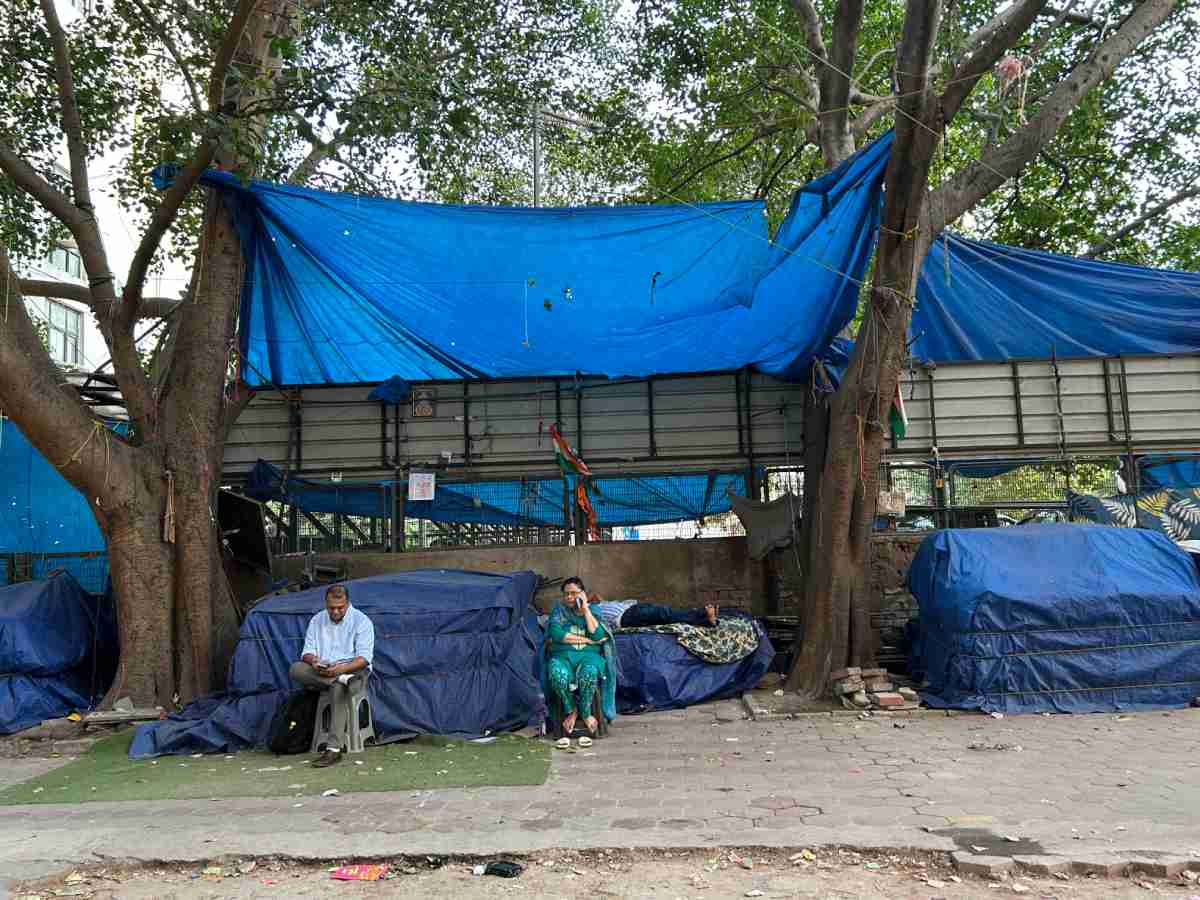
Small vendors’ stalls remain covered with blue tarpaulins at Janpath after they were asked to keep their businesses closed during the BRICS Summit
Tight security arrangements for the BRICS Summit have brought extensive traffic restrictions across New Delhi, but the impact has not been the same for everyone. At Janpath, small vendors and traders say they have been asked to stay away until Monday, losing three days of income.
For those who earn only when they open their shops, the three-day closure means a direct hit to their income.
“Three days is a big problem for us. We earn every day and eat from what we earn every day,” said 52-year-old Naresh, a small trader in the area.
“For us, the biggest problem is food and household expenses. We don’t have a fixed salary coming at the end of the month,” he said.
Naresh said the shutdown is also affecting the young men who work with him.
“There are four boys who work with me. I will also have a problem paying them. They also depend on this work,” he said.
Rising cost of living
For Naresh, the loss is not limited to those three days. He said the rising cost of living has made it harder for small traders to absorb even a few days without business.
“Everything has become expensive. We won’t earn for three days, and the expenses at home will continue. Food will still have to be bought, and the other expenses will not stop,” he said.
The vendors also face another problem: getting to the market.
Many of them live relatively close to Janpath, but route restrictions and diversions linked to the summit have lengthened their daily commute.
“We normally come from nearby, but because the routes have changed, we have to take a longer route. It takes more time and creates more difficulty,” Naresh said.
Another shopkeeper in the market said the three-day closure has hit traders at a time when they can least afford it.
“Mahangai bahut hai [Everything’s become dearer],” he said.
“Everything depends on daily employment. With the shop remaining closed for three days, the household also suffers,” he said.
He also questioned the repeated practice of clearing markets during major summits and high-security events.
‘First casualty’
“Every time there is a summit or a big event, they clear the market. For us, it becomes very difficult. Security is important, but they should also think about the people who depend on these shops for their daily income,” he said.
However, the situation is not the same for every trader in Janpath.
Owners of larger, permanent shops in the market said their establishments have remained open during the summit. They said they received a notification through the Janpath Vyapar group informing them that their shops would not have to shut.
“We have received the notification. Our shops are open,” one shop owner said.
Another permanent shop owner said the restrictions have not affected his business in the same way as they have affected the vendors.
“We have not been asked to close. Our shops are functioning,” he said.
Visible divide
This has created a visible divide in the market: permanent shops can continue their business, while small vendors and stall owners have been asked to stay away.
Amit Gupta, Joint Secretary of the New Delhi Traders Association (NDTA), said no unauthorised vendors are currently operating in Connaught Place.
“There are no unauthorised vendors or beggars in Connaught Place right now. All vendors have been asked to keep their shops closed until Monday. They have been removed from CP,” Gupta said.
But Gupta said the government should answer a bigger question: if authorities can remove vendors for three days for the BRICS Summit, why can’t they address unauthorised vending regularly?
“If they can do this for three days because of the BRICS Summit, why can’t they do the same thing on a day-to-day basis? Now you see Connaught Place; it seems like we’re back in the ’90s,” Gupta said.
According to Gupta, the issue goes beyond the BRICS Summit. He alleged that NDMC has failed to take effective action against unauthorised vendors despite repeated requests from traders.
“This is an issue of corruption in NDMC. They are not helping us remove these unauthorised vendors,” Gupta alleged.
He added that the NDTA has repeatedly approached the authorities over the issue and filed several petitions in the Delhi High Court.
“We have kept requesting NDMC to take action, but there has been no action from their side,” Gupta added.
His comments put the current situation in a different context. While small vendors say the sudden removal has cut off their income for three days, the traders’ association says it has been asking authorities to address unauthorised vending for much longer.
Immediate concerns
For the vendors, however, the immediate concern is simpler.
“Why would we come to Janpath and CP if there is no earning?” one vendor said.
“If we spend money travelling here and sit without business, we will lose more money. With prices already so high, coming here to sit is not practical,” he said.
That is the dilemma facing many of the small traders.
They can come to the market, but if they cannot put up their stalls, they cannot earn. At the same time, travelling to the market itself costs money for someone surviving on daily earnings; even that additional expense matters.
“Why should we spend money to come here when we are not allowed to work? We will spend on travel and food, but there will be no income,” another trader said.
For the government and security agencies, the BRICS Summit is a major international event that requires tight security and controlled movement across Delhi. The presence of senior foreign leaders means authorities have to manage security, traffic and public movement carefully.
For a small vendor, however, the summit looks very different.
It means a small stall, three days without sales and a difficult calculation at the end of the day of how to pay for food and household expenses without the money that normally comes from that day’s work.
The traders are not necessarily questioning the need for security. Their concern is about who bears the economic cost of that security.
For larger shop owners, the impact appears limited because their businesses can remain open. For small vendors, the same three days can mean a complete loss of income.
And that difference is at the heart of the Janpath story.
Delhi inaugurates the 70th National School Games, hosting over 14,000 participants in 14 sports across…
Delhi High Court asked "Doosra" filmmakers to respond to Sourav Ganguly's plea over alleged violation…
Delhi L-G appointed Paralympian Suvarna Raj as State Commissioner for PwDs following her gold win…
DDA is planning Delhi's longest 24-km cycling track along the Yamuna floodplain, linking key eco-projects…
Police detained several anti-SIR protesters heading to the ECI headquarters in Delhi as mass gatherings…
An exhibition that revisits the significance of Indian Modernism through works from earlier and defining…

