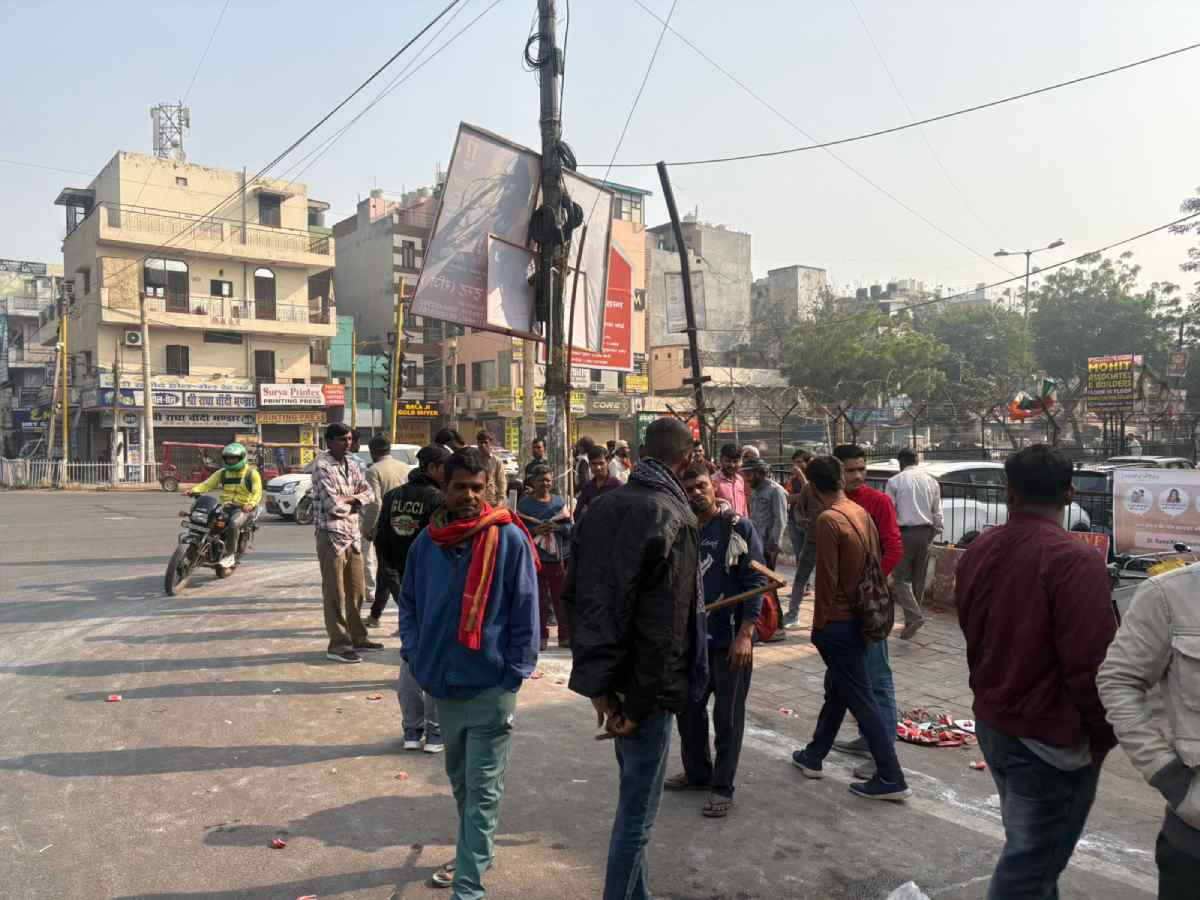
Delhi: The winter morning is still young when the first group of labourers gathers at the Anand Vihar labour chowk. Dark smog hangs like a curtain over the neighbourhood, the air sharp with a biting chill. Men and women, wrapped in thin shawls, stand silently in the fog—some rubbing their hands for warmth, others staring blankly at the road, waiting for a contractor who may not appear today.
It has been more than a week since GRAP III restrictions halted all non-essential construction work across Delhi-NCR. For lakhs of daily-wage labourers who depend on each day’s earnings to survive, the ban has meant an abrupt stop—of work, income, and dignity.
“We didn’t create this pollution, but we are the ones starving because of it,” said Rohit Paswan, a worker.
Among the workers waiting is 28-year-old Paswan, who came from Darbhanga, Bihar, to Delhi hoping to provide a better future for his family. Today, he stands with slumped shoulders, a torn bag by his feet.
He speaks slowly, choosing words that carry both pain and disbelief. “Every day for the past eight days, I have gone back home without work,” he said. He added that he leaves home in the morning with hope, walks for kilometres, waits for hours at the labour point, and returns with empty hands. His children ask him why he has not brought food or milk, and he struggles to find an answer. “It’s not that I don’t want to work—the government stopped the work,” he said. “I did not cause this pollution, yet I am the one who is starving because of it.”
The frustration in his voice is thick, but deeper than that is fear—fear of eviction, unpaid loans, and children going hungry.
Women workers hit harder
At a jhuggi cluster in Uttam Nagar, Rekha Devi tries to calm her toddler as she lights a small chulha. She used to work as a helper at a small construction site but has not had a job since the ban.
Rekha’s voice trembles as she speaks. “People think women don’t contribute to household income, but whatever I earned was what kept our home running,” she said. With her husband’s irregular salary, her earnings covered groceries, milk and soap. “Now, I cannot even afford to buy vegetables.”
Her children cry at night because they are hungry. She asked, “Tell me, how do I make them understand what air pollution is? Why should my children suffer for decisions they don’t even understand?”
Her son’s school has already warned of unpaid fees. “How do I tell my child that he may have to stop going to school?” she said. “He will think it’s his fault. But the truth is, the fault belongs to no labourer. We are punished for something we never caused.”
Labour points now deserted
In Okhla, the usually bustling labour point now resembles an abandoned bus stop. Men sit on broken bricks and metal pipes, staring at the ground or discussing faint rumours of jobs.
One of them is Mohammad Salim, a 40-year-old mason who has worked in Delhi for nearly two decades.
His words stretch like a story. “In winters, work always stops due to the skyrocketing air pollution,” he said. Contractors no longer arrive or call out for masons, helpers or painters. “Now also the road is empty. No vehicles stop. No one is hiring.” He added that malls and markets may be crowded, but the working poor remain shut out. “It feels like the city has moved on and left us behind,” he said. “We are invisible. We exist only when we are needed, and the moment any crisis comes, we are forgotten.”
Borrowing to survive
At a tea stall in Badarpur, 48-year-old Hari Prasad stirs his tea slowly.
“I used to earn Rs 700–Rs 800 a day,” he said. “In that money, somehow we ran the house—poorly, but we managed.” Now he borrows Rs 100 or Rs 200 just to buy flour or lentils. Borrowing, he said, is humiliating. People question how he will repay without work. His daughters have stopped tuition classes. His wife buys vegetables only every three days.
“You tell me—how long does the government think we can survive without work?” he asked. “Hunger does not wait for pollution levels to drop.”
In Wazirpur, Sunita, a 30-year-old mother of two, said, “Men may still get unloading work or night shifts. But nobody hires women.” The small share women contributed has vanished. “This ban has crushed the dignity of every labourer,” she said. “We don’t want charity. We just want work.”
Contractors struggling too
Near Laxmi Nagar, a small contractor expressed helplessness. “We are not big builders. We depend on small house constructions,” he said. When work stops, his income stops too. He still owes money for rented machines lying idle. “When labourers come asking for money or food, my heart breaks,” he said. “But how do I help everyone? I don’t have endless money. This ban has hit every layer of the construction chain—but the poorest suffer the most.”
Children face the consequences
At a shelter near Okhla, 11-year-old Anu sits with her worn-out schoolbag. Her father has not worked in days.
Her mother’s voice breaks as she says, “I want my daughter to study, to become something, to escape this life. But when we cannot even afford food, how can we think of school fees?” She added that the smog may lift eventually, but their struggle feels unending. “The ban may help the air, but it is choking our lives.”
Labourers ask for balance, not exemptions
At Dwarka Mor, Rafiq, who now unloads vegetable trucks, speaks with calm clarity. “People think labourers don’t care about pollution. Of course we care,” he said. “We also breathe this toxic air. We also get sick.” But without income, even masks or medicines are beyond reach. “To breathe clean air, we need to stay alive. And to stay alive, we need work,” he added. “That balance has to come from the government. We cannot carry this burden alone.”
The human cost behind a cleaner sky
Delhi’s air crisis is real. But the humanitarian crisis unfolding under the same sky is just as real. For policymakers, it is about PM2.5 numbers. For labourers, it is about tonight’s meal.
As smog thickens and restrictions continue, it is clear who is paying the steepest price.
Back at the labour chowk, Paswan adjusts the torn bag at his feet. His final words linger in the cold air. “We don’t want fights with the government. We don’t want protests. We just want work,” he said. “We want to earn with dignity, and feed our children with honesty. If pollution must be controlled, then support must also be given. Otherwise, we will die—not from pollution, but from hunger. And that will be a bigger tragedy than any smog Delhi has ever seen.”
BNSS caps custody at 24 hours and requires production before a Magistrate; force permitted only…
An SEM court reserved its order on extending the judicial custody of CJP leaders Saurav…
Delhi recorded its first 'poor' air day of the season on Wednesday as AQI hit…
Stage I of GRAP was invoked later this year in Delhi due to govt's preventive…
DDA plans to resume tethered hot air balloon rides at Baanseera park from Nov 14,…
NDMC is consulting RWAs and traders on draft 2026 property tax bye-laws, seeking feedback on…
