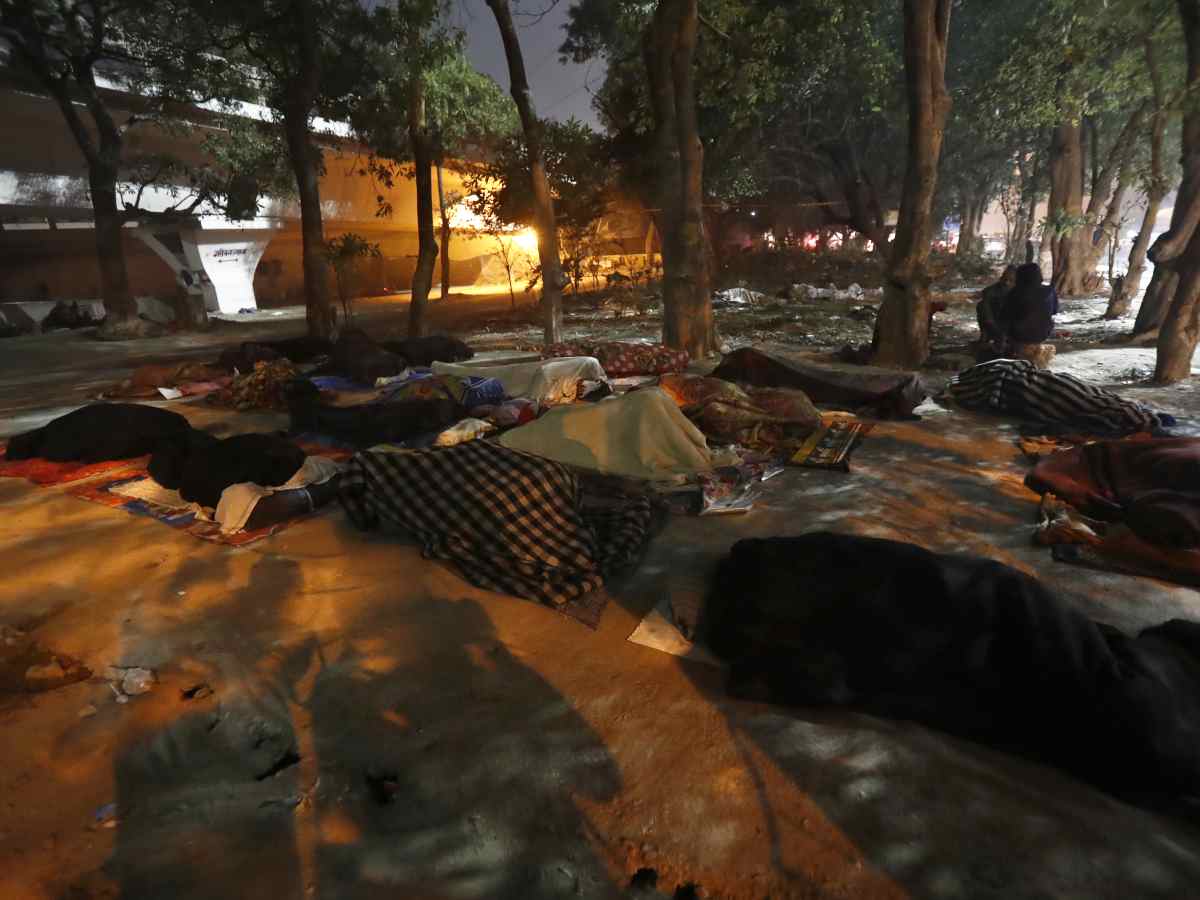
Delhi: Under sprawling flyovers and along bustling pavements, hundreds of homeless individuals continue to succumb to the harsh elements each winter. Their deaths often go unnoticed, their lives unremembered, as the city carries on. The Zonal Integrated Police Network (ZIPNET) website has become a chilling archive, filled with photographs of the lifeless — unidentified, unclaimed and forgotten.
Within the past week, from December 31, 2025, to January 6, 2026, a total of 34 unidentified dead bodies (UIDBs) were recovered from the streets. During the same period last winter, 67 UIDBs were recorded. While the absolute numbers have declined, an average of more than five deaths a day remains a matter of serious concern.
A similar reduction is visible in monthly figures. Between December 1, 2025, and January 6, 2026, 204 unidentified bodies were discovered on Delhi’s streets, most of them believed to be homeless. During the same period last winter — from December 2024 to January 2025 — 324 UIDBs were recovered.
As temperatures hover just above five degrees Celsius, pavements have once again turned into open graves, raising urgent questions about the city’s preparedness to protect its most vulnerable. Despite the drop in numbers, activists say the pattern repeats year after year.
Homeless deaths claim the streets
Photographs of the deceased dominate the ZIPNET website. From the frail and elderly to the young and seemingly fit, the biting cold has exposed the vulnerabilities of Delhi’s homeless population. Pavements resemble gravesites, while metro pillars stand like tombstones. Despite the recurring toll, government intervention remains limited, leaving non-governmental organisations (NGOs) to shoulder much of the rescue work.
During the same winter period last year, 325 homeless individuals were found dead on the city’s streets. Both the Centre and the Delhi Government continue to trade blame, offering little relief on the ground.
“Pavements have taken the form of gravesites, while metro pillars have become tombstones. However, their deaths remain unheard, with little sign of the authorities coming forward to support them; meanwhile, NGOs go about their business saving those they come across while the unfortunate others perish,” said an activist.
How many died last winter?
The National Human Rights Commission (NHRC) of India took suo motu cognisance of a report by the Centre for Holistic Development (CHD), which claimed that 474 people died over a 56-day period during the winter of 2024–25 in Delhi.
According to CHD, an NGO working with the homeless, these deaths occurred between December 14, 2024, and January 10, 2025, due to the lack of essential protective measures such as warm clothing, blankets and adequate shelter. The organisation further claimed that nearly 80% of unidentified bodies found in Delhi are believed to be homeless individuals.
Observing that the contents of the report, if accurate, constituted a grave violation of human rights, the Commission issued notices to the Chief Secretary and the Commissioner of Police in Delhi, seeking a detailed report within one week.
Who recovers the bodies?
For police personnel, winter and summer bring grim predictability — the task of recovering bodies from the streets.
“Each year, the scenario remains the same. It was the same last year, and nothing has changed this year either. Every day we come across a dead body, especially during the summers and the winters. Last week, I recovered five bodies on my route in a single day,” said a North District police officer.
“Finding a body almost every day barely lets anyone rest easily at night. Sometimes there are multiple deceased, while at other times not many, but the situation seldom improves. It takes a mental toll on us as well,” he added.
The deaths include not only homeless adults but also abandoned infants. Over the past month, the bodies of four infants were recovered from pavements and rubbish heaps across the city.
Old Delhi’s grim distinction
The Jama Masjid Police Station area records the highest number of homeless deaths, earning it the grim label of the city’s “homeless capital”. Despite the presence of multiple night shelters — including Delhi’s largest hangar tent with a capacity of 60 people — facilities fall far short of demand.
Most of the deceased listed on the ZIPNET website were found near shops or around the historic mosque.
“Many of the homeless stay on the streets in these areas. Some do not want to use the night shelters, while others are possibly constrained by a lack of identification cards,” said a member of the Maa Astha Samajik Vikas Sewa Sanstha NGO, speaking on condition of anonymity.
“As night falls, it also becomes the time for some of them to earn a bit of money. While some wait at Chor Bazaar since the market opens at four in the morning, others are given the opportunity to earn money by guarding a shop. This eventually leads to their deaths sometimes, especially among the elderly,” he said.
Also Read: Delhi’s health system stretched as pollution, climate stress and disease converged in 2025
He added that rules inside shelters also deter many. “Some want to smoke and drink, and inside the shelters, that is not possible. Eventually, they decide to remain outside, and the winter claims them.”
Why DUSIB’s tents find no takers
In October, the Delhi Urban Shelter Improvement Board (DUSIB) said it had floated a tender for 250 pagoda-style tents for the homeless. As of December 17, DUSIB’s Occupancy Report listed 131 operational shelters accommodating 2,650 people.
Thirty-five tents have consistently recorded no footfall since the start of the year, raising concerns over under-utilisation.
Despite this, the overall capacity remains grossly inadequate for Delhi’s estimated homeless population of over three lakh people. The total available capacity stands at 19,984, down from 20,544 last year.
“Tents have been merged to inflate numbers, further worsening the crisis,” said NGO member Vikas Kumar.
Rescue efforts and medical risks
Despite nightly rescue rounds by organisations such as Janpahal and the Sofia Educational and Welfare Society, the gap between need and availability leaves thousands exposed.
“We go on nightly rounds to look for homeless people who need rescuing from the harsh winter. Presently, we have not come across any bodies. Any person we see freezing, we rescue,” said Ravi Kant from Sofia.
“Some put up a fight when being rescued, but we are successful in the end. However, I believe that this time around, the death toll might increase, especially with the unseasonal rains,” he added.
“The cold is just a factor that speeds up the effect. Many of them are afflicted by a wide array of diseases or have been abusing substances. None of them have had a post-mortem,” alleged Gupta from Maa Astha.
The cold killer
Medical experts warn that the combination of extreme cold, pollution and substance abuse can be deadly.
“Many homeless ingest alcohol or abuse substances, especially during winter, to numb themselves to the cold. It starts innocently enough, but after that, it begins to weaken their immune system,” said Dr Praveen Gupta, Principal Director and Chief of Neurology at Fortis Hospital.
“This inadvertently makes them the easiest prey for the biting cold in the national capital, especially with the pollution,” he said.
He added that low temperatures can cause mental impairment, leading to disorientation, dizziness, confusion and slurred speech. “On the other hand, it can also cause hypothermia, lowering the body temperature. Extreme cold can raise the risk of strokes and heart attacks, while neurological conditions such as Parkinson’s disease, multiple sclerosis and dementia can also be exacerbated.”
While activists continue to press DUSIB for additional shelters and tents, they say their appeals have largely been met with silence.
"Safety audit of hostels, PGs my first task: DUSU president-elect Yash Dabas... vice-president Deepanshu Shokeen…
ABVP secured three of the four central panel posts, while independent Deepanshu Shokeen won the…
Delhi Police head constable and his wife found dead inside their Narela flat; police are…
Delhi High Court seeks police response on plea alleging non-compliance with order to inquire into…
Two passengers arriving from Dubai were intercepted at IGI Airport after intelligence-led checks, with 11…
DTC drivers’ strike over wage hike and other demands enters fifth day, leaving most buses…
