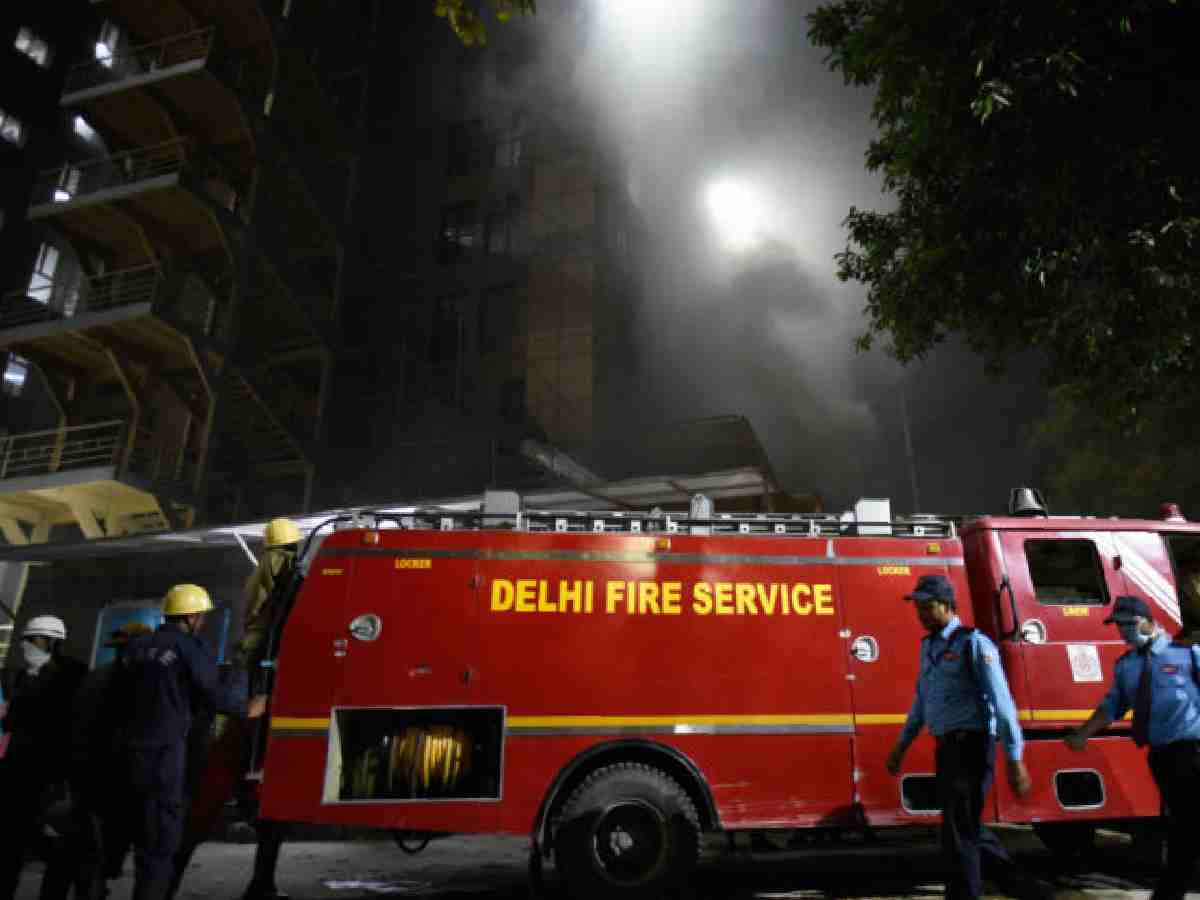
Delhi was brought to a standstill on November 10 after a car bomb exploded near the Red Fort, killing over a dozen people and causing widespread devastation. Although investigations later confirmed it was a planned terror attack, the initial assumption pointed to a CNG or LPG cylinder blast, with shoppers and shopkeepers in the area suspecting the same.
Cylinder blasts are common across the national capital. These often lead to extremely widespread devastation, amounting to people’s homes being razed to the ground or, worse yet, leaving a flurry of bodies in their wake. According to estimates from the Delhi Fire Services’ Online Fire Report portal, there have been nearly 200 instances of cylinder blasts this year itself, till November 18.
To put matters into perspective, from April 1 to September 17 this year alone, the city had reported 17,905 fire-related calls. Compared to the previous year, 36,568 calls were recorded across the entire 2024–25 financial year.
While the share of cylinder-related fires is negligible, the devastation left in its wake is undeniable. Surprisingly, many of these cylinder-blast-related fires fell under the ambit of Rohini Sector 16 and Sector 5 fire stations. Within a space of six months, from June 1 to November 18, there have been six cylinder blasts under Sector 16 itself. Thus, on average, there has been at least one cylinder blast every month. Successively, what can be perceived is the prevalence of such blasts occurring along the JJ clusters of Shahbad Dairy.
The cylindrical plight of Shahbad Dairy
On July 16, a situation unfolded at Shahbad Dairy, which led to two women and a child being injured. This led to them being shifted to the nearby Ambedkar Hospital. According to the DFS, the situation was caused by the LPG cylinder catching fire inside the quarters at the JJ cluster. This led to a massive blast, whereupon the firefighting mission lasted for almost two hours in the night.
Not just residential areas, but also industrial areas have been facing a significant brunt in the form of such mishaps. For example, on August 19, a fire broke out in a powder-coating factory at Prahladpur for iron parts such as bicycle frames and LPG gas burners, on the ground floor of the premises. Two women sustained injuries and were rushed to Maharshi Valmiki Hospital by members of the public. It took almost two hours for the firefighting personnel to douse the blaze.
However, these instances are more usual in residential areas. Shahbad Dairy’s JJ Cluster remains a usual suspect in these instances. On October 11 itself, another blast was reported in the area, which led to the entire area being razed to the ground. The fire was doused within the space of an hour, without any casualties being reported.
“The high population density, particularly in slum areas and in densely built or tightly packed parts of the city, makes it difficult for large fire engines to manoeuvre and reach the scene. Because of these challenges, average response times increase, and small fires can develop into major blazes, requiring far more personnel and equipment and greatly raising the risk of property damage and loss of life,” a government official said.
Murder through LPG
Earlier in October, the Delhi Police had uncovered a chilling murder in Timarpur which a 21-year-old forensic science student attempted to disguise as an accidental fire. The woman, a self-confessed fan of crime shows, allegedly killed her live-in UPSC aspirant partner in revenge after he secretly recorded obscene videos of her and refused to delete them.
In the early hours of October 6, at around 2.50 AM, police received a call about a fire in a fourth-floor flat in Gandhi Vihar. Firefighters discovered a badly charred body, initially treated as an accidental death.
Suspicion arose when CCTV footage showed two people entering the building and only the woman leaving shortly before the blaze. Investigators learned that she, her ex-boyfriend (an LPG distributor), and an associate had strangled and beaten the victim, doused the body with ghee and alcohol, and rigged a gas cylinder to explode. The ex-boyfriend used his professional knowledge to open the regulator and ignite the fire, causing a blast that severely burnt the victim.
The trio fled with the victim’s hard disc, laptops and other items. Police traced them through CCTV, call records and technical surveillance. The woman was arrested in Moradabad, Uttar Pradesh, on October 18, followed by her ex-boyfriend on October 21 and their associate on October 23. A hard disc, a trolley bag, the victim’s shirt and two mobile phones were recovered.
The fact that such methods were used for crimes of passion makes the haphazard nature of safety concerning LPG cylinders all the more lax.
How the DFS is aiming to prevent such accidents
While the presence of more modernised firefighting machinery will be beneficial, the prevalence of cramped localities only makes the situation more difficult — especially since prevention means relocation. According to a fire official, the easiest way to solve such issues is through relocation. “Almost all LPG cylinder blasts are accidental and extremely avoidable. However, the point comes down to the fact that our objective then should be to avoid the spread of the fire to the neighbouring houses. This can only be achieved if something is done about the cramped areas,” he said.
Presently, the Delhi government has identified 24 vulnerable locations that have experienced repeated fire incidents, citing congestion and high population density as the main obstacles to firefighting operations. To address the problem, 24 Quick Response Vehicles (QRVs) are to be deployed at fire stations in the identified areas to ensure a faster emergency response, officials have confirmed.
The vulnerable locations include Hastal Village in Janakpuri, Vishal Garden in Najafgarh, Vikaspuri, Mehrauli, IGNOU Maidan Garhi, Ghitorni Metro Station, Badli Industrial Area, Sant Nagar in Burari, Lajpat Nagar Market, Sonia Vihar, Gandhi Nagar, Paharganj Main Bazaar, Bawana, Rani Bagh Market, Palam Gol Chakkar in Dwarka, and Guru Gobind Singh Government Hospital in Raghubir Nagar, among others.
The Delhi government is deploying Quick Response Vehicles (QRVs) as a key measure to improve fire response in congested areas, at a total cost of Rs 8.61 crore for the first 24 units, including ultra-high-pressure pump systems.
Each QRV is a compact vehicle with a 100-litre water tank, delivering 21 litres per minute, and equipped with water mist, foam and high-pressure jets to tackle various fires rapidly.
Officials said the QRVs will reach incidents faster and contain small fires before larger fire engines are required, addressing delays caused by traffic and narrow lanes. Initial funding was not budgeted, but the government later allocated the necessary amount.
Families displaced by the Seemapuri building collapse spend another night on the streets as damaged…
Camera-based enforcement in Delhi generated around 40.6 lakh notices till September, but only about 2…
Delhi government to fast-track Rs 7,000-crore elevated Ring Road project, with two new Yamuna bridges…
Yamuna water quality deteriorated at three locations in Delhi in September, with BOD levels remaining…
Delhi liquor stores will remain shut on October 9 and 10 following police inputs to…
Strike began September 15; ESMA invoked by month-end has barred strikes for six months; drivers…

