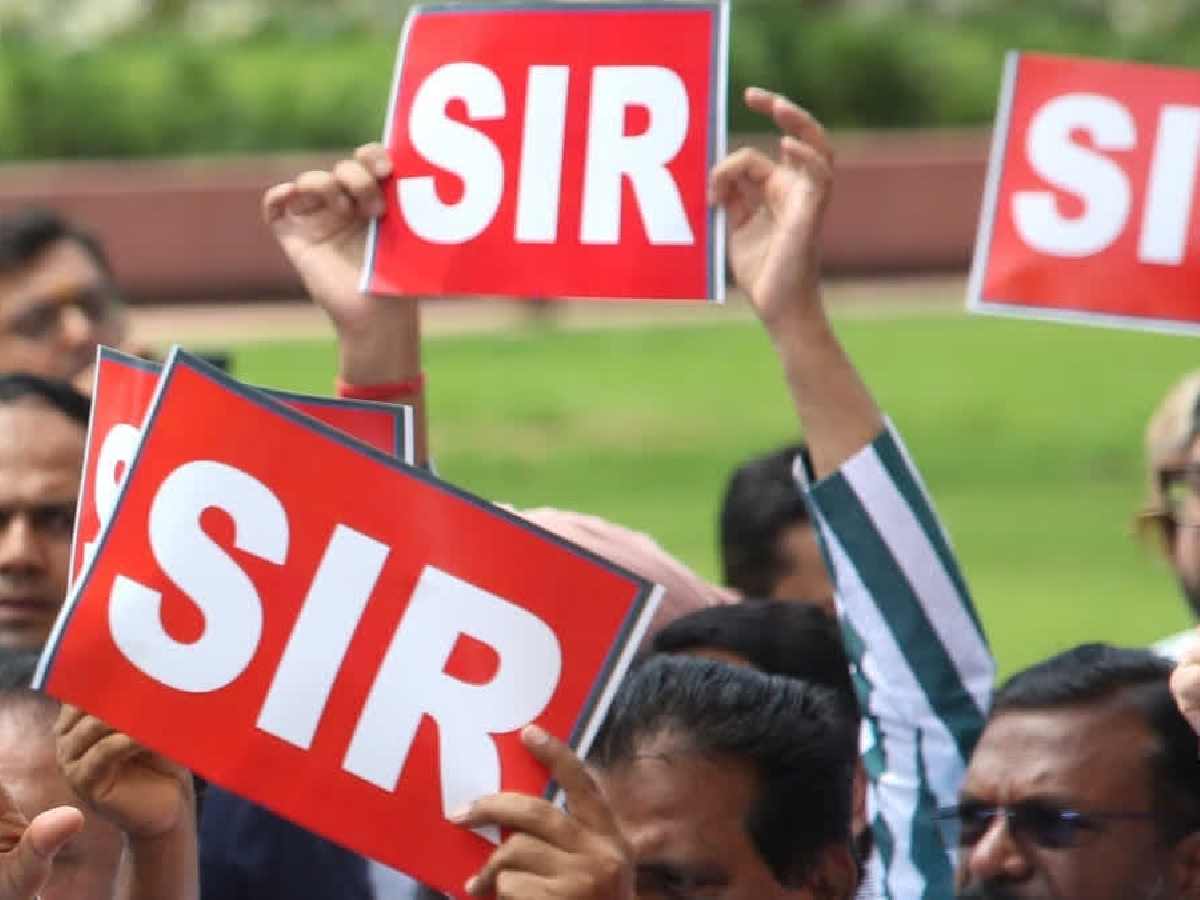
Every day, Nand Kishore waits outside the ration shop in his Pul Prahladpur neighbourhood, hoping to meet the booth-level officer (BLO) assigned to the area.
Kishore, 52, has lived in the unauthorised settlement for more than 25 years and says he has voted for nearly three decades. During the ongoing Special Intensive Revision (SIR), however, his name was marked as “shifted”. He now fears being left out of the draft electoral roll.
“I have to go out to work every day; otherwise, there will be no food on the table for me and my family,” Kishore said.
He said no one was at home whenever the BLO visited for enumeration. His brothers had also returned home to complete the SIR process there.
47 lakh names marked ‘uncollectable’
More than 30% of voters in 47 of Delhi’s 70 Assembly constituencies are likely to be left out of the draft electoral roll scheduled for publication on August 31, 2026, according to constituency-wise data released by the office of the Chief Electoral Officer, Delhi.
Tughlakabad recorded the lowest digitisation rate at 52.15%, leaving nearly 48% of its voters at risk of exclusion from the draft roll.
Across Delhi, more than 47 lakh of the city’s 1.45 crore voters, roughly one in three, are set to be left out after their enumeration forms were classified as “uncollectable”. The category includes voters whose forms were not submitted and those marked absent, shifted, dead or duplicate.
The door-to-door verification exercise began on June 30, 2026, and concluded on August 17, 2026. Booth-level officers distributed enumeration forms during the exercise, of which more than 67% were subsequently submitted and digitised through the Election Commission’s SIR mobile application.
Only two constituencies crossed the 80% digitisation mark: Rohini at 83.43% and Shakur Basti at 81.26%. This means roughly one in five voters in each constituency is still likely to be left out of the draft roll.
Overall, 13 constituencies are expected to record exclusion rates of between 40% and 50%. Another 34 are likely to record rates of between 30% and 40%, while 21 could see between 20% and 30% of their voters left out.
No clear demographic divide
Several relatively affluent constituencies recorded high rates of potential exclusion. The proportion stood at 44.46% in RK Puram, 41.76% in New Delhi, 38.64% in Malviya Nagar and 35% in Greater Kailash.
South and southeast Delhi recorded some of the lowest digitisation rates, including Okhla at 54.67%, RK Puram at 55.54% and Kasturba Nagar at 55.97%.
The pattern, however, does not follow a clear economic or demographic divide. Several constituencies with unauthorised colonies, resettlement areas and densely populated low-income settlements recorded comparatively higher digitisation rates. These included Kirari at 68.98%, Sultan Pur Majra at 68.93% and Karawal Nagar at 67.19%.
Among constituencies with large minority populations, Okhla stood out, with around 45% of voters marked “uncollectable”. Other such constituencies recorded lower exclusion rates, including Seelampur at 23.37%, Matia Mahal at 24.5%, Babarpur at 27%, Mustafabad at 28%, Ballimaran at 32.65% and Chandni Chowk at 38.98%.
Residents seek answers
Since learning that he had been marked “shifted”, Kishore has visited the BLO’s office several times to have his name restored to the electoral roll.
“They have marked me as ‘shifted’ in the list,” he said, adding that he still lived at the same address.
Kishore said he had been asked to submit Form 6 again. Since his father’s death, his uncle is the only relative whose name appears on the electoral roll. However, the BLO told him that his uncle’s entry on the roll could not be used to verify Kishore’s address or eligibility to vote.
In Okhla, some residents who submitted their forms online remain unsure whether their names have been included.
Rajesh Devi, 60, a resident of Harkesh Nagar, said the BLO had visited the area to distribute the forms but did not return.
“The BLO initially came to distribute the forms,” she said.
Devi said her grandson had told her that the form could be digitised online and submitted it for her. However, neither she nor her family knew whether their names had been included in the roll.
Officials cite relocation and deaths
Tughlakabad BLO Anwar Ali said many voters whose details had not been digitised had either moved or died.
“During our visits, we found that a considerable number of voters had moved from their registered addresses,” Ali said.
He added that, in some cases, voters had died recently and their names had consequently been removed from the electoral rolls.
In the New Delhi Assembly constituency, where the digitisation rate was comparatively low, election officials said they had expected a substantial number of voters to be marked “uncollectable”.
New Delhi Electoral Registration Officer and Sub-Divisional Magistrate Piyush Mohanty said officials had expected the digitisation rate to be low because the constituency comprised mainly Central government employees.
“There are a lot of transfers that keep happening,” Mohanty said.
He added that employees often did not inform election officials before leaving their registered addresses.
At the same time, residents of Bhai Ram Camp, DID Camp and Masjid Camp, located near the Prime Minister’s residence, are being relocated to a Delhi Urban Shelter Improvement Board resettlement colony in Savda Ghevra, Outer Delhi.
Notices from August 31
According to an August 25, 2026, report by The Indian Express, nearly 33 lakh electors whose names are expected to appear in the draft roll could be served notices from August 31, 2026, requiring them to establish their eligibility.
Those receiving notices may be asked to furnish one of the 13 documents listed by the Election Commission, including a birth certificate, passport, caste certificate or permanent residence certificate.
The notice period and the disposal of claims and objections will continue until October 29, 2026. The final electoral roll is scheduled to be published on November 4, 2026.
The Supreme Court will hear a plea on Sunday seeking contempt action against authorities for…
Over 7,000 protesters, including CJP chief Abhijit Dipke, were detained as security forces sealed off…
Mamata Banerjee called Delhi’s crackdown “beyond Emergency” after being detained during a protest against Gyanesh…
From kuttu ki poori and sabudana to paneer and festive desserts, these restaurants have put…
Sonam Wangchuk condemned the arrests of student and youth leaders in Delhi, calling the situation…
Court said Sharjeel Imam apparently violated bail conditions by contacting media but refused to cancel…

