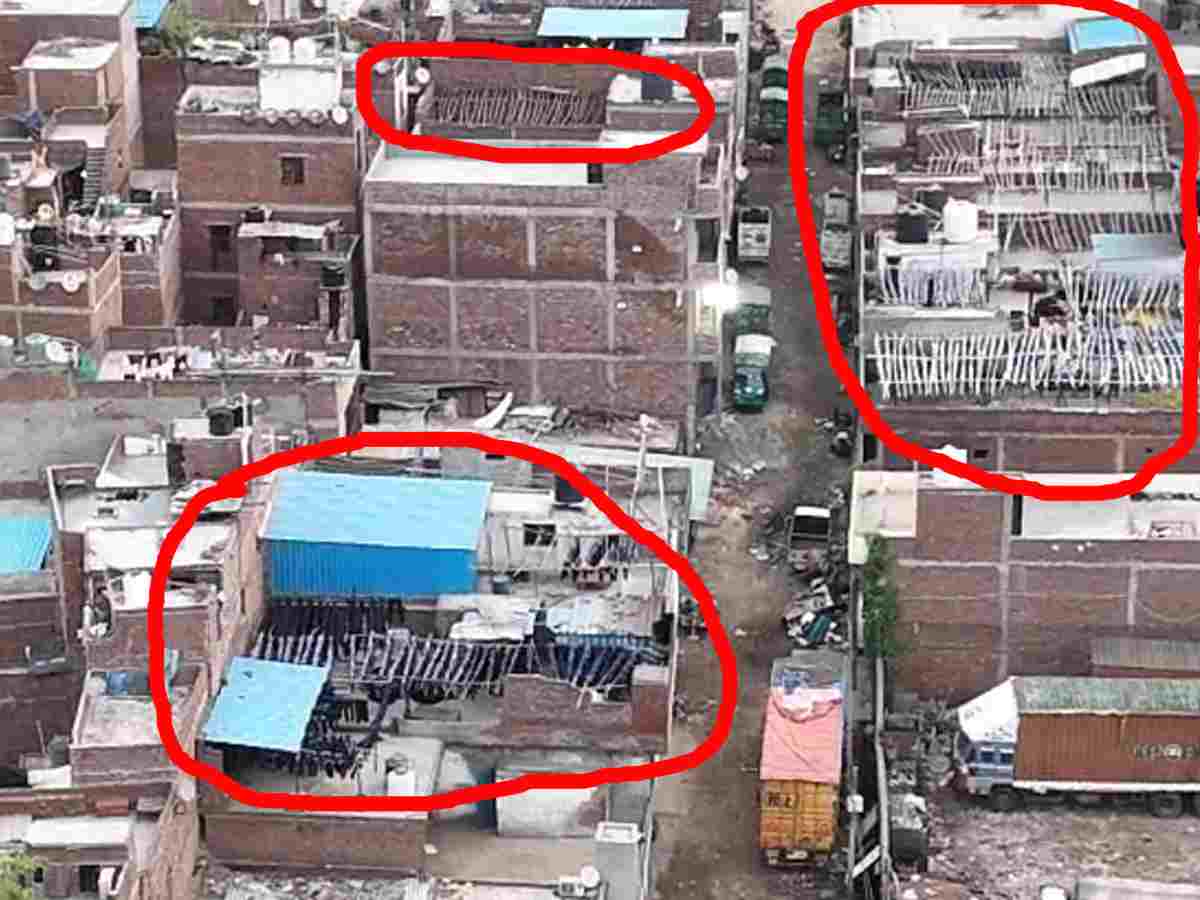
Drone footage of Shaheed Nagar, Ghaziabad unearths multiple ‘illegal’ dyeing units
Delhi NCR: More than 800 ‘illegal’ dyeing factories are operating across the National Capital Region (NCR), discharging industrial effluents directly into stormwater drains that ultimately empty into the Yamuna River. The river has remained in the headlines for the past six months due to its rising pollution levels.
8,000 lakh litres of groundwater contaminated daily
Ghaziabad, Noida, and Greater Noida have emerged as hubs for these unauthorised dyeing units. Each unit uses an estimated 10 lakh litres of groundwater daily—without permission from relevant authorities—leading to both alarming depletion and contamination of groundwater resources. Nearly 8,000 lakh litres of groundwater are polluted each day, environmentalist Varun Gulati claimed, adding that authorities have “turned a blind eye” to these operations.
“Despite multiple complaints,” he said, “the authorities seem to have passed the buck to one another over the issue instead of taking stern action against these industries.”
Patriot had reported on March 10, 2025, that 500 such units were polluting the Yamuna River and depleting groundwater in Delhi. Following that report, some action was initiated by the concerned agencies—but the problem has only grown since.
Also read: Around 21% of Delhi auditoriums running sans fire safety clearance: DFS
Streets turn blue, rooftops dry dyed fabric
Patriot visited several localities where these factories continue to operate, including Vijay Vihar, Sabhapur, Bhopura, Shaheed Nagar, Noida Sector 121, Asgarpur, and Baraula.
In these areas, drains have turned visibly blue due to the direct discharge of chemical-laden wastewater. Drone footage revealed that many house terraces are used to dry dyed fabrics, hinting at widespread informal operations.
Anil Kumar, a resident of Shaheed Nagar in Ghaziabad, said that during the monsoon, the drain water overflows onto the streets. He added that locals had tried confronting factory owners directly, but those who raised their voice were often threatened.
Noida and Ghaziabad at the heart of toxic operations
According to Gulati, at least eight such units operate in Noida Sector 121 and Haibatpur, and 11 more in Asgarpur and Noida Sector 128. The locality behind Ace City in Greater Noida has over six units, while Noida Sector 49 and Baraula together host another 12.
Rajesh Kumar, 42, a resident of Asgarpur, recalled that he never imagined the village drains would turn into “toxic streams.” He described how chemical-laced water from these dyeing units flows past homes, staining the streets red, blue, and yellow. “But this isn’t Holi,” he said, “this is poison.”
He noted that his children had started developing skin allergies, and their doctor attributed it to exposure to contaminated water. Despite repeated complaints, he said, no action had been taken. “The units keep operating at night and dump their waste openly. We feel abandoned, as if our lives don’t matter.”
Meena Devi, 36, a homemaker from Baraula, said the coloured sludge reaches her doorstep every morning. “The smell of chemicals hits us like a punch in the gut,” she said. She no longer allows her children to play outside, and even boiled water turns murky. Weeks of skin rashes, according to the local clinic, are due to chemical exposure. “These illegal factories operate right under the nose of the authorities,” she added. “Why must we live in such filth while others profit from our suffering?”
No effluent treatment in most areas
Despite the industrial scale of dyeing in Noida and Greater Noida, not a single Common Effluent Treatment Plant (CETP) has been installed at any of these locations.
In Ghaziabad, Vijay Vihar and Sabhapur alone host nearly 100 such units. The Uttar Pradesh Pollution Control Board (UPPCB) has allowed dyeing units in Roopnagar and Aryanagar to operate only on the condition that each installs an Effluent Treatment Plant (ETP).
While ETPs have indeed been installed, contaminated water continues to flow freely through drains and streets in these areas, raising questions about the effectiveness of these systems.
Gulati argued that these ETPs are merely “an eyewash” to get official approval. “If all the units have their own ETPs installed and operational, then why is the water still flowing in the drains?” he asked. “If residents can identify this pollution, why can’t the officials?”
Tronica City, another hotspot in Ghaziabad, has around 100 dyeing units and even boasts a dedicated CETP. Yet, effluents still flood the streets and drains, suggesting the CETP is not functioning effectively. Gulati claimed the plant is “non-functional,” which has resulted in widespread contamination.
In Bhopura and Shaheed Nagar, 70 and 20 such factories are operational respectively, he added.
Experts urge urgent action
Environmental experts say urgent, meaningful intervention is needed.
Bhim Singh Rawat, Associate Coordinator at the South Asia Network on Dams, Rivers & People (SANDRP), said that hundreds of grossly polluting industrial units have sprung up in neighbouring districts without the necessary permissions. These units, he noted, draw groundwater illegally and discharge untreated toxic waste into drains feeding the Yamuna and Hindon rivers. “It’s a million-dollar question how these industries came into existence in the first place,” he said.
Rawat was also critical of state and central pollution control boards, saying they had failed to stop the problem early. “Occasionally they pretend to act—some raids, some fines—and then forget the issue altogether,” he said. “Despite multiple complaints and judicial orders, the problem has only worsened, pointing to a systematic failure.”
He also highlighted the government’s unregulated and unsustainable approach to industrial development. “Polluting industries are functioning in residential areas and on farmland, away from designated zones,” he said. “Most lack functioning effluent treatment plants (ETPs), and even in industrial zones, many units aren’t connected to CETPs. Several CETPs do not work as per norms—a problem seen in Sewage Treatment Plants (STPs) too.”
Rawat called the situation a textbook case of “putting the cart before the horse,” resulting in routine violations of the Water Pollution Act. He warned that while rivers can handle some organic waste, chemical effluents destroy their self-cleansing ability.
“The remarkable improvement in the Yamuna’s health during the Covid lockdown, when industrial activities were shut and rainfall increased river flow, proved this,” he said. “Given the environmental cost of industrial effluents, the government must implement the zero-liquid-discharge policy on the ground and take decisive action against grossly polluting industries.”
No response from UPPCB
The regional offices of the UPPCB in Ghaziabad and Noida did not respond to Patriot’s request for comment. The online version of the story will be updated as and when Patriot receives their response.
Delhi-NCR cafés embrace autumn with pumpkin spice, cinnamon, cardamom and chocolate blends, offering cosy seasonal…
A major fire at a bed-and-breakfast establishment in Hauz Rani on June 3 also claimed…
The issue has come into focus following the collapse of a five-storey building in south…
The government would facilitate redevelopment of DU hostels by providing increased FAR and expediting approval…
A case of murder and destruction of evidence was registered at Farsh Bazar police station…
Gardener electrocuted while pruning trees at Delhi University’s (DU) South Campus; family demands action against…
