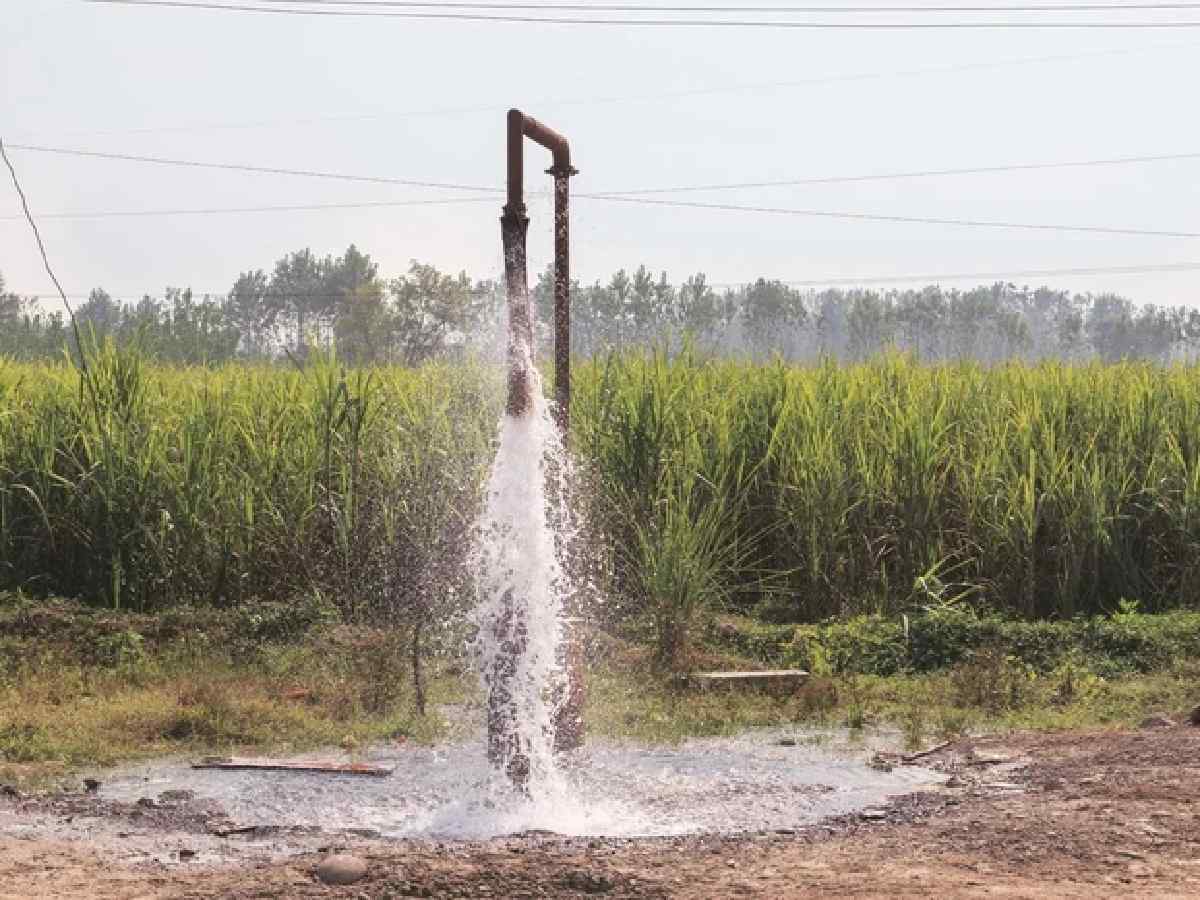
The capital of India is facing an invisible catastrophe. While much of the public discourse surrounding Delhi’s environmental health focuses on seasonal “smog” and air quality indices, a more permanent and potentially more insidious threat is brewing beneath the pavement.
Recent reports from the Central Ground Water Board (CGWB) and insights from leading medical experts paint a grim picture of Delhi’s groundwater — a cocktail of salinity, heavy metals and radioactive elements that poses a generational threat to public health.
Uranium levels in Delhi’s groundwater have surged, placing the capital third in the country after Punjab and Haryana for the proportion of contaminated samples. The CGWB’s latest Annual Ground Water Quality Report 2025 reveals that between 13% and 15% of samples tested in Delhi contain uranium levels exceeding the permissible safety limit of 30 parts per billion (ppb). The finding has raised serious concerns about the safety of drinking water and the long-term risks to public health.
The salinity surge: A system in distress
Groundwater health is often measured by electrical conductivity (EC), an indicator of the concentration of dissolved salts and minerals. Under standard safety guidelines, water with an EC exceeding 3,000 µS/cm is considered unfit for human consumption and harmful to agriculture. In Delhi, the statistics are stark: one in every three groundwater samples now crosses this threshold.
Associate Director of Internal Medicine Dr Tushar Tayal of CK Birla Hospital, Gurugram, notes that Delhi’s groundwater salinity is now four times the national average. He explains that this is not a natural geological phenomenon but a direct outcome of over-extraction.
When groundwater is pumped out faster than it can be replenished through rainfall, the water table drops. As water volume declines, the minerals left behind become increasingly concentrated. Over-pumping also creates a vacuum that draws in wastewater and industrial runoff, further contaminating remaining reserves.
The human and economic cost of salt
The health consequences of consuming high-salinity water are severe. Dr Tayal warns that chronic intake places sustained stress on the kidneys, which must work overtime to filter excess minerals, and is a significant contributor to hypertension.
Beyond health, high salt content acts as an “economic corrosive”, damaging household plumbing and industrial machinery. Consultant and HOD of the Emergency Department Dr Goma Bali Bajaj of Fortis Hospital, Greater Noida, adds that saline groundwater also accelerates soil degradation. Reduced crop yields directly threaten food security and the livelihoods of those dependent on agriculture.
The radioactive threat: Uranium contamination
Perhaps the most alarming aspect of recent findings is the presence of uranium in Delhi’s groundwater. While uranium occurs naturally in the earth’s crust, it becomes a public health hazard when high concentrations leach into water supplies as groundwater levels decline.
According to Dr Tayal, uranium functions primarily as a chemical toxin rather than only as a radiation risk. Its main target is the kidney’s filtration system. Prolonged exposure can result in chronic kidney damage and negatively affect bone health, as the body may incorporate uranium into the bone matrix.
For vulnerable groups — particularly pregnant women and children — the risks are significantly higher. The presence of uranium alongside elevated nitrates and fluorides suggests that Delhi’s aquifers may be approaching a “tipping point” of ecological collapse.
Manganese and the developing brain
While salinity and uranium damage vital organs, manganese contamination in untreated groundwater directly affects the nervous system. Director and HOD of Neurology Dr Vinit Banga of Fortis Escorts Hospital, Faridabad, warns that manganese is particularly harmful to infants and young children whose nervous systems are still developing.
The neurological impact on children
Infants are biologically more vulnerable to manganese toxicity. Unlike adults, they absorb the element more readily through the gastrointestinal tract while lacking mature mechanisms to eliminate the excess. This results in dangerous accumulation in the brain during critical developmental stages.
High manganese levels interfere with neural pathway formation, leading to measurable cognitive deficits such as lower intelligence quotient scores and memory impairments that can hinder educational progress. Behavioural and physical development may also be disrupted. Chronic exposure has been linked to attention disorders and impulsivity, producing symptoms that closely resemble ADHD.
On a physical level, nervous system disruption often leads to delayed growth milestones. Children may experience impaired motor coordination and speech delays. In adults, prolonged exposure can manifest as “Parkinsonism-like” symptoms, including tremors and muscle stiffness.
Mitigation and protection: What can be done?
Dr Bajaj stresses the urgent need for sustainable groundwater management, including large-scale rainwater harvesting, revival of local lakes and ponds, and stricter regulation of borewell usage to prevent irreversible damage.
At the household level, Dr Banga outlines several immediate precautions for families dependent on untreated groundwater.
Household safety measures and protective actions
For households relying on borewell water, vigilance is the first line of defence. Water quality cannot be judged by appearance or smell; clear water may still contain dangerous mineral concentrations. Professional laboratory testing from a certified facility is essential to identify specific heavy metals.
If contamination is confirmed, boiling water is not a solution. Boiling evaporates water but leaves heavy metals behind, effectively increasing their concentration. Instead, households should invest in advanced filtration systems such as reverse osmosis or ion-exchange units rated for the removal of manganese and other toxins.
Special care is required for infant nutrition. Only purified water should be used to prepare infant formula to prevent early-life exposure. Dr Banga also recommends a simple daily practice: running taps for several minutes each morning to “flush” out stagnant water that may have absorbed additional minerals from pipes overnight, reducing exposure risks in daily use.
Elected to the Delhi Golf Club general committee, Mansher Singh says he wants to build…
A $780 million market built on pavements, where the pleasure of reading meets the price…
Supreme Court advocate Abhishek Pawar alleges women were denied washroom access for seven to eight…
Each day of closure costs shops in Khan Market and Connaught Place between Rs 60,000…
Delhi generates nearly 15,000 tonnes of waste daily, prompting the government to deploy 1,000 mechanical…
Delhi Police has issued an NOC for the Congress rally at Ramlila Maidan on November…
