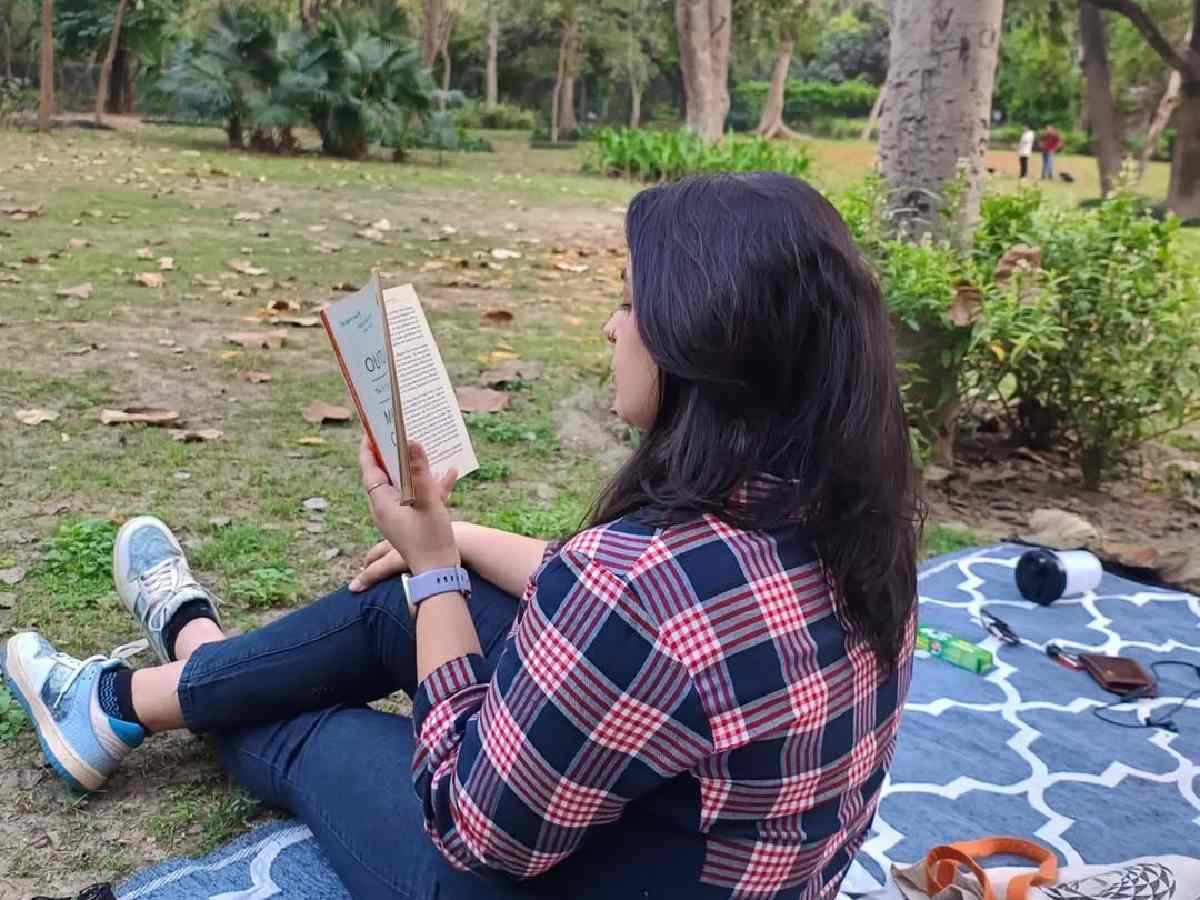
In the heart of Connaught Place, where traffic coils endlessly around its colonial-era circles, a quieter world unfolds above the Rajiv Chowk Metro station. Here, on a sunlit bench in Central Park, retired teacher Rajeev Saxena reads with unbroken focus. With winter settling gently over the capital, he leaves home in Preet Vihar around 11.30 AM, rides the Metro to Rajiv Chowk, climbs into the open lawns and begins his daily ritual.
“It gives me immense joy to read books here with the fragrance of flowers all around. At the moment, I’m reading Diwan-e-Ghalib and Maha Kumbha by Anup Haldar. Both are wonderful books — Maha Kumbha has breathtaking pictures too,” says Saxena.
Saxena is one of many who have quietly transformed Delhi’s parks into reading sanctuaries — green rooms where the sun replaces bulbs and the bustle of the city pauses at the gate.
A quiet tribe in Central Park
Central Park in Connaught Place has long been a refuge for these solitary book lovers. Tucked amid flower beds and trimmed lawns, readers sit undisturbed as the city thunders around them. It is a gentle resistance to digital fatigue — a choice to disconnect from screens and reconnect with stories.
Nearby, Buddha Jayanti Park offers a different kind of retreat — more secluded, more meditative. Situated near New Rajinder Nagar, the 42-acre expanse feels distant from the chaos of Delhi despite being minutes away from it.
Punjabi poet Dr Harmeet Singh sits under a wide banyan tree, rereading The God of Small Things for the third time. “Here, the sun warms my back and the words come alive. It’s as if the park breathes life into the story,” he says. He has been visiting the park for years. “Yes, fewer bookworms come now, but our small tribe still survives. About ten of us read here regularly — some of them are young and come on weekends or holidays.”
Also Read: Delhi sees sharp rise in suicides as Vasant Vihar death adds to mounting concerns
Buddha Jayanti Park’s long reading legacy
A short walk away, retired central government officer S.K. Kapoor is lost in Salman Rushdie’s Midnight’s Children. He recently finished a biography of Dr Ram Manohar Lohia by Pravin Malhotra.
“Delhi’s winters are perfect for reading,” he explains. “The sunlight is inviting, not harsh. I come here to disconnect from the news cycle. Books remind me that history isn’t just headlines.”
Most regulars at Buddha Jayanti Park live in nearby New and Old Rajinder Nagar, Karol Bagh and Patel Nagar — neighbourhoods where generations have embraced relaxed public spaces.
Established in 1957 to mark the 2,500th anniversary of Buddha’s nirvana, the park’s lotus ponds, bamboo groves and gentle slopes naturally encourage solitude. Retirees browse spiritual texts, students revise under trees, and families read aloud to children. It is a rare corner of Delhi where time slows down.
Under one such tree, Aisha Khan, a student from Jamia Millia Islamia, reads The Palace of Illusions by Chitra Banerjee Divakaruni. “Mythology under a tree feels mythical itself,” she says. “The sunlight dancing on the pages makes it magical.”
Connaught Place: reading amid the bustle
By contrast, Central Park thrives on energy. Encircled by the white colonnades of CP, it mirrors the city’s rhythm — brisk, vibrant and unpredictable. On a sunny bench overlooking Palika Bazaar, 62-year-old retired banker Vijay Mehta flips through a poetry collection.
“This place is alive,” he says, gesturing to tourists taking selfies and office staff on lunch breaks. “Reading amid the bustle sharpens my focus. The sun keeps me alert, unlike dim library lights.”
The park’s accessibility has made it a crossroads of solitude and society. Groups of friends sometimes form impromptu reading circles, debating characters and plots over cups of masala tea.
Why parks matter
In a city where air quality routinely dips into “poor” levels, parks remain Delhi’s green lungs. For readers, the mix of sunshine, fresh air and literature offers a restorative escape.
“Outdoor reading in the sun is good for your health. It’s therapeutic — especially in a high-stress metropolis like Delhi,” says Dr Anup Dhir of Apollo Hospital. “Even I spend time in the park reading a book.”
As winter unfolds, these open-air readers — young students, retirees, poets, office workers — continue to gather silently across Delhi’s parks, turning public spaces into personal sanctuaries.
An FIR over Jamia protests alleges Congress MPs Imran Pratapgarhi and Imran Masood unlawfully entered…
Delhi's 'Namo Yamuna River Safari' cruise will launch before Chhath, offering 40-minute family trips between…
Delhi's Old RTR flyover reopens for light vehicles today after repair work following road cracks,…
Visits to Govindpuri, Jangpura, Saket and Mayur Vihar show unlabelled corrosive substances sold for Rs…
Rescue teams recovered two bodies from the debris of a collapsed under-construction house in northeast…
Built on Jawaharlal Nehru’s vision, the Delhi landmark has witnessed the evolution of a young…

