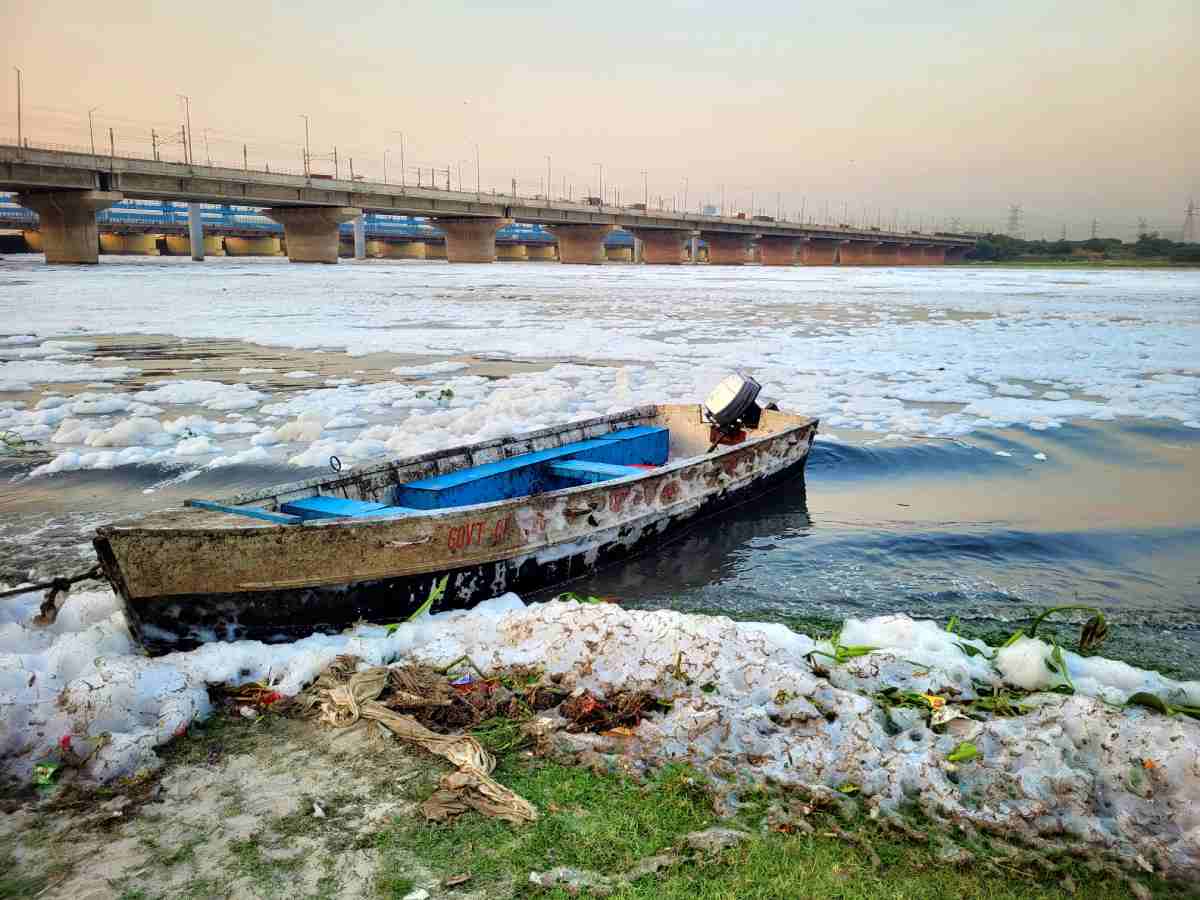
Photo: Umar Dar
As the Delhi government renews efforts to clean the Yamuna, a new report released on Thursday by the Centre for Science and Environment (CSE) has urged a fundamental shift in approach, warning that the continued mixing of treated and untreated wastewater in drains is undermining progress.
The analysis highlights a critical gap in the city’s wastewater management: the improper disposal of faecal sludge from areas without sewer connections. CSE director general Sunita Narain stressed that septic tank waste collected by private tankers must not be dumped into open drains or the river. Instead, all sludge tankers should be fitted with GPS trackers to ensure they deliver waste to sewage treatment plants (STPs) for proper treatment and potential reuse.
Narain further recommended that wastewater from unsewered neighbourhoods be treated locally near the river before being discharged.
A major obstacle to effective river-cleaning efforts, she noted, is the absence of accurate data on Delhi’s population. This makes it difficult to assess whether the city’s existing sewage treatment infrastructure is adequate.
A mere 22-kilometre stretch of the Yamuna between Wazirabad and Okhla—less than 2% of the river’s total length—carries a staggering 80% of its pollution load. This is largely due to the inflow of untreated sewage from unauthorised colonies and slum clusters, as well as subpar output from both STPs and common effluent treatment plants (CETPs).
According to the Delhi Pollution Control Committee (DPCC), the city generates 3,600 million litres per day (MLD) of sewage. While the 37 STPs across the capital have a combined capacity of 3,474 MLD, only 2,777 MLD is currently being treated—about 80% of their capacity. Of this, merely 1,960 MLD meets the required effluent quality norms for biological oxygen demand (BOD) and total suspended solids (TSS), both of which should be below 10 mg/litre.
Also Read: Yamuna boating plan: Next big tourism hub or an ecological disaster?
Between 2017 and 2022, the Delhi government spent over ₹6,856 crore on initiatives aimed at cleaning the Yamuna. Yet the river remains heavily polluted. “Money alone is not enough,” Narain said. “What we need is a new and effective plan.”
She argued that in unsewered areas, managing faecal sludge through tankers is not only quicker but also more cost-effective than laying down new sewer lines. Additionally, Narain urged that STP standards should prioritise water reuse. She warned that pushing for stricter discharge norms without considering reuse potential could delay progress due to the high costs of plant upgrades.
The report also called for urgent, revised plans for the Najafgarh and Shahdara drains, which together contribute 84% of the Yamuna’s pollution load within Delhi.
(With inputs from PTI)
Families displaced by the Seemapuri building collapse spend another night on the streets as damaged…
Camera-based enforcement in Delhi generated around 40.6 lakh notices till September, but only about 2…
Delhi government to fast-track Rs 7,000-crore elevated Ring Road project, with two new Yamuna bridges…
Yamuna water quality deteriorated at three locations in Delhi in September, with BOD levels remaining…
Delhi liquor stores will remain shut on October 9 and 10 following police inputs to…
Strike began September 15; ESMA invoked by month-end has barred strikes for six months; drivers…
