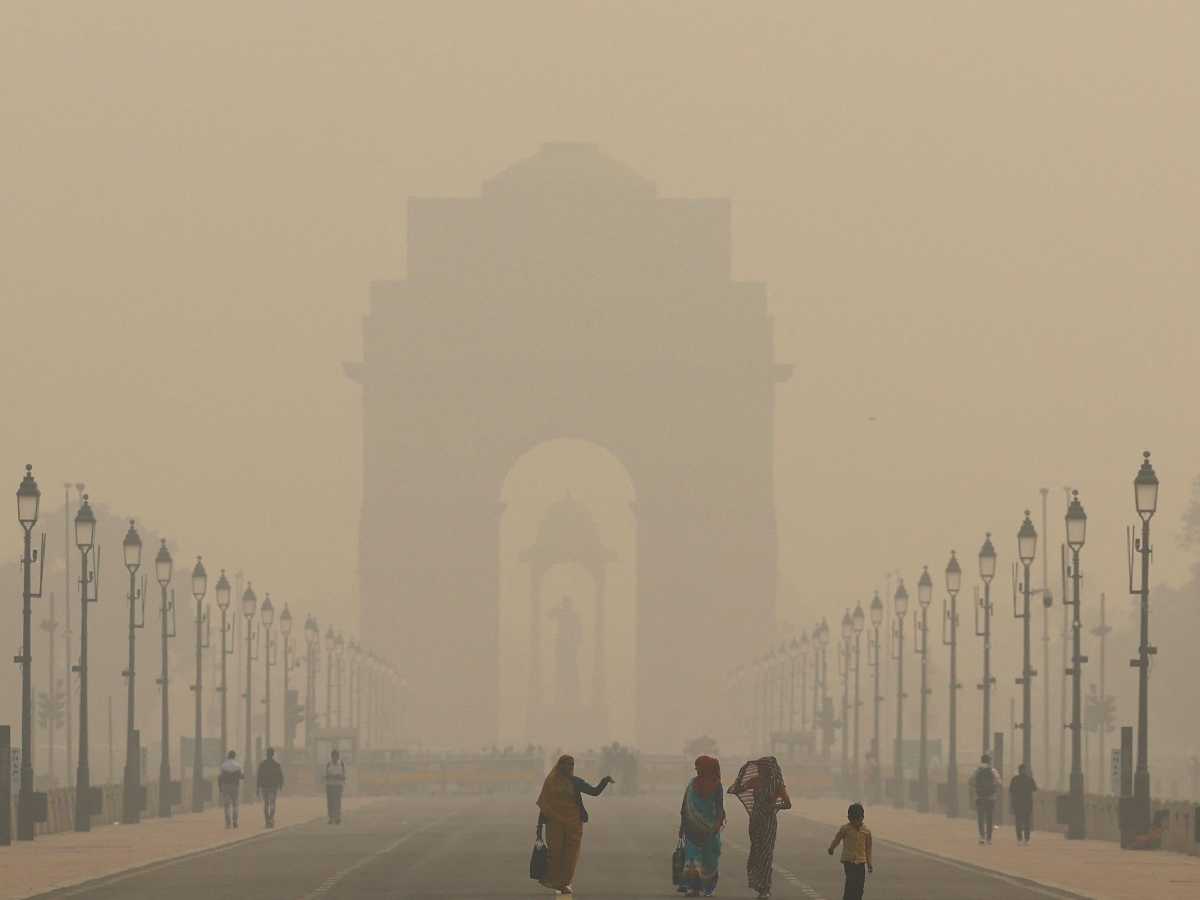
Air quality in Delhi plunged into the severe category for the first time this season on Friday morning, with the national capital recording an average AQI of 403.
The Air Quality Index stood at 403 at 6.05 am and remained at the same level at 8 am and 9 am, according to the Central Pollution Control Board’s (CPCB) Sameer app, which provides hourly updates on air quality. The city’s overall 24-hour average AQI for the day will be recorded at 4 pm.
Of the 58 monitoring stations that recorded data at 8 am, 33 were in the severe category, 24 in very poor and one in the moderate category.
IIT Delhi recorded the worst air quality with an AQI of 488, followed by Chandni Chowk at 479 and North Campus of Delhi University at 478.
Burari Crossing recorded an AQI of 456, while both ITO and Jawaharlal Nehru University stood at 451.
Other areas in the severe category included Jahangirpuri at 430, Wazirpur at 427, Anand Vihar at 419, Rohini at 413, IGI Airport (T3) at 403 and Tikri Kalan at 402.
At 6.05 am, IIT Delhi recorded an AQI of 487, while North Campus and Chandni Chowk recorded 476 each. Pusa recorded 468 and NSUT Jaffarpur 461.
The thick blanket of smog reduced visibility in several parts of the city.
According to the CPCB, an AQI between zero and 50 is classified as ‘good’, 51 and 100 as ‘satisfactory’, 101 and 200 as ‘moderate’, 201 and 300 as ‘poor’, 301 and 400 as ‘very poor’, and 401 and 500 as ‘severe’.
Delhi last recorded a severe air quality day on January 19 this year, when the 24-hour average AQI stood at 410.
The Commission for Air Quality Management (CAQM) had invoked Stage III of the Graded Response Action Plan (GRAP) across the National Capital Region on November 6, under the ‘severe’ air quality category, in anticipation of further deterioration in pollution levels.
Under Stage III, restrictions include a ban on several dust-generating construction and demolition activities across the NCR, closure of stone crushers and mining activities, and curbs on the movement of certain categories of vehicles.
These include restrictions on BS-III petrol and BS-IV diesel or older light motor vehicles in Delhi and high-vehicle-density districts of Gurugram, Faridabad, Sonipat, Ghaziabad and Gautam Buddha Nagar. Restrictions have also been imposed on the entry of certain diesel-operated BS-IV and older goods vehicles into Delhi.
If the city’s 24-hour average AQI crosses 450 and enters the ‘severe plus’ category, Stage IV of GRAP, the highest level of anti-pollution restrictions, is triggered.
The minimum temperature at Safdarjung was recorded at 16.2 degrees Celsius, 2.7 degrees above normal.
Diana Award honourees from Delhi schools developed a ₹140 fan filter to purify classroom air,…
Grade-I heritage building remained largely unused since 2011; conservation assessments and structural warnings went unaddressed
Gold prices drop Rs 2,200 to Rs 1.43 lakh per 10 gm in Delhi for…
A thick haze blankets Delhi as AQI rises to 350, with transport emissions expected to…
Protesting remarks on the 1984 anti-Sikh riots, victims' families and DSGMC members burned Sonia Gandhi's…
Dead fish floating in the Yamuna near Delhi's Sonia Vihar sparked pollution fears, while Minister…
