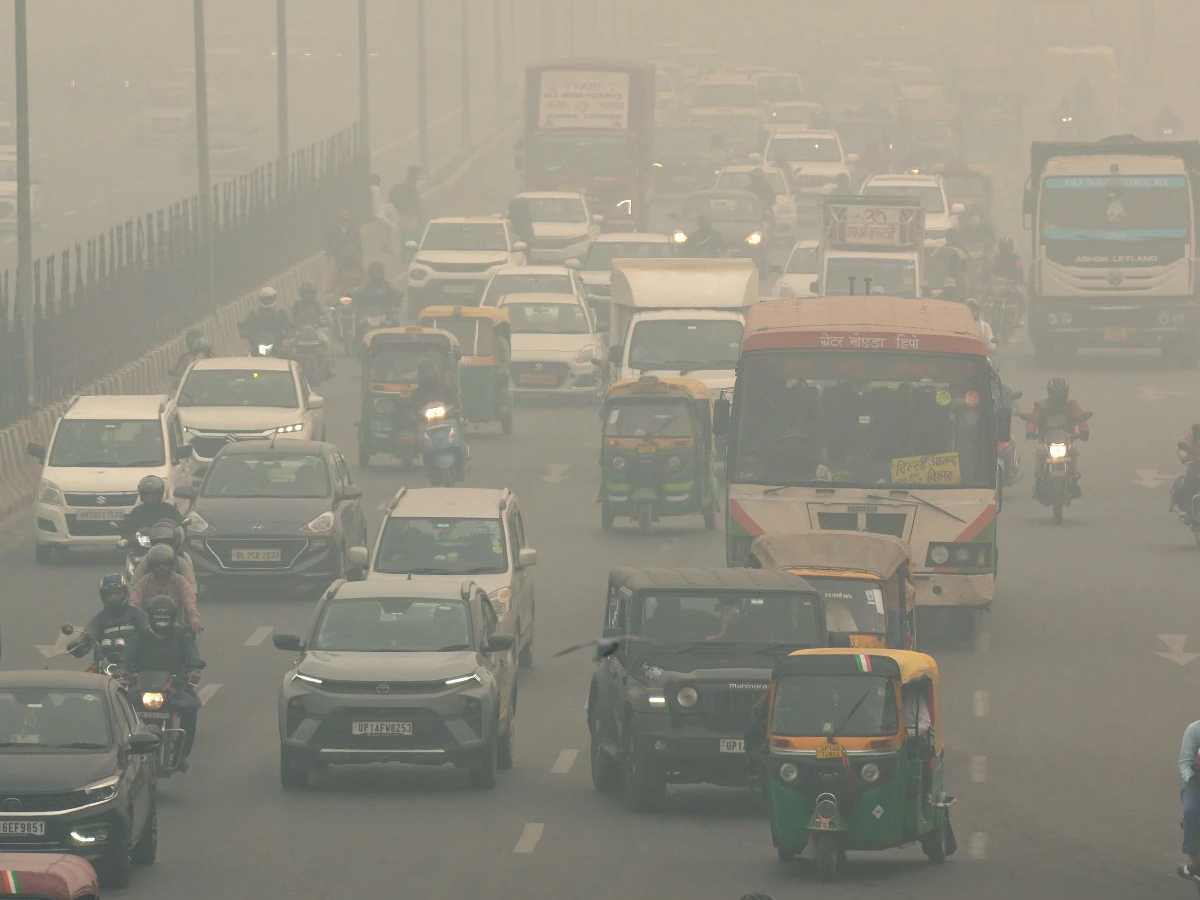
Delhi Pollution: Even as the Capital chokes under a toxic haze and the administration issues repeated advisories to private motorists to keep their Pollution Under Control (PUC) certificates valid, it has emerged that nearly 60% of Delhi government vehicles are plying on the city’s roads without valid PUCs.
According to a reply affidavit that the Delhi government filed in Jitendra Mahajan vs Government of NCT of Delhi before the National Green Tribunal (NGT), over 100 Delhi government vehicles were found plying without valid pollution certificates. The affidavit details such vehicles, the number of government vehicles flagged for expired PUCs, those challaned under the Motor Vehicles Act, and others under process of condemnation or scrapping.
Official fleet under lens
The list in the affidavit also provides registration numbers of Delhi government vehicles with expired pollution certificates — many belonging to departments ironically responsible for enforcing environmental laws and compliance
Of the total 106 vehicles listed, only 30 had valid PUCs, while 60 had expired certificates. Some vehicles termed “valid condemned” or “end-of-life” are still operational. Notices under Section 133 of the Motor Vehicles Act were issued for five such end-of-life vehicles, which are prohibited from being used on public roads.
Transport Department officials admitted in the affidavit that many of these vehicles had been challaned under the Central Motor Vehicle Rules for non-compliance, while others were awaiting scrapping under the vehicle condemnation process.
Also Read: Delhi tops crime charts among metros, vulnerable groups hit hardest
Systemic non-compliance
Nearly 40% of around 31,000 registered non-electric government vehicles in the Capital were running without valid PUC certificates as of June 19, 2025, the Delhi Transport Department has admitted before the NGT.
The startling data, submitted to the tribunal on September 22, shows that only 14,569 government vehicles had valid PUC certificates, while the department had no information on 4,027 others — raising serious questions about compliance within the government machinery itself.
The figures reveal that out of 31,000 registered government vehicles in Delhi, more than 12,000 lacked valid pollution certificates as of mid-June. This means that while citizens face heavy fines and vehicle impoundment for expired PUCs, thousands of official vehicles continue to operate unchecked.
The Transport Department, which itself enforces vehicle emission standards and runs PUC centres across the city, acknowledged the lapse in its affidavit filed in Jitendra Mahajan vs Delhi Government before the NGT.
According to the department, the penalty for an expired PUC certificate is Rs 10,000, while the annual renewal fee is just Rs 110 for four-wheelers and Rs 80 for two-wheelers. Delhi currently has over 950 PUC testing centres, most located at fuel stations.
“This is not about lack of infrastructure,” said a senior official aware of the matter. “The issue is sheer negligence within departments — no one is held accountable when government vehicles skip pollution checks.”
Adding to the smog
An affidavit issued by the Commission for Air Quality Management (CAQM) in April 2025 expressed serious concern over the “large fleet of end-of-life (EoL) vehicles still plying in Delhi-NCR” despite repeated orders from the Supreme Court and NGT.
According to the Commission’s data, over 6.1 million overaged vehicles were identified across NCR, of which Delhi alone accounted for more than 27.5 lakh. However, the progress in impounding and scrapping such vehicles has been “limited,” the Commission noted, calling for “intensified on-road drives” and “technological intervention.”
Cameras at fuel stations
To address the rampant issue, the Delhi government piloted a technological solution — installing Automated Number Plate Recognition (ANPR) cameras at 520 fuel stations across the city. These cameras are integrated with the national VAHAN database, automatically flagging vehicles without valid PUCs or those classified as end-of-life.
“When such vehicles enter a fuel station, the system triggers an audio warning and alerts the authorities,” the affidavit states. The system also enables fuel denial to non-compliant vehicles — a measure recommended in a CAQM advisory issued in November 2024.
However, the effectiveness of this initiative remains questionable, as the affidavit simultaneously confirms that government vehicles themselves are failing to meet these emission norms.
Scrapping delays
The Ministry of Road Transport and Highways (MoRTH) has repeatedly directed all Union and state departments to scrap government vehicles older than 15 years, as per the Vehicle Scrapping Policy (2021). Office memorandums issued in July and December 2024 reiterated that such vehicles should be scrapped via e-auctions on MSTC and Government e-Marketplace (GeM) portals to registered Vehicle Scrapping Facilities (RVSFs).
But despite these mechanisms, progress remains slow. The affidavit reveals that several Delhi government departments have not yet de-registered or scrapped condemned vehicles, continuing to store or even operate them.
Officials cited procedural delays, lack of coordination between departments, and technical glitches in the e-auction portals as reasons for the backlog. In some cases, vehicles older than 15 years were still “under process for condemnation.”
Experts weigh in
The revelation has sparked outrage among environmental and health experts.
“When nearly 60% of government-owned vehicles are plying our roads without a valid PUC certificate while the AQI already is in the ‘very poor’ category, it sends a deeply troubling signal,” said Bhavreen Kandhari, environmental expert and founder of Warrior Moms. “This is pure hypocrisy. You cannot ask ordinary citizens to pay fines or face fuel bans when your own vehicles are polluting freely on Delhi’s roads.”
“Before penalising citizens or imposing blanket bans, it is imperative that the government and its agencies first get their own house in order; ensure vehicles they operate are compliant, procedures are robust, testing systems fit for purpose, no room for corruption and transparency built in,” Kandhari said. “Leadership must show the way. Only then can credible enforcement of pollution norms follow.”
“When vehicles run without a valid PUC certificate, it often means their engines are poorly maintained and emitting far beyond the safe limits,” said Dr Ritu Saxena, Chief Medical Officer, Lok Nayak Hospital. “Vehicular emissions are among the most dangerous urban pollutants because they release fine particulate matter that penetrates deep into the lungs and even enters the bloodstream. Long-term exposure leads to chronic bronchitis, asthma, reduced lung capacity, and increased risk of heart disease. We are now seeing respiratory illnesses in younger people that used to appear only in the elderly. The impact is systemic — it affects not just the lungs, but the brain, heart, and overall immunity.”
The National Green Tribunal had earlier directed strict compliance with PUC norms across all vehicles, public and private. Its orders dating back to 2014 and 2015 clearly stated that no vehicle without a valid PUC certificate should be allowed to ply, and that diesel vehicles older than 10 years and petrol vehicles older than 15 years must be deregistered or scrapped.
Also Read: Delhi: Anti-pollution measures ramped up as ‘very poor’ AQI days return
Official response
When reached for response, the Delhi Transport Department stated that enforcement actions are underway, and most of the non-compliant vehicles had already been challaned or sent for condemnation.
The department added that “an internal circular has been issued to all government departments” instructing them to ensure their fleets have valid PUCs and that all end-of-life vehicles be disposed of through authorised scrapping facilities. The Chief Secretary’s Office has also directed the General Administration Department (GAD) to circulate these scrapping guidelines across all autonomous bodies and local departments.
Still, the affidavit acknowledges that government non-compliance continues to be a concern, and that “action against defaulting departments” may be considered if lapses persist.
NGT’s watchful eye
The affidavit has been taken on record by the NGT, which is monitoring compliance with the CAQM’s directives. The tribunal has repeatedly warned of coercive action against officers or departments failing to ensure enforcement of emission and scrapping rules.
With winter around the corner — and the Capital already witnessing AQI levels beyond 400 — the tribunal’s next hearing could prove crucial in determining whether Delhi’s pollution control promises will finally move beyond paperwork.
Delhi Police books journalist under SC/ST Act for casteist remarks against ACP during a Jantar…
Hindu College staff protests against principal, demanding DU takeover over financial and admission irregularities and…
Delhi Cabinet approves Industrial Policy 2026 with Rs 1,000 crore for top sectors to turn…
Delhi launches DJB command centre with GPS tanker tracking and AI tools to manage water…
ABVP protests at JNU against Congress MP Akoijam over sexual harassment claims, demanding the party…
DU officials oppose HEFA loans for hostel expansion, warning repayment could raise student fees and…
