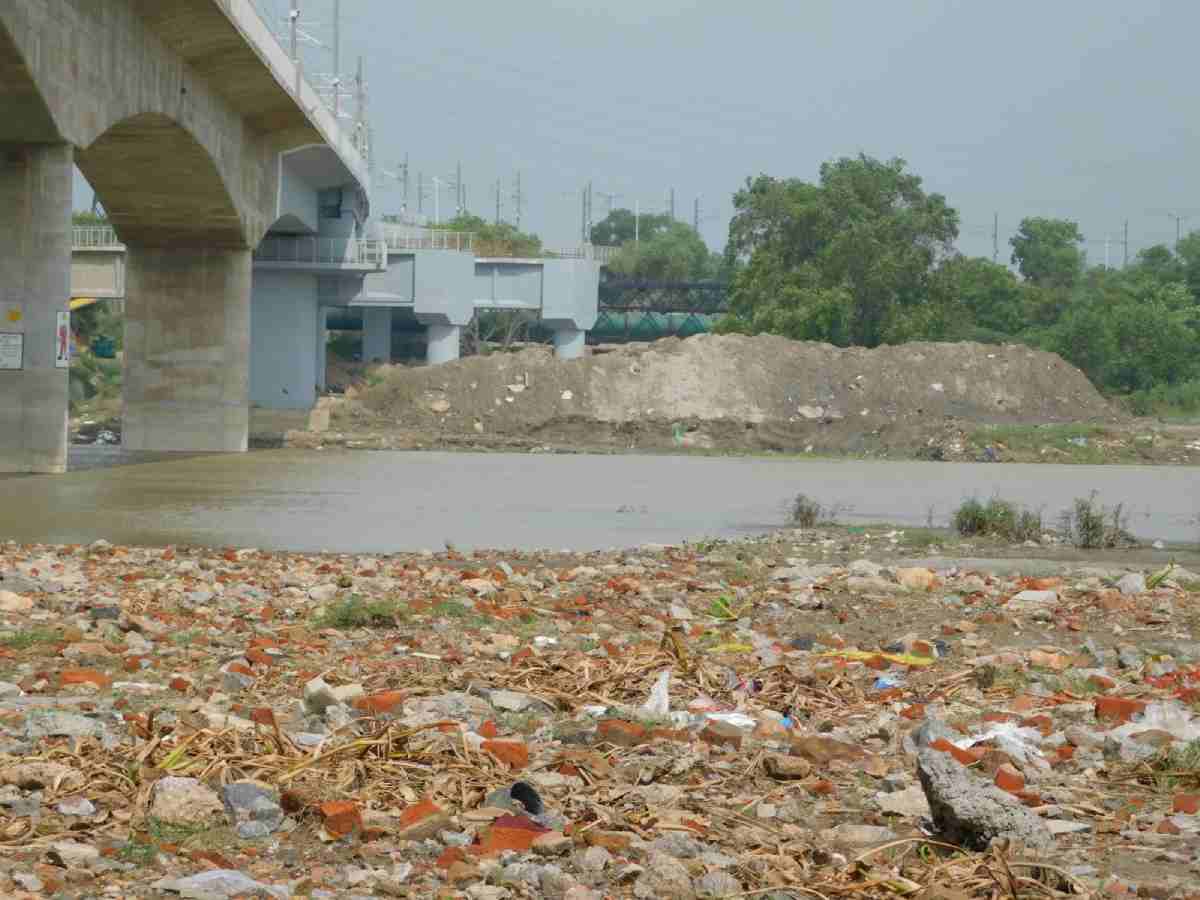
Despite multiple court orders banning any form of construction or dumping, illegal activities continue unabated across the Yamuna floodplains in Delhi. Permanent structures are being erected, demolition and construction waste is being dumped indiscriminately, and heaps of silt and garbage are accumulating — all under the gaze of an administration that environmentalists describe as wilfully apathetic.
The South Asia Network on Dams, Rivers and People (SANDRP), a water advocacy group and think tank, has written to Delhi Chief Minister Rekha Gupta, Lieutenant Governor Vinai Kumar Saxena, and other concerned officials, seeking immediate intervention to stop these activities, which it says pose a serious ecological threat.
Illegal road cuts through Yamuna floodplains
A recent site visit by SANDRP to the eastern bank of the Yamuna downstream of the Wazirabad barrage revealed stark violations. “A new about five kilometres long and about six-metre-wide road dissecting floodplain from Wazirabad crematoria to Eastern Embankment near Usmanpur village has been created. It passes through the Metro Bridge, Signature Bridge and Metro Casting yard facility,” the group said in a statement.
According to SANDRP, “The road has recently been raised by bitumen paving works and widened from earlier single to double lane. The bitumen work has considerably increased the height of the road disconnecting the floodplain along its alignment. Additionally, both sides of the road are paved with cement blocks and there seems to be preparation to install electricity poles along the road at several places. For more than one km the road alignment runs parallel to the river channel at a distance of about 150 m. The road work has disconnected the Yamuna’s old flowing channel.”
Local residents told SANDRP that the road was initially created to facilitate construction of the Metro and Signature bridges. Since both projects are now complete, and connectivity to Wazirabad has been improved via other routes, the group argued that the road has outlived its purpose and must be dismantled to restore the floodplain.
Metro casting yard occupies 13 acres of riverbed
SANDRP also raised objections to the Delhi Metro casting yard facility, which has been occupying over 13 acres of the Yamuna floodplain for years. The organisation demanded its removal, along with the thick concrete layers and waste dumped by the yard’s managers.
“The large part of the floodplain around the casting yard has already been used for compensatory plantation work. So, the casting yard land must be restored as a native floodplain vegetation and not for further compensatory plantation work which has adverse ecological and hydrological impacts on the river floodplain,” the group warned.
Solid waste, C&D debris, sewage continue unchecked
According to the group, around 50 acres of low-lying floodplain opposite Kartar Nagar along the Eastern Embankment have already been reclaimed by dumping massive quantities of soil. The area is now being used as a makeshift parking and gathering zone.
“Recent Google Earth imagery reveals that dumping and levelling activities have further expanded, encroaching an additional 20 acres of floodplain and threatening a nearby water body linked to the DDA’s Vansthali project. If urgent preventive measures are not taken, the entire stretch risks being irreversibly lost to illegal reclamation,” the group noted.
SANDRP further informed that construction waste is being dumped along the road that merges with the Eastern Embankment at Khajuri Chowk. “At places it has been levelled and concretised illegally,” the group said.
They also pointed to debris left beneath the Metro bridge right up to the riverbank. “The construction company is evading the responsibility of restoring the site back to floodplain and river to its original condition,” SANDRP stated.
A massive silt dump has also been created near the mouth of the Najafgarh drain (Sahibi river) on the western bank. The group warned that it must be removed before the next flood season, as it could severely affect the river’s natural flow.
Local accounts cited by SANDRP claim that the riverbed beneath the Signature Bridge has become dangerously shallow and easily crossable due to debris, warranting urgent investigation. A deep, narrow dredged channel created last year has also caused riverbank erosion. Residents report that when water levels rise, the submerged trench becomes a death trap—especially for children.
Court orders flouted, monitoring absent
Over the years, both the Supreme Court and the National Green Tribunal have passed multiple orders prohibiting any construction or dumping on the Yamuna floodplain, citing its critical role in flood mitigation, groundwater recharge, and ecological balance.
The courts have consistently held that the floodplain is a no-construction zone, and that any dumping of construction and demolition (C&D) waste or alteration of its natural contours is illegal. Despite these rulings, SANDRP says illegal activity continues unabated, exposing a yawning gap between judicial intent and administrative action.
SANDRP flagged ongoing solid waste dumping along the riverbank, from the barrage onwards. “Plastic litter, concrete debris, tar coal mixtures, and other waste materials are scattered across multiple spots on the floodplain, with absolutely no monitoring or mechanism in place for their removal or to prevent further dumping,” the group said.
The organisation also expressed concern over the Nanaksar Gurudwara, which it says has raised and levelled around 14 acres of floodplain through soil dumping to construct permanent structures. Despite this violation of court orders, the expansion reportedly continues unchecked.
Adding to the environmental damage is the discharge of untreated effluents into the river just downstream of the Wazirabad barrage through two metal pipes. “While this has been brought to the authorities’ attention multiple times, no action has followed,” SANDRP said. The absence of technical monitoring allows destructive activities to persist with impunity.
Floodplain’s ecological role under threat
The July 2023 floods, according to the group, destroyed plantation work, an artificial fish pond, and other interventions carried out between 2022 and 2023 downstream of Wazirabad—wasting public funds running into lakhs.
SANDRP stressed the importance of protecting the eastern floodplain, which is lower in elevation and gets submerged during every medium to high flood. Continued encroachment, it warned, is undermining the floodplain’s natural ability to buffer floods and recharge groundwater.
Also Read: Plan to clean Yamuna by diverting Ganga water draws experts’ flak
With downstream infrastructure already limiting the Yamuna’s flood-carrying capacity, the group argues that protecting the remaining floodplain is essential for the city’s safety and resilience.
SANDRP demands urgent official intervention
“It is really a very disappointing state of affairs when it comes to management of Yamuna floodplain in Delhi. It has been over a week that SANDRP emailed letters to all concerned governmental bodies including to NMCG, however none of the bodies have responded to the complaints raised,” said Bhim Singh Rawat, Associate Coordinator of SANDRP.
He added, “The 5 km long Wazirabad bypass road with tar coal has been laid, raised and widened in complete violation of norms. There [is] construction waste dumping and concretisation of Yamuna floodplain [that has] happened along Wazirabad barrage road and eastern embankment road. Though DDA claims to have installed CCTVs, security guards, we found none existing on ground during the visit.”
Rawat further said, “The DMRC construction yard is still occupying a precious part of the floodplain. Not just the floodplain, construction debris have been found on the riverbank and inside the river channel. However, there is no monitoring happening by the DDA. Large chunk of the floodplain has been gradually filled up with soil and levelled to be abused as parking and park areas.”
“Instead of sharing point wise action taken reports or inviting concerned citizens for joint floodplain inspection to resolve the issues, there are news reports mentioning a steel barricade to protect the floodplain and plan for dredging the riverbed,” he continued.
Also Read:Delhi: Illegal sand mining continues unchecked, damage Yamuna
“This only proves that the DDA continues to function in the most unprofessional, opaque and unaccountable manner. Floodplain farmers, villagers are easy targets for the agency, but when it comes to stopping the real encroachment and abuse of floodplain land from influential and politically connected encroachers, DDA has chosen to look the other way round. Even its so-called beautification projects have been found concretising the floodplain and damaging native vegetation. It has not publicly shared any information about damage to its project during July 2023 floods and has not learnt any lesson,” Rawat said.
“This is a classic case of who can protect the field when the fence itself starts eating it away. Unless we get an NGT or court monitored professional panel or independent autonomous body to deal with the floodplain affairs in Delhi, the river will continue to lose its precious floodplains bit by bit,” he added.
A Delhi court denied bail to a former DU professor accused of raping a student,…
Delhi Police charged seven dhaba workers in the fatal beating of a Manipuri musician who…
Seven Delhi STPs failed DPCC standards in September, dumping high levels of faecal coliform and…
AISA chief Neha Bora petitioned the Delhi HC against a police notice requiring a peace…
Average AQI of 171 in the first week of this month; falling temperatures and stubble…
Delhi Police dismissed claims of disrupting CR Park Durga Puja, stating actions strictly enforced court-mandated…
