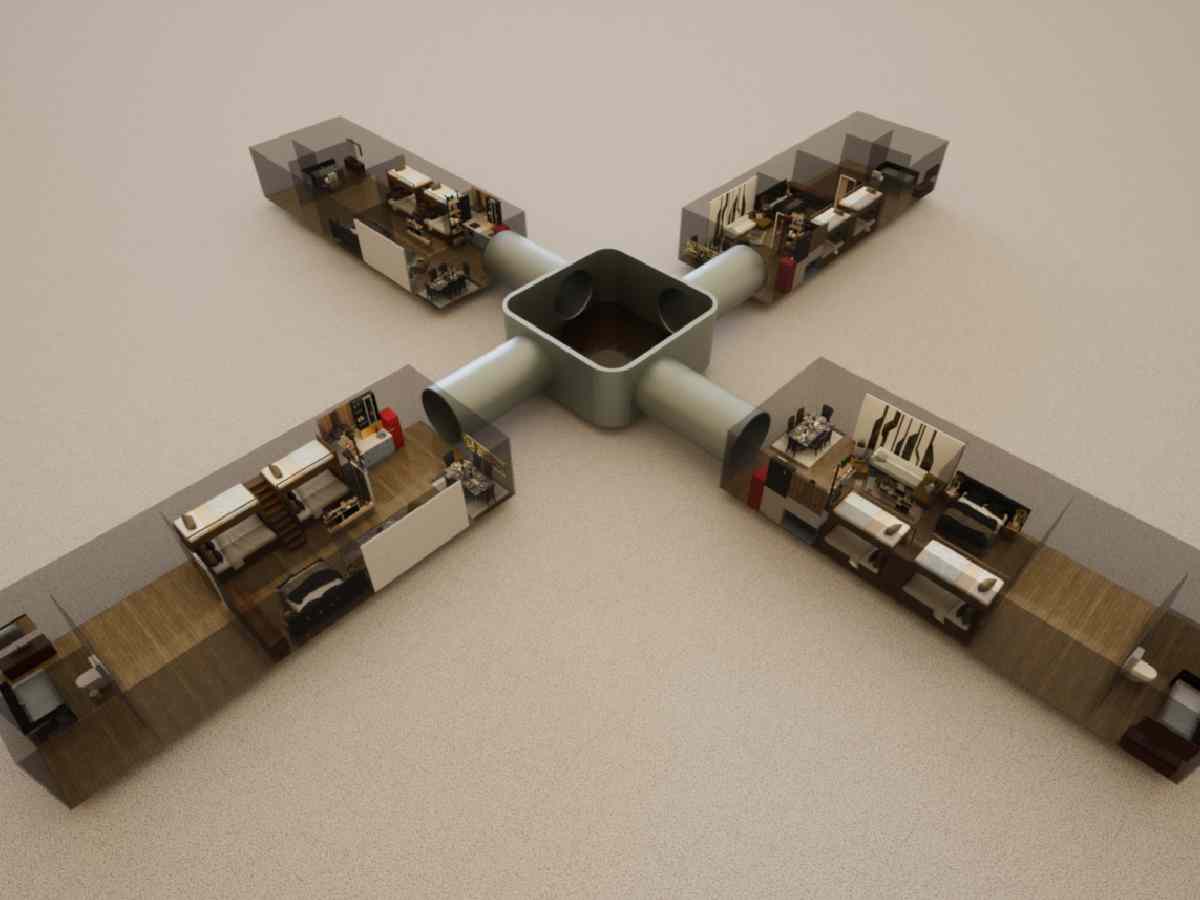
Type of bunker in the Platinum Series
The absence of public safe zones and air raid shelters in the national capital has added to the anxiety over the simmering India-Pak tensions. According to the Delhi government’s Directorate of Civil Defence (DCD), the only available options for civilians are private basements and underground metro stations.
“There are no bomb shelters, safe houses, or bunkers in Delhi. In the case of any instance of a bomb scare, all residents will have to take refuge in private or commercial basements in their residential area. The safest would be to rush to underground metro stations,” said a senior official associated with the department.
Metro stations: A stopgap, not a solution
The Delhi Metro Rail Corporation (DMRC) operates a total of 257 stations across the National Capital Region, but only 71 of them are underground, accounting for less than 30% of the network. The rest are elevated or at grade level, leaving large parts of the city without access to deep-cover refuge.
The deepest stations—Hauz Khas and Chawri Bazar—lie 29 and 25 metres below ground, respectively. On average, underground stations are located 15 metres beneath the surface. Of the DMRC’s 394.4 km operational network, 106.1 km is underground.
East and North East Delhi remain especially vulnerable. Despite being served by the Red, Blue, and Pink lines, these districts do not have a single underground station.
Some lines fare worse than others. The Blue Line has five underground stations, the Red Line just one, the Grey Line two, and the Airport Express Line six (including two stations shared with the Yellow and Blue lines).
While the Delhi Metro was not designed for wartime conditions, officials are now studying international models to explore how some protective measures might be adapted to local needs.
Cities like Kyiv, Seoul, and Helsinki have equipped their metro systems with air filtration, water supplies, and backup power to serve as emergency shelters during missile strikes or natural disasters. In several countries, including Finland, South Korea, and Israel, such stations were purpose-built or upgraded for dual civilian-military use.
Private players to the fore
Amid the anxiety and the lack of a robust public infrastructure, private companies have stepped in to fill the void by offering luxury bomb shelters. While metro stations and basements remain the only option for the majority, a handful of firms are now marketing fortified underground bunkers as a premium survival solution.
One such player is the Delhi-based Shoolin Systems Consulting Group, which offers a wide range of chemical, biological, radiological, and nuclear (CBRN) shelters. These include four models: Standard, Genesis, Triump, and the top-tier Platinum Series, which the company claims to be among Asia’s most luxurious.
The Standard Series offers the most basic underground CBRN shelters designed for self-sustained living for up to 100 days. These bunkers rely entirely on internal systems for power, water, and air, independent of external grids. The series includes models S-170, S-260, and S-400, providing essential protection and functionality for short-term emergency situations.
The Genesis Series provides more spacious bunkers with a self-sustainability period of up to 200 days. These bunkers feature increased storage capacity for emergency provisions and larger rooms, allowing for greater comfort and interior customisation.
Also Read: Didn’t hit Pakistan nuclear site, struck terror infra decisively: India
The Triumph Series represents the most luxurious prefabricated bunkers, offering self-sustained living for up to 300 days. With features such as up to four large bedrooms, extensive storage, and expansive living areas, these bunkers closely resemble above-ground living. Models T-900 and T-1100 can also be combined for additional space, providing a cosy, homely environment with ample provisions.
The Platinum Series consists of custom-built bunkers exceeding 3000 square feet, designed for long-term living of 1 to 3 years. These bunkers can be buried deeper for enhanced protection, depending on soil conditions, and are tailored for those requiring extended, high-capacity underground residences.
These bunkers are made available on a to-order basis
According to data from Similarweb, a software analytics platform, the company’s website recorded an 89.4% surge in traffic immediately after the Indian government announced Operation Sindoor. On May 6, the site had just 532 visits. The next day, May 7, visits jumped to 5,037. A similar trend was observed on Semrush, another data aggregation service.
In a message on the website, Chairman Jitender Marwah links the demand for shelters to escalating global instability following the Ukraine–Russia conflict.
“Today, the world is even more unpredictable, and conflicts at all levels are rising,” he writes. “From the local disturbances in the forms of thefts, home invasions and riots to Russia Ukraine War and increasing temperatures up to 50 degrees due to climate change, the world around us is becoming more and more dangerous with each passing day. They say humans are the only species that have the capability to take action to save themselves from a major disaster.”
Marwah adds that personal protection is no longer a luxury but a necessity: “In the event of a disaster of any kind, big or small, the prepared are better equipped with resources they need to persevere. The unprepared are at the mercy of others or are likely to resort to scavenging or violence… Whatever the disaster that occurs, you have to take the steps now to survive it. And we are there with you every step of the way.”
Similarly, Gurugram-based real estate developer Raheja Developers has promoted what it calls India’s first nuclear bunker beneath The Leela Sky Villas Delhi, a luxury residential project in Kirti Nagar.
India’s civil defence vacuum
Barring Jammu and Kashmir, which by 2021 had nearly 8,000 underground shelters constructed across Jammu province, according to a Times of India report, other states lack any bunker or underground shelter as such. The Centre had earlier approved 14,460 bunkers across five districts of J&K—Jammu, Kathua, Samba, Poonch, and Rajouri—and later sanctioned an additional 4,000, further extending protection to vulnerable border villages.
Several countries have built extensive underground bomb shelter networks to protect civilians during times of conflict. Switzerland leads with around 360,000 shelters—enough to house its entire population—due to strict civil defence laws. Israel also has widespread shelter coverage, including reinforced security rooms (Mamad) in all new buildings and thousands of public shelters.
South Korea has over 19,000 shelters, many integrated into subways and public infrastructure due to its proximity to North Korea. Finland maintains more than 50,000 multi-use shelters that can accommodate entire urban populations, especially in cities like Helsinki.
Russia and China have hundreds of thousands of Cold War-era bunkers, some still operational or repurposed. The United States built over 200,000 fallout shelters during the Cold War; while many are outdated, key government and military bunkers remain active. Norway and other NATO countries also maintain thousands of shelters as part of their civil defence strategies.
City begins mapping emergency shelters
In response to rising public anxiety and the absence of formal bunkers, Delhi authorities have launched a citywide preparedness drive to mitigate the risks of potential aerial attacks.
On May 11, Delhi Police officials confirmed that steps were being taken to identify and mark basements across the city that could serve as emergency shelters during missile strikes or air raids. These efforts aim to fill the vacuum left by the lack of state-built bomb shelters.
Also Read: ‘We struck Pakistan in its heart’: PM Modi hails ‘Operation Sindoor’
Parallel initiatives include compiling detailed lists of vulnerable residents—including children, the elderly, and persons with disabilities—to ensure they can be evacuated swiftly in the event of an emergency.
Community engagement and public awareness
To maximise outreach, the government is roping in civil defence volunteers, Resident Welfare Associations (RWAs), and local beat constables. These individuals will be responsible for spreading awareness about how to respond if air raid sirens are triggered—citizens are being advised to immediately seek cover, avoid open spaces, and follow official communications closely.
“The Delhi Police is not solely focusing on rapid-response mechanisms,” noted another official. “We are equally committed to proactively educating the public about the precautionary measures they must take in the event of an aerial threat.”
District Deputy Commissioners of Police (DCPs) have received instructions to assess local infrastructure for its suitability as emergency shelters. Coordination with the Delhi Disaster Management Authority (DDMA) and municipal bodies is ongoing to ensure sufficient resource allocation.
New disaster response force readies for wartime threats
In a significant enhancement to the Capital’s emergency capabilities, the Delhi Police has established a dedicated unit—the Delhi Police Disaster Response Force (DPDRF). This newly formed team comprises approximately 270 personnel, including constables and sub-inspectors, and is currently undergoing a six-week specialised training programme at the National Disaster Response Force (NDRF) campus in Ghaziabad.
“These personnel are being trained in a wide range of skills, including rescue operations during fires, building collapses, and urban flooding. Additionally, they are being specifically prepared to handle air raid scenarios,” an officer said.
Out of the 270 members, roughly 150 have already completed their training. The remaining personnel are expected to finish by the end of this month. Once training is complete, the force will be divided into three units, likely to be stationed strategically across South, East, and New Delhi to ensure rapid deployment and quicker response times.
Crucially, the DPDRF is also being trained to respond to CBRN emergencies. A police source emphasised, “This dramatically expands the unit’s operational scope, aligning it with the kinds of threats that major cities around the world face during times of conflict or large-scale crises.”
Protests against CEC Gyanesh Kumar over the SIR of electoral rolls started on October 10.…
Delhi Police books journalist under SC/ST Act for casteist remarks against ACP during a Jantar…
Hindu College staff protests against principal, demanding DU takeover over financial and admission irregularities and…
Delhi Cabinet approves Industrial Policy 2026 with Rs 1,000 crore for top sectors to turn…
Delhi launches DJB command centre with GPS tanker tracking and AI tools to manage water…
ABVP protests at JNU against Congress MP Akoijam over sexual harassment claims, demanding the party…



