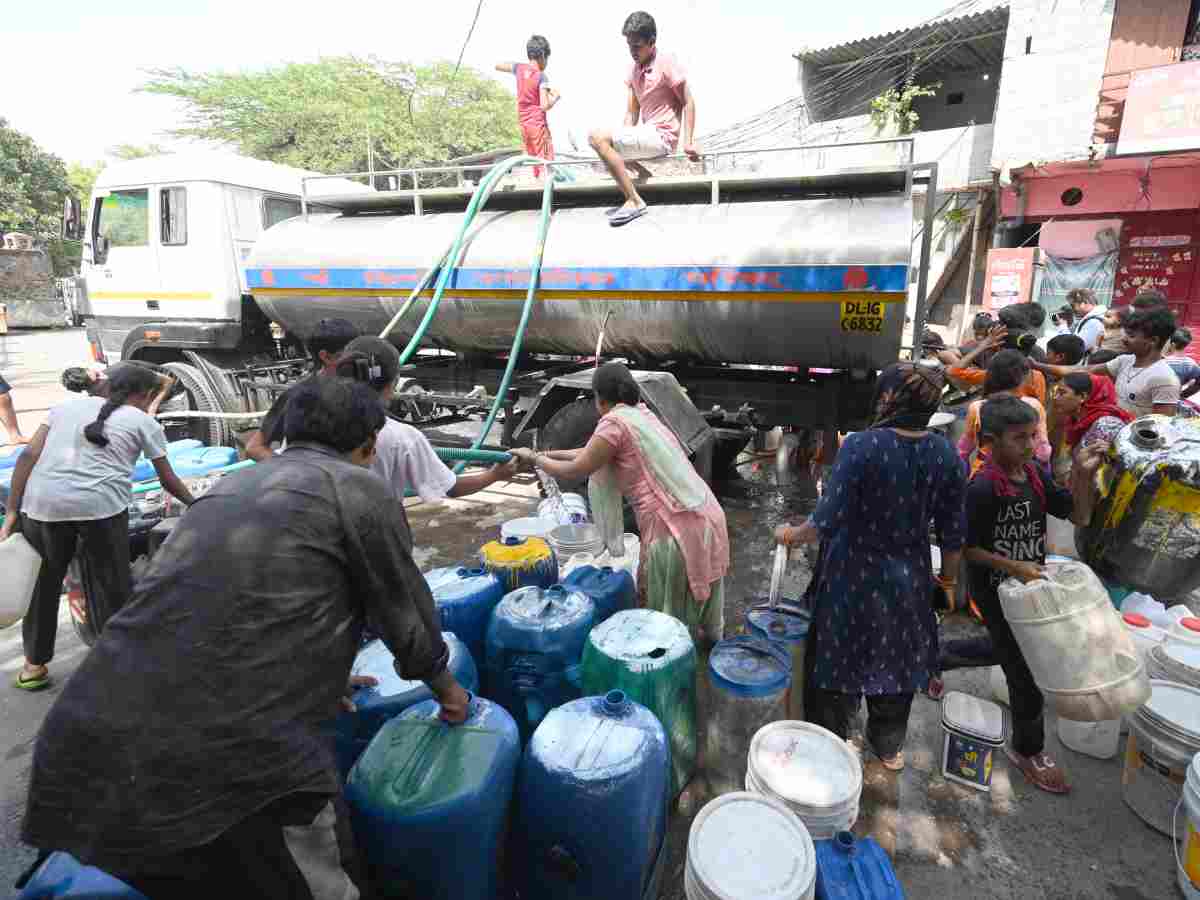
QUEUING UP: People in Sanjay Camp rush to collect water from the tanker. A couple of childerns are seen on top of the tanker PHOTO: GETTY
A rapid water audit in Delhi has revealed that 34% of surveyed low-income households are spending as much as 15% of their monthly earnings—between Rs 6,000 and Rs 10,000—just to secure basic drinking water. The findings highlight stark inequities and point to an unsustainable distribution system, particularly during the March–July peak summer months.
The survey, conducted across 500 households in 12 informal settlements—including Sakurpur Basti, Savda Ghevra, Daya Basti, Chunna Bhatti, Khajan Basti, BIW Colony, Seemapuri, Sunder Nagri, Lohar Basti, Sangam Vihar (waste pickers basti), Raghubir Nagar JJ colony and Kusumpur Pahari—found a clear mismatch between demand and supply. While 37% of households required at least 20–25 litres per person per day, only 28% reported receiving that amount, and often only if they paid for it.
Reliance on costly private sources
Access to water remains heavily reliant on non-piped sources. According to the audit, 34% of respondents depend on private water suppliers, 29% on Delhi Jal Board (DJB) tankers, 21% on Water ATMs, 14% on submersible connections and 2% borrow from neighbours.
Many families said they spend between Rs 500 and Rs 1,500 a month on water, often purchased from private vendors at Rs 15–Rs 30 per gallon. These expenditures directly displace other essential needs.
Seventy per cent of respondents said rising water prices had dented their household budgets. Fourteen per cent reported reduced access to healthcare, while 8% said their children’s education was affected. Around 80% of respondents faced frequent or occasional shortages, with the situation worsening in the summer. Thirty-seven per cent said they missed hours or even entire days of work or school because of long queues to collect water.
Government promises fall short
Despite the Delhi government’s April 2025 announcement to install 3,000 Water ATMs under the Heat Action Plan 2025, only 20 had been set up by June—and none in the surveyed settlements.
Where ATMs do exist, such as in Savda Ghevra, Sakurpur Basti, Khajan Basti and Chunna Bhatti, residents reported malfunctioning systems and irregular service. Thirty-seven per cent of users said the promised 20 litres of free daily water was often unavailable or charged.
Voices from the ground
“Water is a basic right, but for these families, it’s an everyday crisis,” said Vaishali Upadhyay, Campaigner at Greenpeace India. She added that in bastis without Water ATMs, people are compelled to buy water from private suppliers at Rs 15–Rs 30 per gallon. This, she said, highlights a wide gap between policy promises and ground reality, forcing families to make painful choices between “water and food, water and school fees, water and medicine.”
Also Read: Water crisis hits everyone in Delhi, except the private players
Ankit Rana, a member of COHAS who participated in the survey, said many residents walk long distances or pay steep prices for water that is often unsafe to drink. “Government sources like tankers come rarely, and ATMs where they exist are broken or charge extra,” he said, pointing out that the infrastructure is failing the city’s most vulnerable. “Clean and affordable water shouldn’t be a privilege—it’s a necessity.”
Call for urgent action
The audit urges the Delhi government to fulfil its pledge to install 3,000 fully functional Water ATMs as outlined in the Heat Action Plan 2025. It recommends that the ATMs operate 24×7 in residential areas without quantity caps, and that coverage be extended to labour chowks, construction sites, markets, bus stands and public parks to ensure wider access.
Elected to the Delhi Golf Club general committee, Mansher Singh says he wants to build…
A $780 million market built on pavements, where the pleasure of reading meets the price…
Supreme Court advocate Abhishek Pawar alleges women were denied washroom access for seven to eight…
Each day of closure costs shops in Khan Market and Connaught Place between Rs 60,000…
Delhi generates nearly 15,000 tonnes of waste daily, prompting the government to deploy 1,000 mechanical…
Delhi Police has issued an NOC for the Congress rally at Ramlila Maidan on November…
