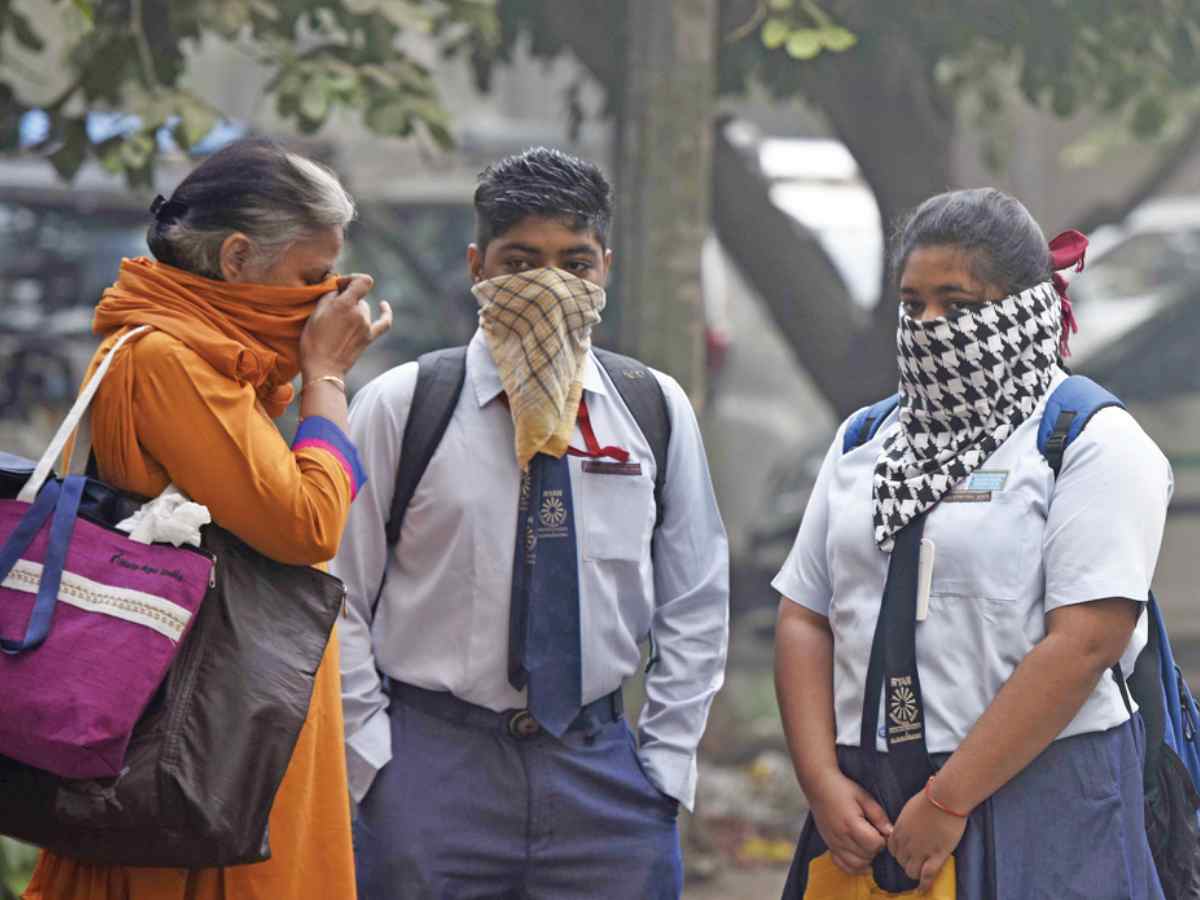
Sitting in vehicles stuck in traffic or walking along crowded footpaths as they make their way back home from work, men in Delhi are absorbing more of the city’s polluted air into their lungs than women, according to a study conducted over five years.
Titled ‘Respiratory deposition of particulate matter in Delhi: A five-year assessment of exposure patterns and health risks’, the study was conducted by researchers from the Netaji Subhas University of Technology, Delhi, along with researchers from a Noida-based environmental consultancy.
The team analysed data from 39 air quality monitoring stations across Delhi between 2019 and 2023.
The findings point to a clear difference between men and women in terms of lung deposition of air pollutants.
While sitting, men recorded about 1.4 times higher PM2.5 lung deposition and about 1.34 times higher PM10 lung deposition than women.
While walking, men inhale more pollution, with lung deposition about 1.2 times higher than women for both PM2.5 and PM10, according to the study.
Researchers said this difference is linked to higher breathing volume and airflow in men, which leads to more polluted air entering the lungs.
Using an internationally accepted scientific model, the researchers calculated how much particulate matter actually enters and settles in different parts of the lungs, rather than only measuring the pollution present in the air.
The study said this dose-based approach highlights the urgent need for immediate policy changes to reduce everyday exposure, especially for commuters and outdoor workers.
After comparing men and women, the researchers assessed how Delhi residents fare against the safety limits.
The study found that lung deposition of fine particulate matter among Delhi residents was about 10 times higher than what would be expected under India’s air quality standards, and nearly 40 times higher than the levels estimated under the World Health Organization (WHO) guidelines.
The National Ambient Air Quality Standards prescribe a daily PM2.5 limit of 60 micrograms per cubic metre and a PM10 limit of 100 micrograms per cubic metre.
The WHO’s daily guidelines are stricter, at 15 micrograms per cubic metre for PM2.5 and 45 micrograms per cubic metre for PM10.
The study said lung exposure in Delhi far exceeds doses corresponding to both benchmarks.
The study compared activity levels and found that walking resulted in two to three times higher particulate matter deposition in the lungs than sitting, across both men and women.
Among all the groups analysed, men while walking recorded the highest lung deposition, followed by women walking, men sitting, and women sitting.
Based on this, the researchers said pedestrians and street-level workers face the greatest risk, as they combine physical activity with prolonged outdoor exposure.
Fine particles such as PM2.5, which are small enough to penetrate deep into the lungs, were identified as the most harmful.
Exposure was found to rise further during the evening commute. The study showed that lung deposition during evening travel hours was 39 per cent higher for PM2.5 and 23 per cent higher for PM10 as compared to the morning.
This was attributed to higher traffic emissions and weather conditions that trap pollution close to the ground in the evening.
Short-term pollution spikes were also observed during Diwali and other festivals. On Diwali nights, particulate matter deposition in the lungs was found to nearly double compared to pre-festival days, with elevated exposure continuing for several days after the festival.
Area-wise analysis showed that industrial areas recorded the highest lung deposition, followed by commercial zones.
Central Delhi areas with higher green cover recorded comparatively lower exposure, the study found.
During the Covid-19 lockdown in 2020, lung deposition of particulate matter fell sharply by around 60 to 70 per cent across several areas. This showed that large-scale reductions in traffic and industrial activity can quickly reduce health risks, the researchers said.
Contemporary artist Ashima Dhir Sehgal presents her first solo exhibition in India, exploring memory, human…
Traffic near Kashmere Gate will be restricted Wednesday as INDIA bloc holds a joint protest…
CAQM ordered NCR industries to expand PTZ camera coverage by Oct 31, 2026, to monitor…
A 4.9-magnitude earthquake hit Uttarakhand's Chamoli late Tuesday, sending tremors across Dehradun and Delhi-NCR. No…
AUD asked IGDTUW to halt a new security gate at Kashmere Gate, warning it blocks…
The 3-lane Barapullah Phase-III merges into 2 lanes near Sundial Park, creating massive traffic jams;…
