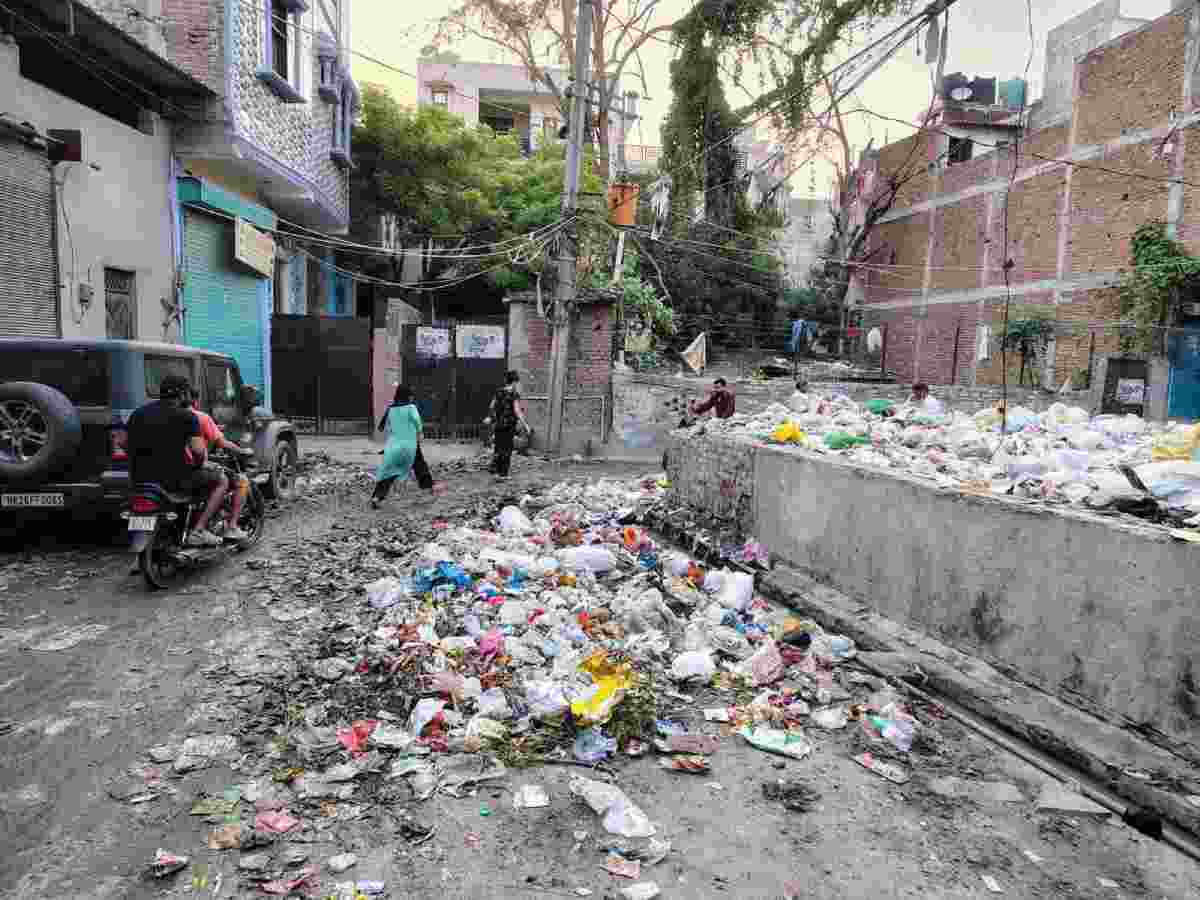
Heaps of garbage lying unattended on the streets of Sangam Vihar
The Municipal Corporation of Delhi (MCD) has issued nearly 28,000 challans and imposed fines worth Rs 2.31 crore in over five months since the implementation of the Jan Vishwas Act, officials said on Tuesday, adding that public urination, illegal garbage dumping, and defacement of public spaces accounted for nearly one in every four challans.
Of the 27,915 challans issued from May-end to October 28, nearly 7,000 were for offences falling under the broad category of ‘commission of nuisance’, which includes public urination, defacement of public property, unauthorised pasting of posters, dumping garbage in public places, and other activities prohibited under Section 397 of the Delhi Municipal Corporation (DMC) Act.
According to official data accessed by PTI, the MCD collected Rs 99.15 lakh against 16,281 paid challans, while 11,634 challans involving Rs 1.32 crore remain unpaid.
An analysis of the offence-wise data from August 1 to October 30 showed that 3,633 challans were issued under Sections 397(1), (2), and (3) for ‘commission of nuisance’, involving fines of Rs 18.16 lakh.
An official said the number of such challans could have exceeded 7,000 during the broader period, based on the proportion recorded in the available data. Of these, 1,810 challans worth Rs 9.05 lakh were paid, while 1,823 challans involving Rs 9.11 lakh remained unpaid.
Keeping rubbish or filth unattended for more than 24 hours attracted the second-highest number of penalties, with 3,180 challans issued under Section 357(1), involving Rs 3.18 lakh. Additionally, 2,764 challans were issued for allowing filth to flow onto streets, attracting fines of Rs 5.52 lakh.
The civic body issued 971 challans under Section 398 for failing to comply with directions to remove or abate a nuisance.
Among other violations, 557 challans were issued for failing to provide arrangements for refusing collection or removing garbage. Another 440 were issued for failing to collect or remove filth or polluted matter, while 276 challans were issued for failing to remove rubbish from market premises despite directions.
The MCD also issued 117 challans for failing to provide or maintain clean latrines at premises used by large numbers of people, while 103 were issued for failing to provide toilets at markets, cattle sheds, or cart stands.
The Jan Vishwas (Amendment of Provisions) Act, 2026, was notified by the Union Ministry of Home Affairs on May 15. It amended several provisions of the DMC Act, replacing criminal action with monetary penalties for specified violations.
The MCD authorised officers across departments to function as adjudicating and appellate authorities and to impose civil penalties on May 19.
Under the revised provisions, public urination or causing nuisance, which earlier attracted a fine of up to Rs 50, can now invite a penalty of Rs 500. The penalty for allowing a ferocious dog to roam without a leash has increased from Rs 50 to Rs 1,000, while that for defacing a house number has also been raised to Rs 1,000.
The Department of Environment Management Services (DEMS) accounted for the highest number of challans among the civic body’s nine departments, issuing 15,961 penalties involving Rs 98.11 lakh. Of these, 10,773 challans were paid, bringing in Rs 41.86 lakh, while Rs 56.25 lakh remained outstanding.
The Public Health Department issued 3,904 challans involving Rs 61.60 lakh, while its Malaria wing issued another 5,599 challans worth Rs 30.77 lakh.
The Licensing Department recorded 1,334 challans, followed by the Veterinary Department with 623.
At the zonal level, the City-SP zone, covering Old Delhi, recorded the highest number of challans at 6,066, involving fines of Rs 32.48 lakh. Of these, 4,636 were paid, amounting to Rs 18.03 lakh.
An MCD official said that merely imposing monetary penalties would not be enough to change civic behaviour unless violations carried a sustained and tangible consequence.
“People should not feel that they can repeatedly violate civic rules and get away with paying a small fine. The penalties must act as a deterrent and encourage compliance. Enforcement has to be consistent, with stricter action against repeat offenders,” the official said, adding that Delhi could adopt elements of Indore’s enforcement model, which combines incentives for compliance with strict penalties for violations.
The civic body uses a digital challan system integrated with its MCD 311 mobile application to facilitate the reporting and penalisation of civic violations. The system enables complaints and violations to be recorded digitally, allowing the municipal authorities to track enforcement and follow up on complaints.
From heritage monuments and lakeside trails to open lawns and seasonal blooms, these 5 green…
Only 1.85 lakh of 25.4 lakh overage vehicles identified across Delhi, Haryana, UP and Rajasthan…
Delhi's air quality remained 'poor' for the 10th consecutive day, with the Cantonment area recording…
A 26-year-old labourer was allegedly attacked with a sword after intervening in a dispute between…
The proposed Android and iOS app will allow economically weaker section patients to check vacant…
Pipeline-laying work by the Delhi Jal Board will affect traffic on both carriageways between Kamal…
