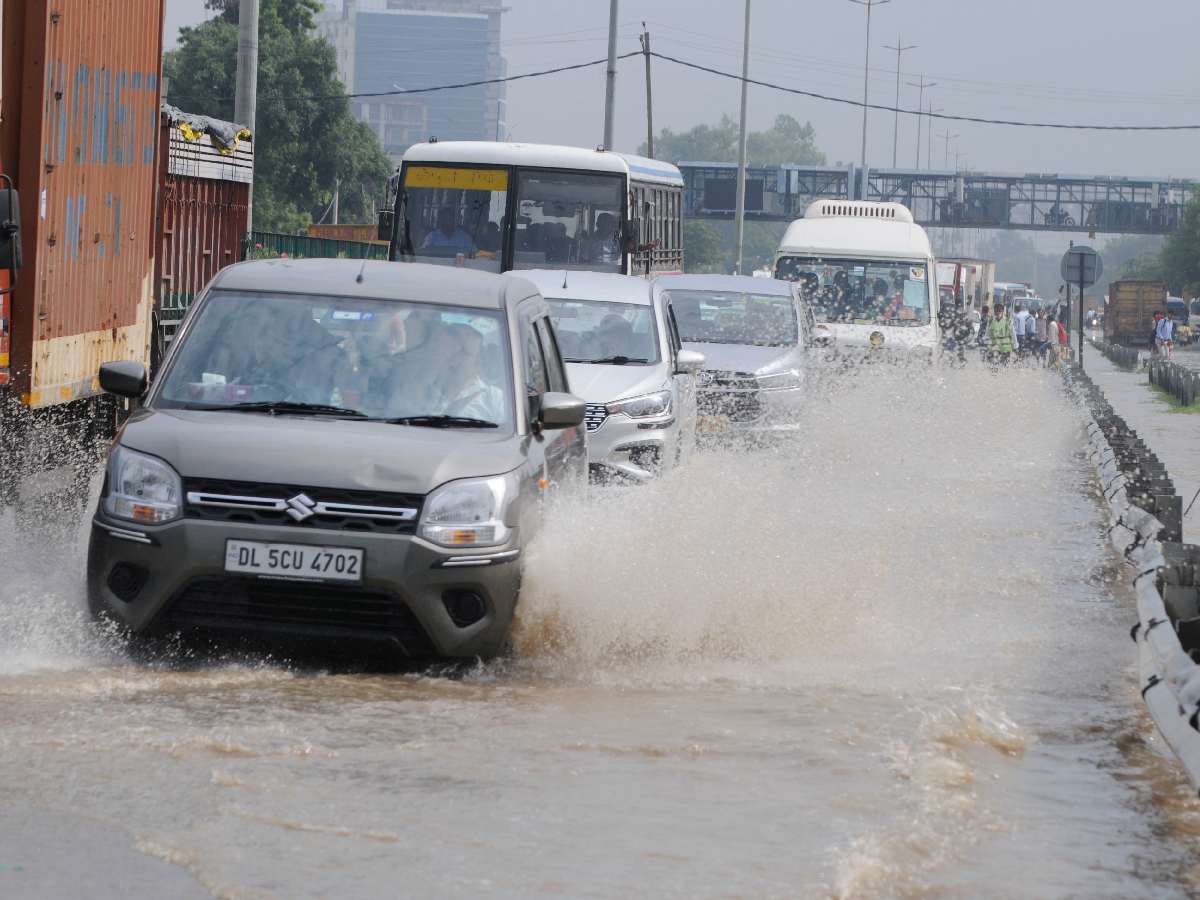
Across the national capital, the roads were drowned in a sense of deluge, with many of its nooks and crannies submerged by the Yamuna River and overflowing sewage water. Few residents were prepared for the devastation that followed.
According to the Delhi Traffic Police, there were 225 instances of waterlogging across the city between May 5 and September 2. Of these, 164 specific locations were affected. Most of the incidents occurred during August, when the monsoon lashed the capital. In that month alone, 71 cases of waterlogging were recorded.
In September, the tally has so far stood at nine. While this appears to be a reduction, the Yamuna’s breaching of the safety mark meant that a significant portion of the low-lying floodplains was completely inundated. The worst day was August 9, when 47 separate locations went under water at once.
Traffic police under pressure
Joint Commissioner of Police (Traffic) Kime Kaming acknowledged that waterlogging is a major contributor to Delhi’s traffic woes. “When it comes to waterlogging in Delhi, it becomes extremely difficult to contend with the situation that the personnel are faced with, especially when it comes to how drainage works here,” he said. During monsoon months, he added, most unseasonal or randomised snarls occur because of waterlogging, particularly across low-lying areas and around unauthorised colonies.
Beyond the monsoon, most of Delhi’s traffic snarls occur around permanent congestion points. Even on days without a drop of rain, commuters face long delays. The Delhi Traffic Police have identified 62 locations prone to daily jams.
Congested points across the city
Several of the worst-affected areas are located near railway stations, ISBTs, and metro stations, where pedestrian movement adds to vehicular pressure. Bhavbhuti Marg and Chelmsford Road near New Delhi Railway Station, ISBT Kashmere Gate, and the Anand Vihar railway and bus terminal zone are particularly notorious.
“These locations are congested not only with private and public vehicles but also with auto-rickshaws, taxis, and e-rickshaws vying for space throughout the day,” a senior traffic police officer explained.
The list of bottlenecks was compiled in recent weeks as part of an internal survey using CCTV footage and field staff reports. Officials said the list is still being refined before it is sent to civic and infrastructure agencies for coordinated decongestion drives.
The identified locations have been categorised based on the type of traffic they handle — from office-hour congestion points to border bottlenecks and high-volume commercial hubs.
Also Read: Yamuna floods leave Delhi residents stranded and struggling
Office rush, borders and markets
Many arterial roads in central and south Delhi witness heavy snarls during office hours. Shadipur Chowk, Chirag Delhi, Khanpur, Lala Lajpat Rai Marg near Moolchand, and Neela Gumbad are among the most affected.
In east Delhi, the stretch from Nizamuddin Bridge to Sarai Kale Khan and adjoining sections of the Ring Road remain gridlocked morning and evening.
At the city’s borders, long-distance goods carriers clash with local traffic. Kalindi Kunj and DND approaches towards Noida, and Kapashera Border towards Gurugram, are infamous for choked carriageways. “These border points often become choked due to a combination of long-distance goods vehicles, local traffic, and inadequate road capacity or signal planning,” another officer said.
Wholesale markets only worsen the picture. Sadar Bazar, Azadpur Mandi, Karol Bagh, Gandhi Nagar, and Lajpat Nagar see severe bottlenecks during business hours. Shahdara and Mori Gate experience heavy jams during offloading periods.
Key roundabouts and flyovers — Naraina Flyover, Punjabi Bagh Club Road, Mukarba Chowk, and Apsara Border — add to the pressure. Extended corridors such as Burari 100-feet road, the Dwarka-Palam corridor, and the Noida Link Road near Mayur Vihar Phase I also figure prominently on the list.
Managing the unmanageable
Kaming said that while traffic snarls were an everyday problem, they remained manageable compared to waterlogging. “Unlike times when there is widespread waterlogging, issues pertaining to periodic congestion are fairly manageable. Most times these occur due to construction work, and also, specifically during the office rush hour. However, during instances of waterlogging, we seldom get the chance to prepare beforehand,” he explained.
A senior police officer added that this year traffic management was slightly less difficult thanks to the clearing of larger drains. “However, due to a spurt in the number of vehicles, traffic congestion remains a sad fact of Delhi,” he said.
Voices from the ground
Commuters and residents alike are struggling.
Vikas Bal, a truck driver who uses the DND route, said waterlogging has made it unbearable to drive. “Most days I think of calling in sick but I have to earn my money to help with household expenses at home. We were saved last year since waterlogging days were not as extended. This time around the situation reminds me of the 2023 floods. It was extremely difficult to go anywhere then,” he said.
For Kunwar Patel, a resident of Majnu Ka Tilla, the main concern is overflowing sewers. “Most of the drainage and storm water drains here had burst since they were never meant to withstand the amount of rainfall. Just getting out of the house has become a chore now,” he said.
Experts point to poor planning
Pushkar Pawar, a town planner who has worked with the Municipal Corporation of Delhi, outlined the deeper problems.
“The primary issue is the absence of contour-mapping in Delhi. Civic authorities have not identified low-lying areas in the capital. As a result, people have constructed homes and buildings in areas that should have served as natural drainage channels. Consequently, water accumulates in these contours, causing waterlogging as it has no path to flow through,” he said.
He added that drains are rarely maintained. “Multiple factors contribute to Delhi’s waterlogging problem. Drains have not been desilted for a long time. Authorities claim they have cleaned them, but this is often only on paper. If drains are not cleared, waste material has no space to exit, leading to blockages. When drains are clogged, neither waste nor rainwater can flow out,” Pawar explained.
He also pointed to outdated infrastructure. “The drains are very old, and over the past 20 years, Delhi’s population has surged significantly. For instance, if a drain was built to handle waste from 500 people, it struggles now that 1,000 people live in the same area. This leads to waste accumulation and clogged drains,” he said.
Government promises quick relief
In July, Delhi Chief Minister Rekha Gupta announced that her government had identified more than 500 waterlogging hotspots across the city and appointed nodal officers, with the support of the Delhi Police, to address them.
She claimed that drainage systems had been improved and that water, which once took hours to clear, was now receding more quickly. “There are over 500 waterlogging points in Delhi. A comprehensive list is being compiled. The Delhi Police are also providing assistance. Nodal officers have been appointed to tackle the issues,” Gupta said at an MCD event.
The Yamuna river level fell below the danger mark in the national capital on September 8, five days after it breached the safe limit. On September 4, the river touched 207.48 metres — the third-highest level recorded since 1963.
The river has a long history of flooding Delhi. In 2023, it hit 208.66 metres, while in 1978 it rose to 207.49 metres, causing damages of Rs 10 crore and displacing thousands of people.
Currently, residents of the floodplains and low-lying neighbourhoods have been evacuated to relief camps. Majnu Ka Tilla, Yamuna Bazaar, and parts of East Delhi are among the areas where families have been shifted.
BNSS caps custody at 24 hours and requires production before a Magistrate; force permitted only…
An SEM court reserved its order on extending the judicial custody of CJP leaders Saurav…
Delhi recorded its first 'poor' air day of the season on Wednesday as AQI hit…
Stage I of GRAP was invoked later this year in Delhi due to govt's preventive…
DDA plans to resume tethered hot air balloon rides at Baanseera park from Nov 14,…
NDMC is consulting RWAs and traders on draft 2026 property tax bye-laws, seeking feedback on…
