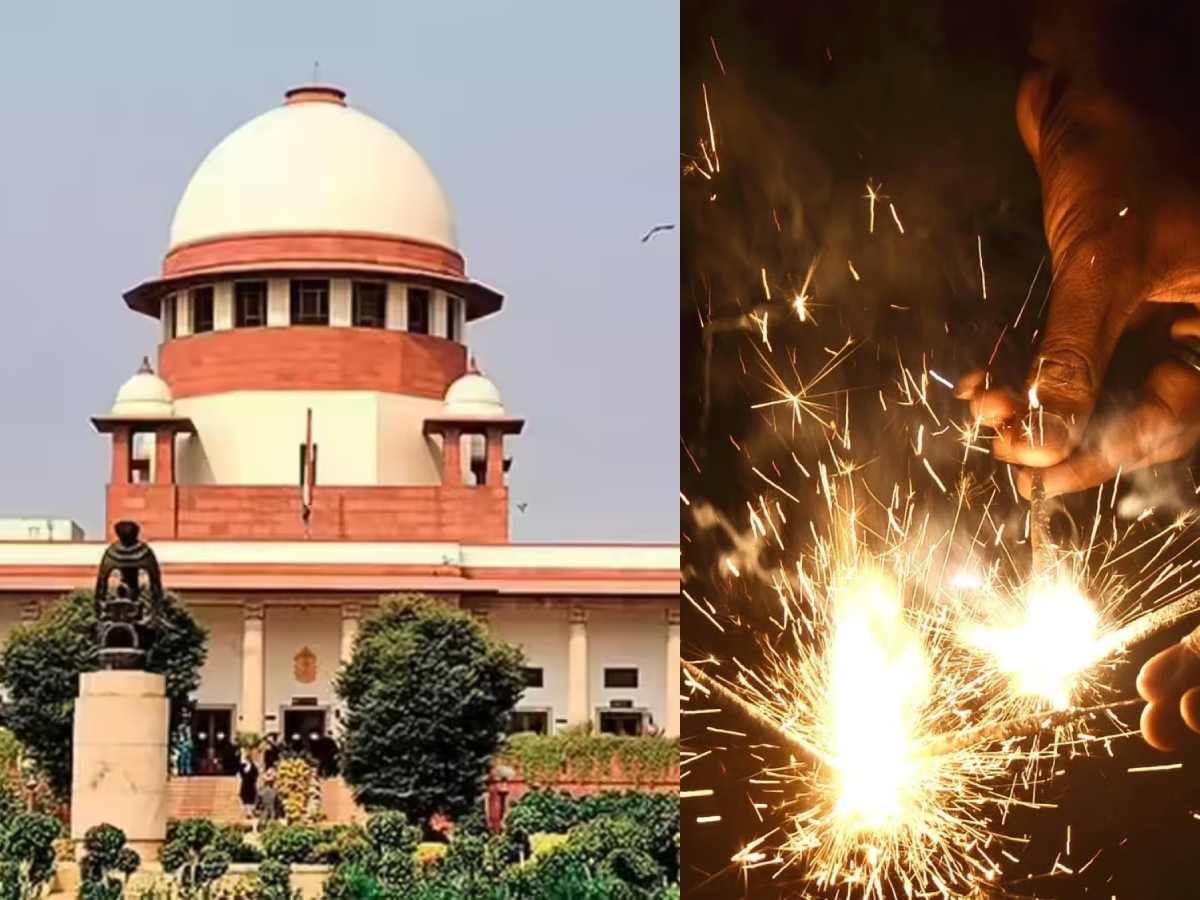
Few days before Diwali, as grey skies grow heavier and AQI levels creep toward the “severe” category, a new debate has reignited in Delhi — one that pits tradition against survival. On October 10, the Supreme Court hinted that it may relax the year-round ban on firecrackers in the Delhi-NCR region “on a trial basis.” The move, the court said, was aimed at finding a “balanced approach,” much like its 2018 Arjun Gopal verdict, which had restricted conventional firecrackers and permitted only “green” ones with reduced emissions.
However, for thousands of mothers across Delhi, Gurugram, and Noida—who have watched their children grow up coughing through the winters—the suggestion goes against their lived experience. Many mothers the Patriot spoke to said the top court must uphold the complete ban on firecrackers, arguing that no festival should come at the cost of their children’s right to clean air.
Decade-long battle
The fight for clean air began in 2015, when three infants—Arjun, Zoya, and Aarav—through their parents, petitioned the Supreme Court seeking protection from Delhi’s deadly air. Their plea turned into a landmark case on the fundamental right to clean air.
In October 2018, the court ruled that only “green crackers” could be manufactured and sold—those designed by the Council of Scientific and Industrial Research (CSIR) to cut emissions by 30-40%. The National Environmental Engineering Research Institute (NEERI) was tasked with creating these supposedly less-harmful alternatives, and the Petroleum and Explosives Safety Organisation (PESO) under the Ministry of Commerce was put in charge of testing and certifying them.
However, in November 2020, with Delhi’s pollution levels spiralling out of control, the National Green Tribunal (NGT) imposed an “absolute” ban on firecrackers across the NCR during Diwali. This was followed by successive orders from the Delhi Pollution Control Committee (DPCC) reinforcing the prohibition every winter. In fact, in 2024, following yet another devastating pollution season, Delhi implemented a year-round ban on the manufacture, sale, and use of firecrackers.
Yet, the enforcement on the ground has been uneven and ineffective. Crackers—often imported illegally or relabeled as “green”—continue to explode across the city every Diwali night.
Parents outraged
The latest hearing has reignited fears that years of hard-won progress could be undone. The court suggested that it might allow “certified” green crackers during Diwali “on a trial basis” to see if a middle ground could be found between environmental concerns and cultural traditions.
Chief Minister Rekha Gupta echoed this sentiment, telling the court that “keeping in mind the sentiments of crores of people,” the government would support the limited use of certified green crackers. But environmentalists and medical experts say there is no “green” version of toxic smoke.
And no one feels this more deeply than the mothers in Delhi-NCR.
‘Pollution with a label’
In Dwarka, 49-year-old Rashmi Sharma is furious at the idea that public health could be negotiated for tradition.
“As toxic air chokes millions, ‘green crackers’ can’t be India’s answer,” she says. “Pollution with a new label is still pollution. The judiciary must draw a firm line. Public health cannot be compromised for ritual. Red, yellow, white, or green—crackers can never be clean. The government is talking about ‘green’ crackers, but what about ‘green lungs’? What about Article 21? It’s meant to protect us and our children.”
In Gurugram, Jasmine Singh, 45, calls the move a form of “greenwashing.”
“Who will check whether the crackers being sold or burst are actually green? With the AQI we live in, any kind of cracker is a big no. Once the door opens, there will be crackers for every wedding, match, or political rally. It will never end,” she warns.
Also read: SC permits sale, bursting of green crackers in Delhi-NCR on Diwali
‘Kids breathing poison’
For Neha G Jain, a 38-year-old mother of two in Delhi, the pollution crisis is personal and immediate.
“The Supreme Court must put our children first. Every day, they breathe poison instead of air, battling asthma and lung infections,” she says. “My two kids, aged 2 and 9, rely on nebulisers just to get through Delhi’s air. Whether called green or not, firecrackers burn the same way—into their lungs, their laughter, their futures. We owe them not a compromise, but clean air.”
In Noida, Shruti Sharma echoes a similar sentiment.
“How can the highest court of our country turn away from the suffering of our children?” she asks. “Calling toxic firecrackers ‘green’ doesn’t make the air cleaner—it only makes our conscience weaker. My son already lives on antibiotics and nebulisers; doctors say he could have a shorter life expectancy because of Delhi’s air. Every source of pollution needs to be dealt with firmly—not diluted in the name of tradition.”
Anuradha Dhawan, a mother from Gurugram, questions the practicality of implementing such a decision.
“Calling a firecracker ‘green’ doesn’t make it harmless. It just makes us feel less guilty while our kids cough through their childhoods. What kind of justice allows even a few hours of sanctioned suffocation?” she asks.
“No parent will stand with a QR code in hand, trying to verify a cracker’s purity while smoke clouds the night. There is no safe smoke, no clean explosion. Our courts should defend our children, not watch their right to breathe be bartered away.”
For Dr Anjali Mehta, 57, a physician in Delhi, the health argument is unassailable.
“There’s nothing green about crackers,” she says. “Watering down their harmful potential by some percentage doesn’t take away their role in worsening pollution, global warming, and respiratory illnesses. Diwali is a festival of hope, light, and goodness—not selfishness.”
Her point resonates with Vibha Chawla, 52, also from Delhi, who challenges the cultural justification for crackers altogether.
“What exactly are green crackers? Do they not generate smoke? Are they silent? Why do we even need crackers to celebrate?” she asks. “There’s no mention of firecrackers in the Ramayana. I’m a devout Hindu and I’ve never read about firecrackers being used to celebrate Lord Ram’s homecoming. Let children celebrate Diwali, yes—but not lung damage. Why can’t we teach them that true light doesn’t come from explosions?”
‘Gas chamber’
In Noida, Ruchi Angrish, 49, worries that the so-called green cracker allowance will only worsen Delhi’s already fragile environment.
“These crackers still produce harmful gases and pollutants,” she says. “Once you allow them, there will be no checks on vendors. How can a customer distinguish between real and fake green crackers? How many people even have smartphones to scan QR codes? We’re already living in a gas chamber—why add more to it in the name of celebration?”
She adds, “Let there be a complete ban on the manufacturing of firecrackers—traditional or green. We citizens want clean air to breathe, and ensuring that is the government’s duty.”
‘Justice for children’
For older citizens like Namita Sood, 63, the issue strikes at the heart of family life.
“As a grandmother of a 10-month-old, I’m praying that the complete ban continues,” she says. “The so-called ‘green crackers’ are a myth. Once allowed, they’ll wreak havoc on Delhi’s air, forcing families like ours to keep our babies indoors during this beautiful season. Is that how we want to celebrate Diwali?”
In central Delhi, Chinky Singh, 58, recalls a haunting memory.
“Ask a mother who’s watched her child wheeze all night, clutching their chest, while the sky outside bursts with fireworks,” she says. “Now they call them ‘green crackers,’ as if a label could make the smoke gentler. It still burns. It breaks my heart that the institutions meant to protect our children seem willing to watch them suffer in silence.”
What data shows
Mothers’ fears are backed by hard data. According to the Central Pollution Control Board (CPCB), Delhi’s air quality index (AQI) spikes alarmingly after Diwali every year, despite repeated bans and advisories.
In 2015, AQI levels rose from 353 before Diwali to 360 after it. In 2016, the post-Diwali figure hit 445. The next few years followed the same pattern: 403 in 2017, 390 in 2018, and 368 in 2019. In 2020, the post-Diwali AQI reached 435; in 2021, it climbed to a staggering 462—the highest level in the decade. Even in 2022 and 2023, when temporary bans were in place, AQI levels worsened after Diwali, from 259 to 302 in 2022 and from 218 to 358 in 2023.
In 2024, the pattern continued—307 pre-Diwali, 328 on Diwali, and 339 afterwards. These figures, consistent over ten years, show a clear and disturbing trend: Diwali celebrations, especially the bursting of crackers, consistently push Delhi’s air into the “severe” or “hazardous” category, leaving millions gasping for breath.
Also Read: Delhi’s fragile foundation: 55% surge in building collapses exposes civic failures
‘Green illusion’
Bhavreen Kandhari, an environmentalist and founder of Warrior Moms, said that the term “green cracker” itself is misleading. Even if emissions are reduced by 30–40%, the residual pollutants are still enough to push the air quality into dangerous levels in a city like Delhi, which already battles crop-burning smoke, vehicular emissions, and construction dust.
“There’s no such thing as a ‘safe’ firecracker,” she said.
“You’re still burning chemicals, releasing metals, and adding to PM2.5 concentrations. Calling them ‘green’ only soothes public guilt, not the planet,” Kandhari concluded.
Elected to the Delhi Golf Club general committee, Mansher Singh says he wants to build…
A $780 million market built on pavements, where the pleasure of reading meets the price…
Supreme Court advocate Abhishek Pawar alleges women were denied washroom access for seven to eight…
Each day of closure costs shops in Khan Market and Connaught Place between Rs 60,000…
Delhi generates nearly 15,000 tonnes of waste daily, prompting the government to deploy 1,000 mechanical…
Delhi Police has issued an NOC for the Congress rally at Ramlila Maidan on November…

