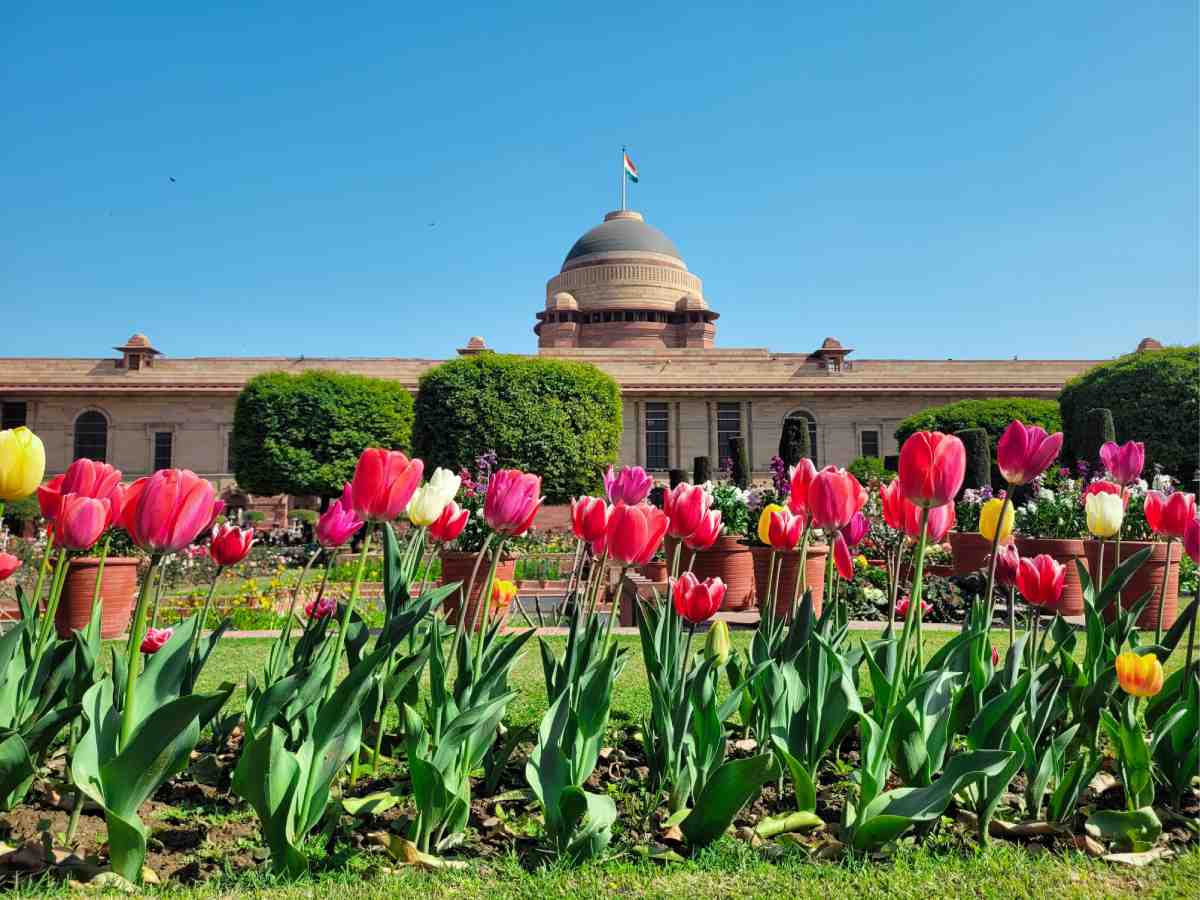
Tulips and roses are the highlight of the Winter Annuals at Amrit Udyan Photo: Umar Dar
As Amrit Udyan reopens to the public, its colours and fragrances draw thousands of visitors. Behind this seasonal transformation lies the quiet, generational labour of the malis, whose skill, discipline and continuity sustain one of Delhi’s most iconic public gardens year after year
As in the past, Amrit Udyan, formerly known as the Mughal Gardens, is thronged by visitors of all ages as it reopens to the public. Spread over 15 acres, the meticulously landscaped garden transforms from barren brown beds in September into a vivid tapestry of colours and fragrances by February.
Behind this annual spectacle lies the dedicated and often unsung workforce — the malis — whose relentless labour, generational expertise and quiet devotion bring the garden to life each year.
Generational gardeners
The gardeners of Amrit Udyan primarily belong to the Saini community, a traditional horticultural group from northern India with centuries-old expertise in floriculture and garden maintenance. Many trace their roots to families that have served here for generations.
As employees of the Central Public Works Department (CPWD), they live within the Rashtrapati Bhavan estate and are rarely transferred elsewhere. This continuity allows skills and techniques to pass seamlessly from fathers to sons, preserving practices refined over decades.
Pritam Dhariwal, associated with park development in New Delhi, notes that these gardeners often remain attached to Amrit Udyan throughout their working lives, developing a familial bond with the land.
Colonial origins
The garden’s story dates back to the British era. Designed in 1928–29 by William Mustoe under Sir Edwin Lutyens’ team, the original Mughal Gardens have been tended by malis since their inception.
Many present-day staff members were born within the Rashtrapati Bhavan estate, following fathers and grandfathers who worked here before them. One gardener recalled that his father served in the gardens for 36 years.
During Zakir Hussain’s presidency, the late leader was known for his deep affection for the gardens. He frequently interacted with the malis — discussing planting techniques, suggesting new varieties and valuing their opinions. Such engagement elevated their work from routine labour to a recognised and respected craft.
As sociologist Amita Baviskar writes in First Garden of the Republic: “The lakhs of visitors who file through the gardens in the spring little know that months of painstaking planning and hard labour have gone into creating this floral spectacle. From the brown flowerbeds of September to the rainbow colours and scents of February, it is the malis whose quiet and unremitting work makes the garden glow.”
Despite the blood, sweat and toil that go into the garden’s upkeep, these workers largely remain anonymous.
Labour and skill
At present, Amrit Udyan’s gardeners include highly skilled professionals known as phool malis, who are known for their expertise in flower cultivation.
Their routine is demanding. From September, when beds lie fallow, they prepare soil, plant saplings, water, prune and maintain lawns, channels and fountains. This sustained effort continues for months, until the garden reaches its peak bloom by February. Their work supports not only visual beauty but also functional elements such as shaded areas and water features.
The range of flora stands as a testament to their skill. Amrit Udyan houses over 140 varieties of roses — with some past records citing up to 159 — including ‘Just Joey’, ‘Queen Elizabeth’, ‘Christian Dior’, ‘Adora’, ‘Mrinalini’, ‘Taj Mahal’, ‘Eiffel Tower’, ‘Modern Art’, ‘Black Lady’, ‘Paradise’, ‘Blue Moon’ and ‘Lady X’.
Several roses are named after historical figures such as Mother Teresa, Raja Ram Mohan Roy and John F Kennedy, as well as characters from the Mahabharata, including Arjun and Bhim. Beyond roses, the gardens feature tulips, Asiatic lilies, daffodils, hyacinths and more than 70 varieties of seasonal flowers, including exotic bulbous and winter-blooming plants.
The garden also cultivates 60 of the 101 known varieties of bougainvillaea, with borders edged by alyssum, daisies and pansies. Nearly 50 varieties of trees, shrubs and climbers — including the Moulsiri tree, Golden Rain tree and the flower-bearing Torch Tree — thrive under their care.
Evolving spaces
Over the years, Amrit Udyan has expanded beyond its original design. During the presidencies of APJ Abdul Kalam and Ram Nath Kovind, new sections such as the Herbal Garden, Tactile Garden, Bonsai Garden and Arogya Vanam were introduced.
Malis played a central role in integrating traditional horticultural knowledge with modern practices. Regular training programmes, including sessions at Pusa, help sharpen their skills and keep them abreast of new methods.
As Amrit Udyan opens to the public from February 3 to March 31 — six days a week, from 10 AM to 6 PM, remaining closed on Mondays and on Holi — when visitors can throng, drawn to its colour and symmetry.
Amid the crowds, a pause among the blooms offers a reminder of the hands that nurture the garden year after year. The malis’ generational commitment has turned Amrit Udyan into a living symbol of India’s floral heritage and the quiet dignity of labour.
Elected to the Delhi Golf Club general committee, Mansher Singh says he wants to build…
A $780 million market built on pavements, where the pleasure of reading meets the price…
Supreme Court advocate Abhishek Pawar alleges women were denied washroom access for seven to eight…
Each day of closure costs shops in Khan Market and Connaught Place between Rs 60,000…
Delhi generates nearly 15,000 tonnes of waste daily, prompting the government to deploy 1,000 mechanical…
Delhi Police has issued an NOC for the Congress rally at Ramlila Maidan on November…


