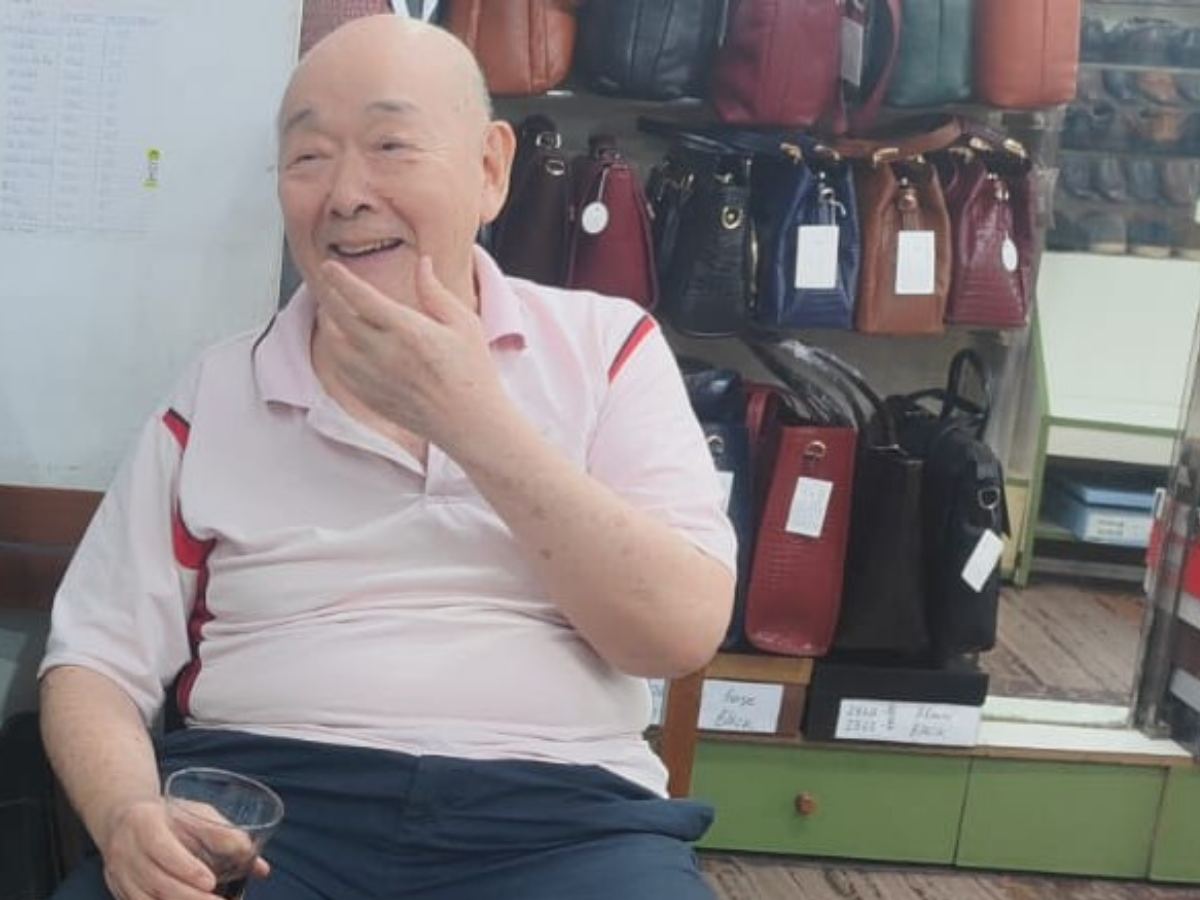
George Chew sits quietly in his shoe showroom at Connaught Place, listening to conversations between customers and salesmen. He no longer handles sales directly but continues the legacy his father began.
Chew started working in the shop in 1972, soon after completing his post-graduation in Chemistry from Hansraj College. Over five decades later, he has become one of the senior figures in the bustling business district — and the last Chinese-origin owner of a showroom in Connaught Place.
Until just a few years ago, another Chinese-owned shop, John Brothers, operated nearby. In the 1990s, as many as seven or eight Indian citizens of Chinese descent ran shoe showrooms in Connaught Place. Gradually, these businesses shut down, mainly because the younger generation chose different professions or migrated to countries such as Canada, the UK, and Australia.
The beginnings of D. Minsen & Company
In 1937, Chew’s father, Chew Yueh San, opened D. Minsen & Company in the F Block of Connaught Place. The store continues to operate successfully even today.
Originally from Canton in South China, Yueh San arrived in Kolkata around 1935 before moving to Delhi in search of better business opportunities.
By the 1970s, Connaught Place had around a dozen shops owned by people of Chinese descent. Most were bespoke shoemakers crafting custom shoes, sandals, slippers, and bellies for loyal customers. Others sold decorative items, crockery, and art pieces.
Among them was Chung Sem Nian’s showroom, Charles Semian, in F Block — famous for its craftsmanship and for Chung’s engaging personality. His wife worked alongside him.
In A Block, a grand showroom named Chinese Art Palace was established by a man named Wong, who also owned a large packaging business. He expanded to Karachi, Mumbai, Srinagar, and Shimla, appointing managers to oversee each outlet. Wong’s son eventually settled in the United States, and Wong handed over the Delhi showroom to his manager, Chen Kin Ten.
Another well-known shoemaker, Yep Thian, also ran a showroom in A Block. Known for his impeccable sense of style and his skill in making elegant high-heeled sandals, he drew a clientele of Delhi’s elite women.
Memories of a thriving community
Recalls Chew, “In D Block, there was a Chinese shoe showroom called Allied & Company, owned by Liu Thong Kian. Similarly, G Block housed Smart Shoes Company, run by Chung Yin Nian. In B Block, Liong Pin Chong operated a small shoe shop with his wife and daughter. Also in B Block, a part of Bhagwandas & Company housed a shoe showroom called Hopson & Company, owned by Liu Chi Hesin, who was reputed to craft excellent shoes in just two hours.”
Beyond Connaught Place, Lee Hon Kiong ran John Lee in Shankar Market. His business prospered until he closed it in the late 1980s and returned to his homeland with his family.
Also read: 15 per cent of deaths in Delhi in 2023 linked to air pollution: Report
When India and China went to war
The 1962 India-China war marked a difficult period for Delhi’s Chinese-origin residents.
Chew, then a student at St Columba’s School, recalls, “I was very young during the 1962 war, but I remember plainclothes policemen keeping watch outside our Connaught Place shoe showroom. They suspected we might have ties to China, but they were disappointed. After the war ended, a couple of policemen met my father and told him, ‘You are more Indian than any Indian.’”
During that time, homes and shops owned by Indian citizens of Chinese descent were placed under surveillance. Prominent names such as Kim Brothers in Jor Bagh, K K Lee in Khan Market, and Dr Chen, a dentist in Paharganj, also came under scrutiny.
Delhi’s Chinese professors
By the early 1960s, Professor Tan Chung and Professor Huang Yin Shu, a Chinese academic couple, had made Delhi their home. They taught at Delhi University (DU) and Jawaharlal Nehru University (JNU) for nearly four decades. The couple founded the Chinese and Japanese Studies departments at both institutions.
Professor Tan, a noted scholar of India–China relations, was born in India. When JNU was established, he moved there to set up the Centre for South East Asian Studies, while Professor Huang continued teaching at DU.
After retirement, they lived in East Delhi’s Sah Vikas Society before moving to the US, where their son, Dr Siddharth Chung, worked at AIIMS.
The Chinese-origin cricketer who wowed Delhi
Among Delhi’s cricket fans of the 1970s and 1980s, few names evoke as much nostalgia as S S Lee, a talented all-rounder and a local star.
Lee, related to George Chew, was known for his pace bowling, powerful batting, and athletic fielding. “It was a real treat to watch him,” recalls Shekhar Parashar, who played alongside him. “Avid cricket buffs of Delhi University used to throng the university ground to watch him play. Lee was a gem of a player with great control over speed and swing. From the very first ball, he was spot-on. He was also a very sporting player who appreciated opponents’ efforts — a virtue really missing now.”
An alumnus of Frank Anthony School and St Stephen’s College, Lee captained both his college and university teams in inter-college and Rohinton Baria Trophy tournaments. His hero was Bishan Singh Bedi, with whom he shared a close bond, strengthened by their mutual love of Punjabi, which Lee spoke fluently. Under Bedi’s captaincy, Lee played for Delhi in the Ranji Trophy.
Supreme Court advocate Abhishek Pawar alleges women were denied washroom access for seven to eight…
Each day of closure costs shops in Khan Market and Connaught Place between Rs 60,000…
Delhi generates nearly 15,000 tonnes of waste daily, prompting the government to deploy 1,000 mechanical…
Delhi Police has issued an NOC for the Congress rally at Ramlila Maidan on November…
CJP chief Abhijeet Dipke received conditional bail following his arrest for participating in a Connaught…
The DPCC has floated ₹104 crore tenders to test pilot pollution-control technologies across 40 key…

