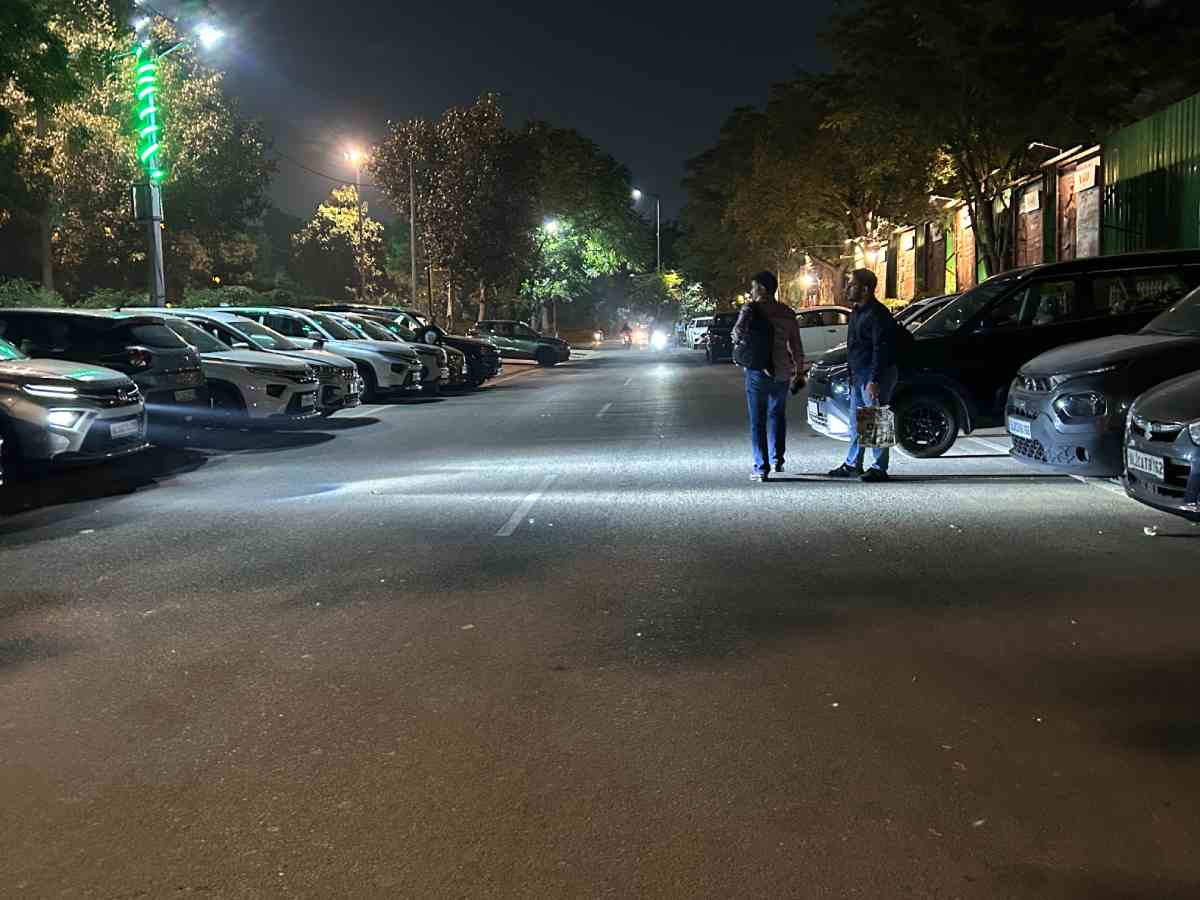
MCD’s implementation has reportedly encountered resistance from its elected wing
As Delhi continues to struggle with air pollution, a measure intended to discourage private vehicle use has exposed administrative difficulties in implementing environmental policies. While the New Delhi Municipal Council (NDMC) has doubled parking charges at its authorised facilities, the Municipal Corporation of Delhi (MCD) is yet to implement the increase across its approximately 400 surface parking sites.
The difference in execution between the two civic agencies has raised questions about the effectiveness of the Graded Response Action Plan (GRAP), particularly when a measure intended to reduce private vehicle use depends on separate administrative and approval processes.
For commuters in South Delhi and Central Delhi, the issue extends beyond government notifications. Around Munirka (MCD), Basant Lok–PVR Priya area (MCD), and RK Puram (MCD), as well as Sarojini Nagar (NDMC), Janpath (NDMC) and ITO (MCD), parking is part of everyday travel for office employees, students, shopkeepers and residents. While some commuters believe higher charges could encourage people to use public transport, others argue that raising parking fees without improving transport facilities would only increase their expenses.
The government’s directions provide for doubling parking charges during GRAP Stage II. While the NDMC announced revised charges from November 1, MCD’s proposal continued to face administrative hurdles.
Caught in approval process
The Delhi government’s directions under Section 5 of the Environment (Protection) Act, 1986, require authorised parking facilities to double their charges during GRAP Stage II. The objective is to discourage unnecessary private vehicle use when air pollution reaches severe levels.
However, MCD’s implementation has reportedly encountered resistance from its elected wing. The proposal requires approval from the House of Councillors, and previous attempts to introduce higher parking charges failed to secure the necessary support.
According to an MCD official, the House had sent the previous proposal back, forcing the corporation to prepare a fresh one.
The official also pointed toward complications arising from existing agreements with private parking contractors.
The official told Patriot that implementing the revised parking charges could be challenging because private contractors manage several parking facilities under existing agreements, which would need amendment before new rates could be introduced.
Question by commuters
Around the Munirka Metro Station and the adjoining market, a multilevel parking serves people travelling for work, shopping and other daily activities. The area also experiences pressure from vehicles parked along surrounding roads. Car owners who use the facility regularly say doubling parking charges could substantially increase monthly expenses.
One such commuter, BR Gautham, told Patriot, “I use my car almost every day because my workplace is not easily accessible through public transport. If parking charges double, my monthly expenses will increase. But I cannot simply stop using my car because the government wants people to use public transport.”
For students travelling through Munirka, the issue is also connected to affordability. Many students use two-wheelers because they find them convenient for travelling between their accommodation, university and nearby markets.
Janhvi Singh, 27, a Jawaharlal Nehru University student, told Patriot, “Students already have to manage several expenses. If parking charges increase, it will affect us too. I understand that the government wants to reduce pollution, but public transport should also be affordable and convenient enough for people to make that switch.”
The difference of opinions highlights a larger problem. While higher parking charges may discourage some people from using private vehicles, they may not influence commuters who depend on their vehicles for daily travel.
A similar concern emerges among people visiting Munirka Market for short periods.
Deepak Kumar, who runs a pharmacy in Mahipalpur, said, “I do not park here every day. I usually bring my vehicle when I have some work in the market. If the charges increase, I may prefer taking the metro. But people who have to carry heavy items or visit several places may not have that option.”
He added, “Diwali is over, but pollution is still severe, and people have returned to work. If everything keeps getting expensive, how will a common person manage? Petrol is costly, groceries are costly, and now parking charges are increasing too. What is an ordinary person supposed to do? I have employees to pay, and I have just given my workers their Diwali bonus as well. Managing all these expenses is becoming difficult.”
Women commuters’ concerns
For women travelling across South Delhi, the decision to use public transport is not always based on cost alone. Travel timings, safety, waiting time and the distance between metro stations and destinations can influence their choice.
A woman commuter travelling through Vasant Vihar may find a private vehicle more convenient, particularly when returning late or travelling with family members.
A woman commuter, Sunita Sinha, told Patriot, “Sometimes I prefer using my own vehicle because I feel more comfortable travelling directly to my destination. If parking becomes expensive, I may consider taking the cab, but safety and convenience also matter. The government cannot expect everyone to change their travel habits simply by increasing parking fees.”
Another commuter using a two-wheeler around RK Puram questioned whether the policy gives enough attention to smaller vehicles: “People generally discuss parking charges for cars, but two-wheeler users also have to pay. Even a small increase matters when you park almost every day. If the government wants to reduce the number of vehicles, it should also explain what alternatives are available.”
These experiences underline the importance of considering different categories of commuters before evaluating the effectiveness of a parking fee increase.
Difference in implementation
According to a report by The New Indian Express on November 5, NDMC doubled parking charges from November 1 until February 28, 2027, or until the specified GRAP Stage-II orders, whichever is earlier. The order exempted electric vehicles and monthly parking pass holders.
At relevant off-street facilities, four-wheeler charges increased from Rs 20 to Rs 40 per hour, while two-wheeler charges increased from Rs 10 to Rs 20 per hour.
The difference in implementation also raises questions about the administrative structure of the two civic agencies.
When approached for comment, Sonu Yadav, an NDMC parking operator at Sarojini Nagar Market, said that operators had been informed about the revised charges.
“We have been told about the new rates. It is displayed at the parking site so people know how much they have to pay. It is still too early to say if higher charges will make people use their vehicles less,” he said.
“I haven’t noticed any major drop in the number of cars so far. The numbers seem almost the same as before. However, the restrictions on BS-IV vehicles could also be affecting the situation.”
‘Could spike roadside parking’
On the possible impact of higher parking charges, Rajiv Kumar, a parking contractor in South Delhi, said some motorists might prefer parking outside authorised facilities if rates increase.
“People may start looking for cheaper places to park if authorised parking becomes expensive. Unless roadside parking is also monitored, vehicles will move to other areas,” he said.
The concern is particularly relevant around Munirka Market and the commercial areas of RK Puram, where authorised parking facilities and roadside parking exist side by side.
For local businesses, the possibility of higher parking charges also raises concerns about customers. Sumit Singh Gautam, who runs a furniture shop in Munirka Market, said that parking costs could affect market visitors.
“Many customers come here for furniture. If parking becomes expensive, some may avoid bringing their vehicles. But proper parking arrangements are also necessary; otherwise, people end up parking on the roadside, as tempo owners who carry furniture usually do,” Gautam said.
Residents’ concerns
For residents of Munirka and nearby neighbourhoods, parking congestion is not limited to designated facilities. Vehicles parked along roads and near market entrances often make movement difficult, particularly during busy hours.
Nivedita Mishra, a resident of Munirka, said that increasing charges would make little difference if roadside parking continued without proper monitoring.
“Vehicles are parked along the roads every day, making it difficult for us to move around. If authorised parking becomes expensive but roadside parking continues unchecked, what difference will the increase make? The authorities should enforce parking rules everywhere,” the resident said.
Another concern is whether commuters have convenient alternatives to private vehicles. Nilakshi Jha, who travels regularly through RK Puram, said that better public transport was necessary before people could be expected to leave their vehicles at home.
“Pollution is a serious issue, and something needs to be done. But the metro should be easier to access, buses should run regularly, and last-mile connectivity should improve. Only then will people seriously consider leaving their cars at home,” Jha said.
The issue also extends to Central Delhi, particularly outside the Shaheedi Park in ITO, where parking is managed by the MCD.
“The government’s restrictions on older vehicles during the pollution season have impacted the number of cars parked here. Earlier, we used to have around 100–120 cars, but now the number has dropped to approximately 75. However, this is expected to last only one more month, after which the situation should return to normal. As far as the restrictions are concerned, we currently know that they are in place until December. However, the government may extend them, so we cannot say for certain whether BS-IV vehicles will be allowed after December,” a parking operator told Patriot.
BMS-affiliated transport unions announced a Ramlila Maidan protest on Wednesday demanding higher auto-taxi fares and…
A truck driver died after his vehicle mounted a road divider and overturned near north…
A Delhi court ordered framing of charges against 14 accused in the NEET paper leak…
Nine fire tenders controlled an early-morning godown blaze in Delhi's Mundka Industrial Area on Wednesday;…
Delhi recorded its coldest morning of the season at 11 degrees Celsius, while the city's…
From a quick coffee break in Kamla Nagar to a casual outing in Satya Niketan,…

