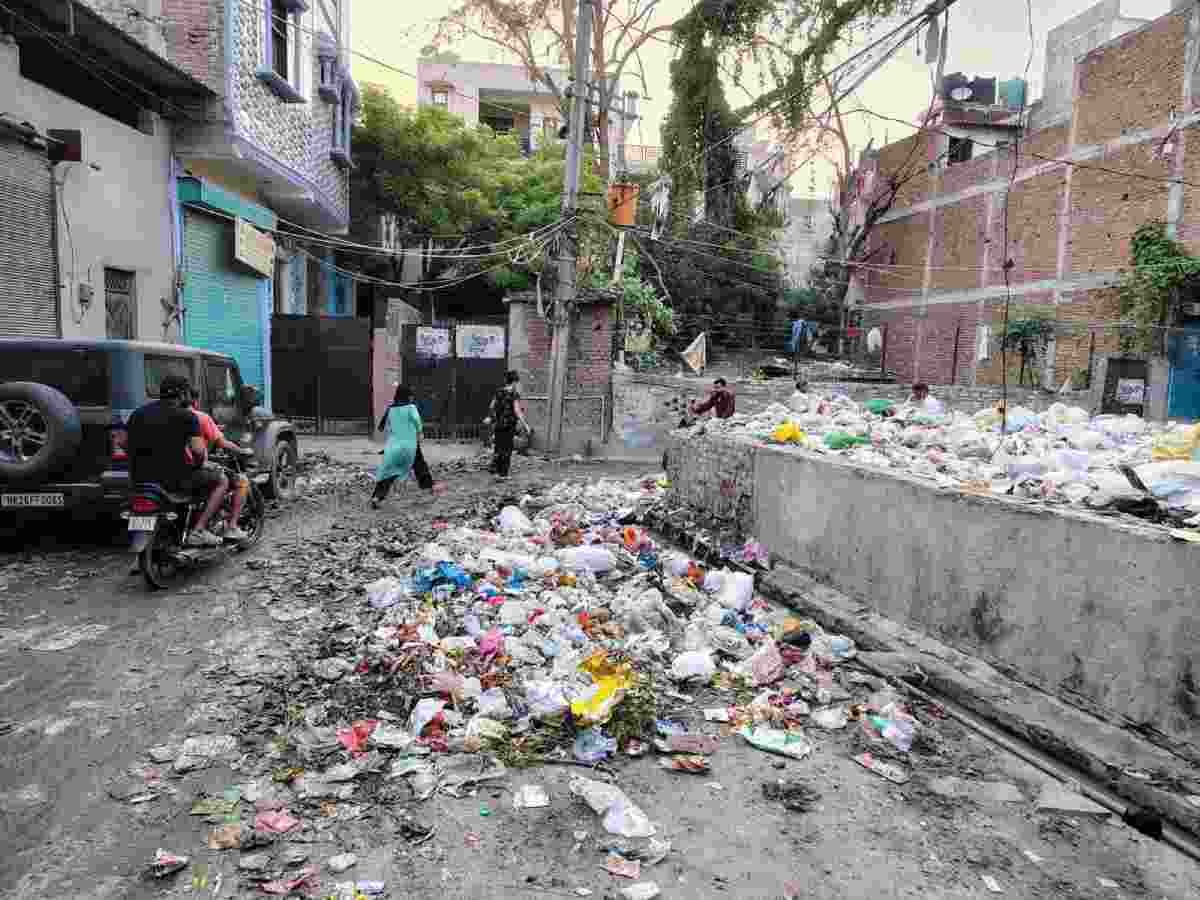
Heaps of garbage lying unattended on the streets of Sangam Vihar
For the over 10 lakh residents of Sangam Vihar—one of Delhi’s largest unauthorised colonies—the dream of a clean and dignified life has turned into a daily struggle against towering garbage piles and civic neglect. For more than a month, no municipal vans or sanitation workers have come to collect the waste, leaving the locality to choke under an ever-growing solid waste management crisis.
“Yeh zindagi nahi, ek azaab hai (This is not life, it’s a punishment),” said 58-year-old Meena Devi, a resident of G-block.
“Hamare gali ke kone pe teen mahine se kachra ka dher lagatar badhta jaa raha hai. Na koi gaadi aayi, na koi safai karamchari. Jab bhi kisi ko complaint karte hain, woh bolte hain ki yeh toh unauthorised area hai. Kya hum insaan nahi hain? (The garbage pile at the end of our lane has been growing for three months now. No vehicle has come; no cleaner has appeared. Every time we complain, officials say this is an unauthorised area. Are we not human?)” she added.
A crisis building, a system failing
Sangam Vihar falls under the jurisdiction of the Municipal Corporation of Delhi (MCD), but residents say the locality has been all but abandoned. With no structured waste collection mechanism in place, household garbage lies strewn across streets. For nearly a month, no sanitation workers or garbage vans have visited the area, turning the colony into a hazard zone.
Children play dangerously close to mounds of refuse swarming with flies and rodents. The arrival of the monsoon has worsened the crisis. Several lanes have become impassable due to a mix of plastic waste, rotting food, and rainwater—creating ideal breeding grounds for mosquitoes and bacteria.
“I have to cover my face with two dupattas just to cross the street,” said 26-year-old schoolteacher Salma Bano, who walks 15 minutes daily to her school.
“I teach about hygiene to my students, but we ourselves are surrounded by filth. Children fall sick every week with vomiting, diarrhoea, or skin infections. Our health is being sacrificed,” Bano said.
Where are the garbage vans?
One of the community’s main grievances is the absence of regular garbage collection vehicles. Residents report that while they occasionally spot a waste collection van near the periphery of the colony, it never ventures into the inner lanes where most people reside.
“I’ve been running a tea stall here for 18 years,” said Sanjay Yadav near A-block. “Earlier, at least once a week a garbage van would come, and the safai karamchari would help us clean. For the past 25 days, nobody has come. We are left with no option but to collect our daily waste and throw it out ourselves.”
His frustration was palpable. “We may not live in a posh colony, but we pay taxes when we recharge our phones, when we buy goods. Why does the government forget us every time?” Yadav asked.
Layers of neglect and legal inertia
Part of the issue stems from Sangam Vihar’s status as an unauthorised colony, placing it in a bureaucratic grey zone. While residents have access to water tankers and electricity, solid waste management remains glaringly absent.
Municipal officials admitted that Sangam Vihar lies in the Central Zone, which has faced sanitation problems following the lapse of the previous garbage collection contractor’s agreement.
A senior MCD official stated that a new agency has now been appointed on an interim six-month basis to manage waste collection. “The agency currently covers about two-thirds of the zone, and we are working to extend its services to the remaining areas shortly,” the official said.
Citizens’ makeshift solutions—and desperation
Residents say the last time they saw a municipal garbage collection van in their area was over two months ago. Since then, many have resorted to dumping waste in open drains or burning it—leading to air and water pollution.
“No sanitation worker comes here, and no garbage collection van ever shows up,” said Irfan Malik, a 41-year-old auto driver from F-block. “People have started dumping waste directly into the drain, which has only made the smell and mosquito problem worse. The government only remembers us during elections—after that, we don’t exist.”
“There’s so much garbage piled up outside our house that just opening the door hits you with a wave of stench,” said 35-year-old homemaker Suman Sharma from C-block. “My children keep falling sick, and we end up at the clinic almost every week. Are we not human beings that even the basic right to cleanliness has been taken away from us?”
Thirty-year-old Shaheen Anjum, a mother of two from E-block, shared similar fears. “My children play just a few feet away from a garbage dump that hasn’t been cleared for months,” she said. “I live in constant fear they’ll fall ill. We’ve made complaints, begged the authorities—but no one cares because we’re from an unauthorised colony.”
Expert warning: A public health emergency
Health experts warn that the unattended waste in Sangam Vihar could trigger a full-blown public health crisis.
Dr Tushar Tayal, Consultant in Internal Medicine at CK Birla Hospital, Gurugram, explained the dangers: “When household waste is left unattended on the streets, as seen in Sangam Vihar, it becomes a breeding ground for multiple health hazards, especially in densely populated urban settlements. In the absence of regular waste collection, rotting garbage attracts flies, mosquitoes, rats, and stray animals, which in turn become carriers of infectious diseases.”
He said one of the immediate risks is the surge in mosquito-borne illnesses like dengue, chikungunya, and malaria—already common in Delhi during the monsoon. “Piles of garbage trap rainwater and create perfect mosquito breeding sites,” he noted.
“Additionally, open waste often leads to gastrointestinal infections such as diarrhoea, cholera, typhoid, and hepatitis A—especially affecting children and the elderly. Airborne infections are another major concern. Decomposing organic waste releases harmful gases like methane and ammonia, contributing to foul odours and worsening respiratory problems such as asthma, bronchitis, and allergic reactions,” Dr Tayal added.
He warned that people living close to these waste heaps often suffer persistent coughs, throat irritation, and eye infections. “Improper disposal also raises the risk of skin infections and injuries due to hazardous materials in household waste. Rats and stray animals rummaging through garbage can spread leptospirosis and other zoonotic diseases, posing a silent but serious threat,” he said.
Administrative lapses and inaction
On April 5, the District Magistrate (South) submitted a report to the National Green Tribunal (NGT), highlighting poor coordination between the Delhi Jal Board (DJB) and MCD in allocating land for a waste disposal and management plant in Sangam Vihar. The report flagged serious hygiene concerns and deficiencies in solid waste management.
Earlier, in August 2024, the MCD informed the NGT that Sangam Vihar generated approximately 35–40 metric tonnes of solid waste daily. Two of its wards lacked even a basic dhalao (secondary waste collection point) due to space constraints. The MCD said it had requested land from the Delhi Development Authority (DDA) to establish a fixed compactor transfer station—but had received no response.
A cry for dignity
As dusk descends on Sangam Vihar, the air thickens with the stench of rotting waste. Flickering streetlights cast shadows over plastic bags and discarded food. Children tiptoe around puddles of garbage water, and women clutch scarves over their noses.
“I don’t want luxuries,” said Meena Devi, gazing at the garbage mountain outside her house. “I just want to live without fear of disease. Is that too much to ask?”
Also Read: Dengue and Malaria cases surge in Delhi as monsoon intensifies
Just a few lanes away, Ram Prakash, a 50-year-old stationery shop owner, watched rats scurry across a clogged drain outside his store.
“We are not asking for roads made of gold or AC buses,” he said. “We just want someone to take the garbage away. That’s it. The waste has been lying here so long, it feels like part of the neighbourhood now. My customers don’t even come inside anymore; the smell drives them away. And the worst part? We’ve been left to believe that this filth is normal. That this is what we deserve.”
At least 50 cases have already been reported this month; NCPCR guidelines mandate help desks,…
DMRC says zero reduction in train trips, attributes decline to security measures and public apprehension…
A Delhi court denied bail to a former DU professor accused of raping a student,…
Delhi Police charged seven dhaba workers in the fatal beating of a Manipuri musician who…
Seven Delhi STPs failed DPCC standards in September, dumping high levels of faecal coliform and…
AISA chief Neha Bora petitioned the Delhi HC against a police notice requiring a peace…

