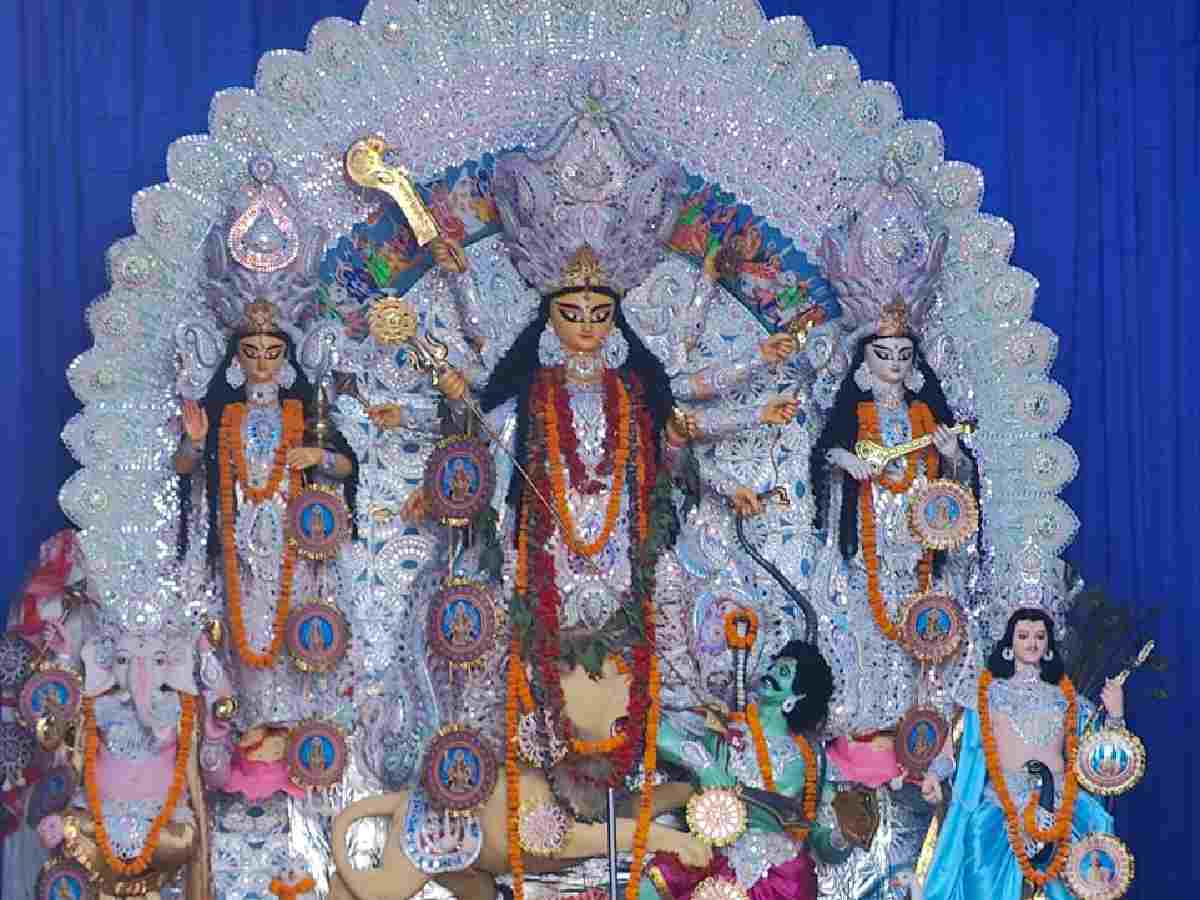
At 5 Daryaganj, the family of Dr HC Sen prepares for the upcoming Durga Puja, a cherished annual event in their community. Dr Sen, regarded by some as Delhi’s first allopathic doctor, was a respected figure among both the local populace and the small Bengali community of his time. The Daryaganj Durga Puja, initiated in 1948 at 5 Daryaganj, later shifted to the Commercial Senior Secondary School in the same locality.
Two decades ago, Daryaganj was home to a significant number of Bengali families, particularly along Ansari Road. As the area transformed into a commercial hub, most families relocated to other parts of Delhi. Yet they return each year to celebrate Durga Puja, a festival that continues to unite the community. Remarkably, the organising committee is led by a non-Bengali, Dr AK Singh, a renowned retina surgeon.
“We moved to Delhi in 1988 and settled in Daryaganj. Thanks to our Bihari roots, my wife and I quickly became part of the Durga Puja organising committee. In Bihar and Jharkhand, Durga Puja is celebrated with immense fervour and devotion,” Dr Singh shares.
Steadfastly traditional
While themed pujas are popular today, the Daryaganj Durga Puja remains steadfastly traditional. “We ensure our Durga Puja is conducted as it has been since its early years. It begins with Shashti, marking the goddess’s arrival. Artisans craft intricate clay idols of Durga, adorned with vibrant attire and weapons, and place them in elaborately decorated pandals. Devotees offer prayers, perform rituals like Anjali, and chant mantras. Cultural events, including dance, music, and dramas, enliven the festivities. On Dashami, the idols are immersed in water, symbolising Durga’s return to her celestial abode,” explains Dr Singh.
Dr HC Sen’s legacy
Dr Sen’s legacy extends beyond the festival. Visitors to Chandni Chowk, Fawarra, or Delhi Junction may notice Dr HC Sen Marg, a street named in his honour. Originally from Agra, where he worked for the Railways, Dr Sen moved to Delhi in 1879. “He began treating railway employees and locals, becoming deeply engaged in Delhi’s social life,” says Rana Sen, his great-grandson and a key figure in managing the Daryaganj Puja.
Dr Sen forged ties with prominent Delhi businessmen Lala Krishan Das Gurwale and Lala Sultan Singh, with whom he co-founded Hindu College at Kinari Bazaar. The college later relocated to Kashmiri Gate and eventually to the Delhi University campus. Around 1900, Dr Sen purchased a plot at 5 Daryaganj to accommodate his growing family, who still reside there.
However, some older Bengalis in Delhi dispute the claim that Dr Sen was the city’s first Bengali resident. They argue that goldsmiths and artists from Bengal, employed during the Mughal era, were the earliest Bengali settlers. In her book Delhi, in Thy Name (Rupa Publications), Adrija Roychowdhury writes: “The Bengali presence in Delhi today is often associated with CR Park. Less known is the long history of Bengali-speaking residents dating back to the late 19th century. At that time, Delhi was primarily Shahjahanabad, which explains why early Bengali settlers left their mark in Old Delhi.”
The first Kali Bari
Records suggest that Umacharan Basu, from Chandannagar in West Bengal, was Delhi’s first documented Bengali resident, arriving in 1837 to serve in the Mughal army. Three years later, in 1840, the first Kali Bari was established at Nigambodh Ghat, reflecting the Bengali community’s deep-rooted devotion to Goddess Kali. This temple, a vital cultural and religious symbol, was destroyed during the 1857 mutiny. Its idol was later salvaged and relocated to Roshanpura. In 1917, land was acquired in Tis Hazari, where the Kali Bari was re-established and continues to thrive.
Also Read: Lack of Bengali artisans hits Durga Puja pandals in CR Park
Half a century after Umacharan’s arrival, Dr Sen came to Delhi to attend a fair and decided to stay. He established a pharmacy in the Fountain area of Chandni Chowk, marking one of the earliest Bengali commercial ventures in the city. The Daryaganj Durga Puja and Dr Sen’s contributions remain enduring symbols of Delhi’s Bengali heritage.
New Delhi Kali Bari: the heart of tradition
New Delhi Kali Bari remains the epicentre for the capital’s numerous puja committees. Its celebrations adhere to time-honoured rituals unchanged since the 1930s, including traditional competitions in Rabindra Sangeet and recitation. Notably, former President Pranab Kumar Mukherjee was a frequent visitor. Before settling at its current location in 1935, the puja rotated across Dalhousie Square, Edward Square, Baird Square, and Sikandra Place.
Visiting the New Delhi Kali Bari for Durga Puja is a cherished tradition for Delhi’s Bengali community. Established in the 1930s on Mandir Marg near the Laxminarayan Temple (Birla Mandir), this iconic pandal emerged after the growing Bengali diaspora in Delhi was granted one acre of land on what was then Reading Road.
“The idol at New Delhi Kali Bari mirrors the revered deity at Kalighat Kali Temple in Kolkata. The temple committee, formed in 1935 with Netaji Subhas Chandra Bose as its first president, has preserved its traditions,” shares Manju Majumdar, former Principal of Union Academy School in Connaught Place, who has frequented the Kali Bari since childhood.
The spread of Durga Puja
When the Capital of India shifted from Kolkata to Delhi in 1911, many Bengali government employees relocated, settling primarily in Timarpur. “This led to Delhi’s second-oldest Durga Puja in 1913 at Timarpur. In 1919, employees of the Government of India Press, which later moved to Minto Road in 1941, initiated another puja, now held at Deen Dayal Upadhyay Marg. These historic pujas continue to thrive,” says Kishore Sen Gupta, an old Delhiwala Bengali.
By the 1940s, Durga Puja expanded to Lodhi Road (1944), Karol Bagh (1947), Daryaganj, and Mata Sundari Road (1948, now discontinued), followed by Vinay (Sarojini) Nagar and Moti Bagh. The 1960s saw further growth in neighbourhoods like Defence Colony, Ramakrishna Puram, Kailash Colony, Shahdara, Kamala Nagar, Tilak Nagar, Palam, Chanakyapuri, Hauz Khas, Green Park, Lajpat Nagar, Pandara Road, and Patel Nagar.
The 1970s and 1980s brought pujas to Chittaranjan Park, Safdarjung Enclave, Badarpur, Paschim Vihar, Nivedita Enclave, Vasant Kunj, trans-Yamuna areas, NOIDA, Faridabad, and Gurgaon. As Delhi expanded into the National Capital Region, Durga Puja celebrations multiplied in areas like Dwarka, Mayur Vihar, Vasundhara, Indirapuram, and Kaushambi.
Chittaranjan Park: the epicentre of festivity
Chittaranjan Park (CR Park), home to a large Bengali community from East Bengal (now Bangladesh), has become Delhi’s primary hub for Durga Puja. Each year, CR Park hosts grand celebrations with magnificent pandals, drawing huge crowds to its vibrant displays. As Durga Puja approaches, the neighbourhood transforms into a glittering spectacle, embodying the spirit of Bengali culture and devotion.
Elected to the Delhi Golf Club general committee, Mansher Singh says he wants to build…
A $780 million market built on pavements, where the pleasure of reading meets the price…
Supreme Court advocate Abhishek Pawar alleges women were denied washroom access for seven to eight…
Each day of closure costs shops in Khan Market and Connaught Place between Rs 60,000…
Delhi generates nearly 15,000 tonnes of waste daily, prompting the government to deploy 1,000 mechanical…
Delhi Police has issued an NOC for the Congress rally at Ramlila Maidan on November…

