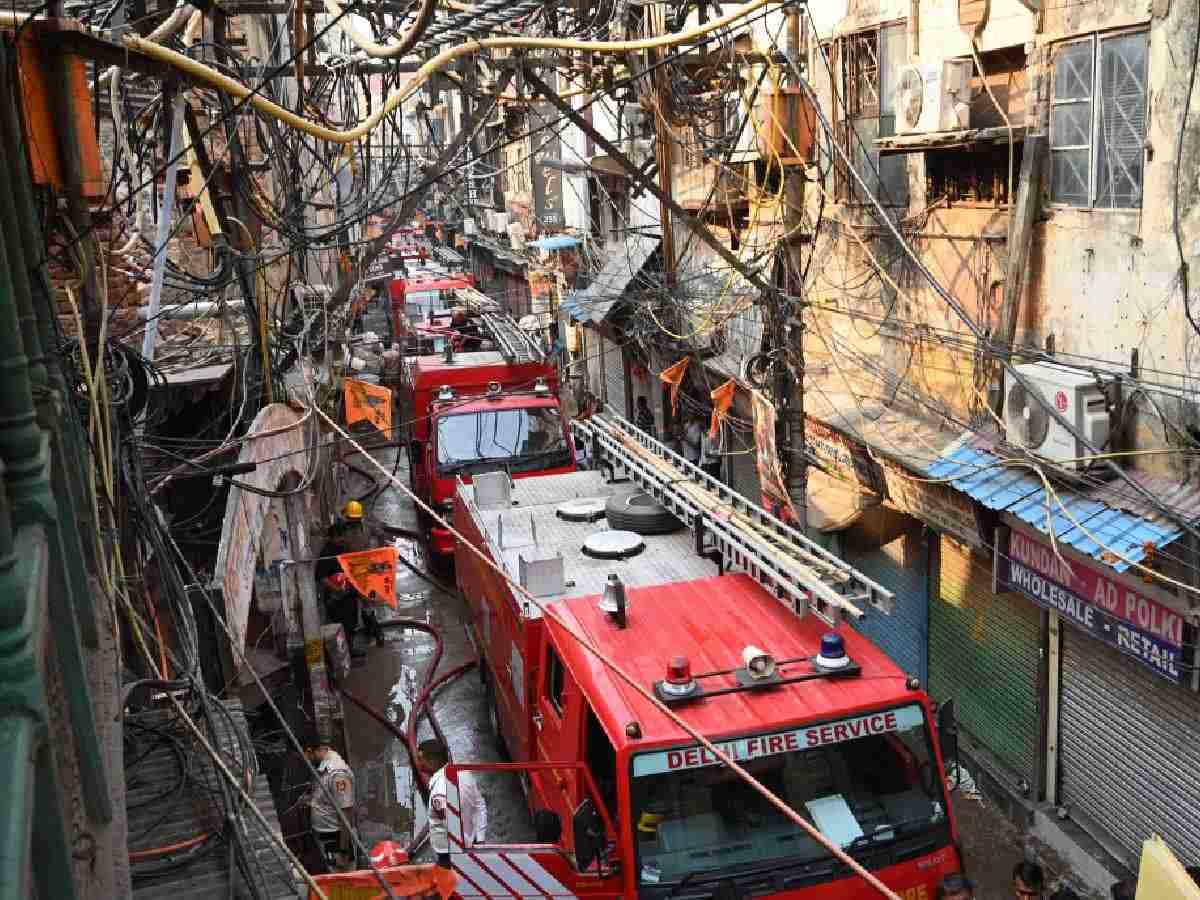
On December 6, a thirty-one-year-old grocery shop owner and his wife died after a fire broke out outside their shop in Delhi’s Tikri Kalan area, causing severe suffocation.
Officers arrived at the scene immediately. A preliminary enquiry suggested that a short circuit at the shop counter likely ignited plastic packets hanging nearby. Vineet and Renu, the couple, were unable to escape because of the thick smoke. In an attempt to flee, they lowered the shutter but became trapped, resulting in fatal suffocation.
“The police team forced the shutter open using a wooden log and rushed both victims to Oscar Hospital in Bahadurgarh, where they were declared dead on arrival,” an officer said.
The deceased, originally from Uttar Pradesh, left behind two sons. Renu’s sister, Alka, said the children first noticed smoke and alerted their father. She added that he received an electric shock while trying to raise the shutter. She has called for a full investigation.
Rising calls from West Delhi
Data obtained from the Delhi Fire Services (DFS) show that, for the past three years, the highest number of fire incidents in the national capital have occurred in its western districts.
According to the data, the West Zone, which includes the industrial-heavy North West and West Delhi districts, recorded almost 10,000 emergency calls in a year. Within the zone, Janakpuri recorded the highest number of calls, at 1,200.
Delhi’s areas are divided into three zones: the New Delhi Zone (East and Central districts), the South Zone (South and South West districts), and the West Zone (North West and West districts). These calls were recorded up to January 31.
A senior official informed Patriot that most calls originated from western Delhi due to high industrial activity.
“Areas such as Rohini and Wazirpur have historically recorded the highest number of fire incidents, and indeed the highest number of emergency calls,” he said.
Rohini recorded 1,874 emergency calls over the year, while Wazirpur recorded around 1,500. Rohini consists of four neighbourhoods; Wazirpur includes two.
Unsafe factories
Much of the fire risk in these areas is linked to industries that operate with poor safety standards. Many factories run in basements where the only ventilation is an exhaust fan, leaving workers in suffocating conditions.
A large number of these factories are unregistered and lack No Objection Certificates (NOCs) from the DFS.
“To obtain an NOC, they must first be registered with the Municipal Corporation of Delhi. The MCD will ensure compliance with labour laws and industrial norms. Only then do they ask us to conduct our inspection. We do not act independently unless we are provided with information,” a senior official said.
He added that NOCs are issued only after MCD clearance and DFS verification of windows, exits, fire-fighting equipment, and ceiling height.
These requirements are routinely ignored by Wazirpur’s illegal steel-manufacturing units located inside residential areas.
Tarakeshwar Manjhi, forty-one, a worker in Wazirpur Industrial Area, said even officially designated industrial units lack basic precautions.
“There are no fire safety measures in place. We have only one gate for entry and exit. We don’t have fire extinguishers either, though we do have one bucket of sand in case anything happens,” he said.
Illegal units in residential areas
Wazirpur Village, under Ashok Vihar police station, hosts numerous makeshift factories producing steel utensils and similar items inside residential premises. While Wazirpur Industrial Area is one of India’s largest steel utensil hubs, the village operates as an unauthorised extension of it.
Many units are partially shuttered, unmarked, or set up in basements connected to the outside only through an exhaust fan. A bouncer often stands outside to monitor movement.
Violations of the master plan
The Delhi Master Plan 2021 permits only twenty-eight types of small-scale domestic industries in residential zones.
“Factories mainly involved in incense-making, papad-making, assembly and repair of electronic goods, and a few other small industries are allowed to function from residential premises,” Additional Deputy Commissioner KD Verma of the MCD’s Factory Licensing Department said.
He noted that checks are in place to identify violators.
“We do not permit polluting industries such as chemical or paint units anywhere in Delhi, and we do not permit factories operating from residential areas,” he said.
Yet many units escape detection. According to RP Singh of AICCTU, more than 5,000 illegal factories operate across North District.
“We have identified these factories in multiple areas including Wazirpur Village, Mangolpuri, Siraspur, and Jahangirpuri. None are registered and all operate from residential premises,” he said.
Workers left unprotected
Because these units are illegal, they are not covered by the Occupational Safety, Health and Working Conditions (OSHWC) Code 2020, which applies only to establishments with more than twenty workers with power or more than forty without power.
Sachin Kumar Manjhi, twenty-one, a worker at a utensil-making unit in a residential area, suffered a severe injury due to a lack of safety gear.
“It was a normal working day. I was operating the powder-making machine when, while loading material, my hand got caught and two fingers were sliced off,” he said.
He received only Rs 3,000 as compensation before being dismissed.
His father, Tarakeshwar, said they could not pursue the case because there was no proof of employment. “None of the workers are issued identity cards, but we have no choice — we must work anyway,” he said.
According to Singh of AICCTU, such cases are frequent. “Recently we received two complaints of workers dying on the job. One was crushed to death, the other electrocuted. Complaints were lodged with the police, but nothing has happened because we cannot prove their employment,” he said.
Crackdowns make little difference
In 2018, the Delhi State Industrial and Infrastructure Development Corporation identified 51,837 factories in “non-conforming” areas.
News reports indicate that the MCD has taken action against 20,000 of them, leaving about 30,000 still functioning.
In October 2023, the National Green Tribunal ordered the MCD and Delhi’s Environment Department to close all factories in non-conforming or residential areas. It reminded authorities of its 2004 order mandating the closure of factories set up after 1990. The tribunal also sought a report from the Delhi Pollution Control Committee on an illegal dyeing unit.
Over the past five years, emergency calls from these areas have declined only slightly, even as illegal units continue to operate openly.
West Delhi remains both a victim of and contributor to the city’s growing fire hazard, its industrial clusters functioning as ticking time bombs.
Delhi inaugurates the 70th National School Games, hosting over 14,000 participants in 14 sports across…
Delhi High Court asked "Doosra" filmmakers to respond to Sourav Ganguly's plea over alleged violation…
Delhi L-G appointed Paralympian Suvarna Raj as State Commissioner for PwDs following her gold win…
DDA is planning Delhi's longest 24-km cycling track along the Yamuna floodplain, linking key eco-projects…
Police detained several anti-SIR protesters heading to the ECI headquarters in Delhi as mass gatherings…
An exhibition that revisits the significance of Indian Modernism through works from earlier and defining…
