As 2025 draws to a close, Delhi’s classrooms and campuses emerged as key arenas of civic mobilisation and political contestation.
Parents protesting private school fee hikes, students voting in high-stakes union elections, and policymakers pushing regulatory change ensured that education remained closely tied to questions of governance, equity and democratic participation in the capital.
Fee hikes dominate public discourse
One of the most visible education-related developments of the year was the prolonged protest movement against private school fee hikes. Beginning early in 2025, parents raised concerns over steep increases in tuition and ancillary charges across unaided private schools in Delhi.
Demonstrations were organised at locations such as the Delhi Directorate of Education and Jantar Mantar, where groups including the United Parents’ Voice pressed for regulatory intervention. Parents alleged that some schools imposed fee hikes ranging from 30–80% without adequate justification, placing pressure on middle-class households.
Protesters also highlighted instances where students were reportedly subjected to pressure or denied access to regular classes over non-payment of disputed fees, underscoring the human impact of the dispute. The issue remained in the public spotlight for several months, drawing responses from political parties and education authorities.
Change in government and fee regulation law
Mid-2025 marked a political shift, with the Bharatiya Janata Party assuming power in the Delhi Government. One of the new administration’s early priorities was private school fee regulation, responding to months of parental mobilisation.
The Delhi Cabinet first cleared a fee regulation ordinance, signalling its intent to introduce structured oversight. This was followed, during the Monsoon Session of the Delhi Assembly, by the passage of the Delhi School Education (Transparency in Fixation and Regulation of Fees) Bill, 2025.
Introduced by Education Minister Ashish Sood, the law mandates that private unaided schools seek government approval before increasing fees and disclose detailed fee structures. It provides for penalties, including fines ranging from Rs 1 lakh to Rs 10 lakh and possible de-recognition in cases of serious non-compliance.
A key feature of the legislation is the creation of school-level and district-level fee regulation committees comprising parents, school management and government officials. According to the government, the law affects nearly 37–38 lakh students across the city.
Debate and political contestation
The fee regulation law drew mixed reactions. Supporters described it as a long-awaited corrective measure, while critics, including some parent groups and opposition leaders, argued that it lacked adequate public consultation and stronger grievance redressal mechanisms.
Opposition parties accused the government of leaving scope for unauthorised fee increases, a charge the ruling party rejected. As a result, private school fees remained a politically contested issue even after the law was enacted.
Student elections at Delhi University
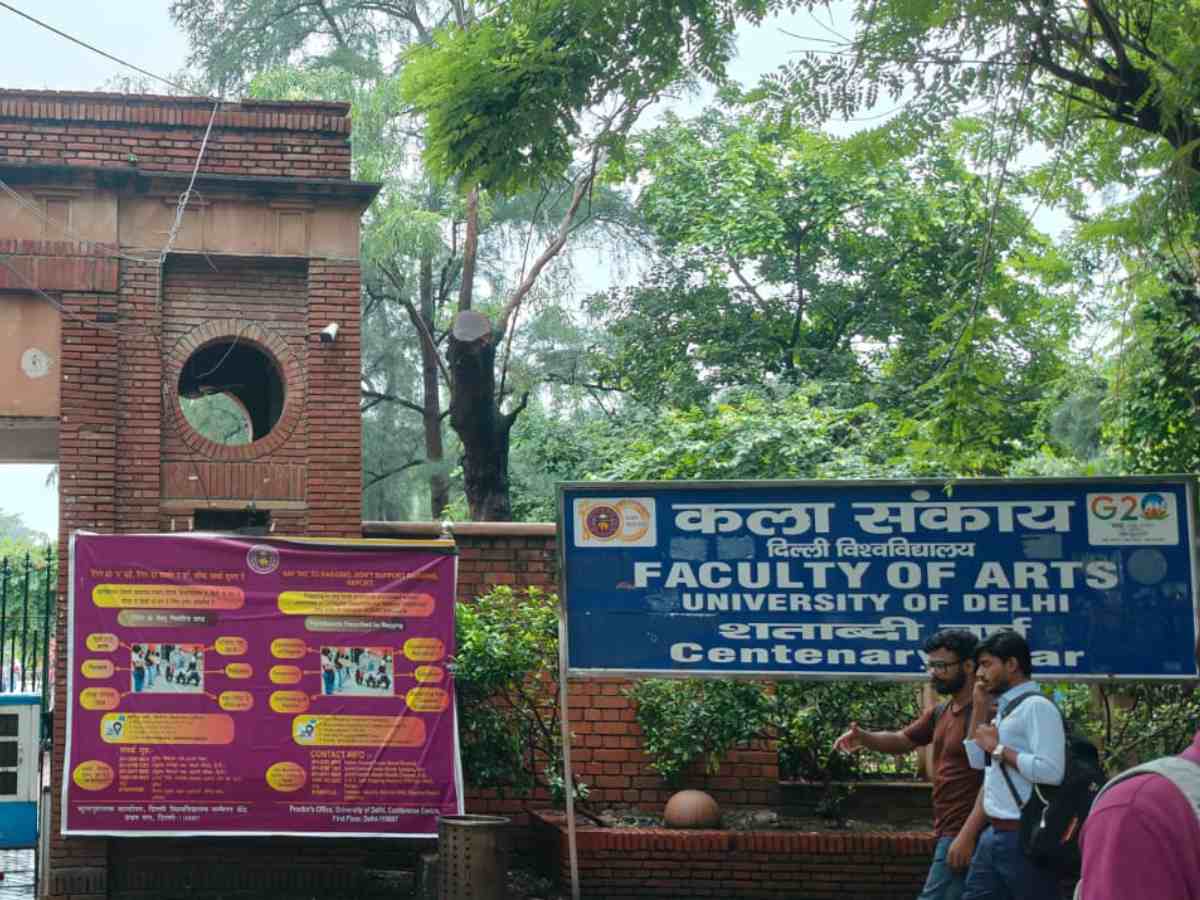
Campus politics also remained prominent in 2025. In September, Delhi University conducted its student union elections, one of the most closely watched campus events of the year.
Polling for the Delhi University Students’ Union Election 2025 took place across more than 50 affiliated colleges. Around 2.75 lakh students were eligible to vote at 195 polling booths, with turnout recorded at approximately 39.45%, slightly higher than in previous years.
The Akhil Bharatiya Vidyarthi Parishad won three of the four central panel posts, including the presidency. Aryan Maan was elected President, while the National Students’ Union of India secured the Vice President position through Rahul Jhansla. ABVP also won the Secretary and Joint Secretary posts.
Campaign debates focused on campus infrastructure, academic support, safety and inclusivity. University authorities noted the relatively peaceful conduct of polls under stricter monitoring and anti-defacement measures.
JNU and continued student activism
Jawaharlal Nehru University remained a focal point of student activism during the year. Delays in conducting student union elections prompted protests and sit-ins, with student groups demanding adherence to democratic timelines.
Various organisations, including ABVP and left-leaning alliances, campaigned on issues such as academic freedom, infrastructure and campus safety. Student activism at JNU also extended beyond electoral politics. The JNU Students’ Union led protests against the Supreme Court’s revised definition of the Aravali, arguing that it could have ecological implications for the region around the campus.
Beyond protests and elections
Education debates in Delhi during 2025 extended beyond fee regulation and student politics. While private school fees dominated headlines, concerns around government schools persisted.
Education experts and teacher unions reiterated the need to address learning gaps and staff shortages, cautioning that infrastructure upgrades alone were insufficient to strengthen public education.
The city’s expanding coaching sector and education technology platforms also came under scrutiny. Parents and policymakers called for clearer norms on fee transparency, advertising practices and student well-being amid growing competitive exam pressure.
Looking ahead
By the end of the year, Delhi’s classrooms and campuses reflected a period of heightened engagement rather than resolution.
While parents’ protests translated into a new regulatory framework and student elections reaffirmed the vitality of campus politics, debates over access, accountability and participation remain unfinished, set to carry forward into the years ahead.
Elected to the Delhi Golf Club general committee, Mansher Singh says he wants to build…
A $780 million market built on pavements, where the pleasure of reading meets the price…
Supreme Court advocate Abhishek Pawar alleges women were denied washroom access for seven to eight…
Each day of closure costs shops in Khan Market and Connaught Place between Rs 60,000…
Delhi generates nearly 15,000 tonnes of waste daily, prompting the government to deploy 1,000 mechanical…
Delhi Police has issued an NOC for the Congress rally at Ramlila Maidan on November…
