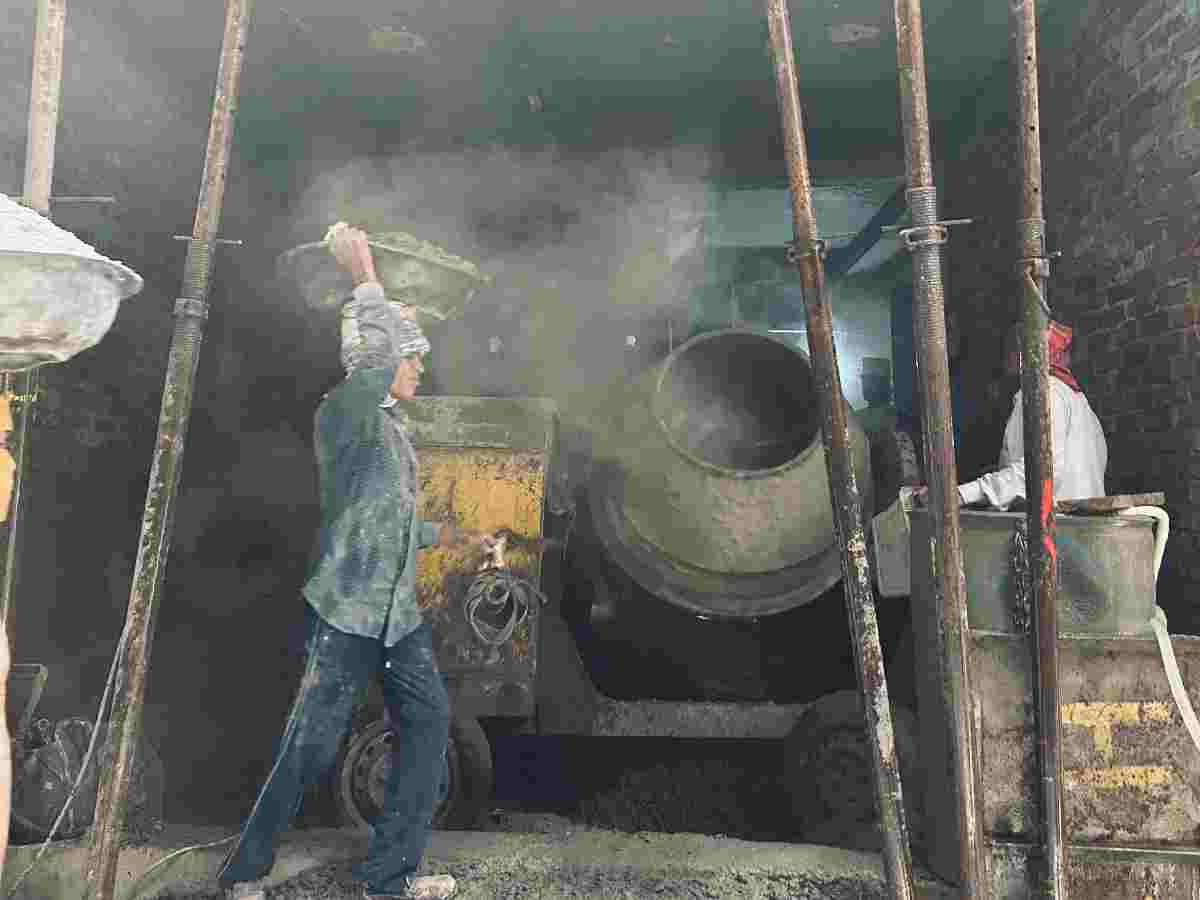
Construction in full swing in Munirka despite restrictions
With air quality deteriorating in Delhi-NCR, the Commission for Air Quality Management (CAQM) imposed restrictions on dust-generating construction and demolition activities across the region earlier this month. However, a ground visit to Munirka village in South Delhi found construction, painting and renovation work continuing at several locations. Residents cited security concerns and household repairs, builders pointed to projects that had already begun, and construction workers reported fewer opportunities to earn daily wages.
The pollution situation worsened around November 8, when Delhi recorded its most polluted Diwali in five years. According to CAQM, the city’s average AQI reached 376 on Diwali and stood at 370 at 9.05 AM the following morning. However, as per a report by The New Indian Express, the private monitoring platform AQI.in recorded a reading of 2,283 after Diwali. According to a report by The Indian Express, the Delhi Pollution Control Committee’s station-level data showed PM2.5 concentrations reaching 4,985 micrograms per cubic metre in Jahangirpuri and 3,744 micrograms per cubic metre in Mundka. The difference between government and private-platform figures highlighted gaps in pollution monitoring and variations in AQI calculation methods.
GRAP III was enforced earlier this month but was revoked on November 17. However, a prohibition remains on activities such as excavation, piling, demolition, brick and masonry work, major welding and gas-cutting, painting, polishing, varnishing and certain flooring activities. Cement and plaster work also face restrictions, with exemptions for minor indoor repairs and maintenance. Major road construction and repairs are prohibited, while pothole repairs are permitted. Specified essential infrastructure projects, including hospitals, railways, metro services, airports and water supply projects, receive exemptions under prescribed conditions.
Residents defend repair works
At Budh Vihar in Munirka, Arvind, 52, a building owner, was getting a gate installed at his property. He cited repeated thefts as the reason for the work.
“After repeated thefts at my property, I felt the need to install a gate for security. Clothes and other household belongings had gone missing several times, so putting up a gate had become necessary,” Arvind told Patriot.
He acknowledged the pollution concerns but maintained that the installation was unavoidable. “We know there is pollution, and we understand the restrictions. But this work was necessary. Otherwise, we would not have undertaken it. It is a small job, not a major construction activity,” he said.
Arvind also questioned what he described as unequal treatment of government and private activities. He pointed to road digging and other public works in the area and argued that residents should be able to complete essential household jobs too.
“When ordinary people get some work done, the government immediately talks about pollution. But government agencies themselves dig roads and carry out other work. If the government can undertake these activities, why can’t residents get their own small jobs done?” he said.
Builders cite ongoing projects
At another construction site in Munirka, work on a building had been underway for about one and a half to two months. Only the first floor had been constructed at the time of the visit, and the activity at the site generated visible dust.
Jagat Singh, 71, a Munirka resident and building owner, said the project had started before the restrictions came into effect. He argued that construction required continuity once work reached an advanced stage.
“Once you start constructing a building, you have to take the work forward and complete it. If you keep stopping in between, the work will never get finished. We are trying to complete it as soon as possible. We understand that pollution is a concern and are also trying our best to control it,” Jagat Singh told Patriot.
Sharif, the contractor working on the building, also pointed to the timing of the restrictions. He said the project had already been underway when the latest curbs came into force.
“The construction started around two months ago. The restrictions came in only this month. We are trying to complete the work quickly and are sprinkling water at the site to control dust,” he said.
Mohammad Mohsin, another contractor associated with construction work in the locality, said stopping a project midway could affect the building’s structure. He said contractors had to consider the stage of construction before halting operations.
Gaurav, another building owner in Munirka, said construction at his property had started only around a month ago. He maintained that workers did not carry out the activity regularly and that the site remained covered during the work.
“The construction started about a month ago. We do not work every day. However, the work takes place occasionally. We know that there is a construction ban, so we have covered the entire site while carrying out the work,” Gaurav said.
Renovation work afoot
Construction activity in Munirka was not limited to building projects. Workers were also installing tiles and undertaking other renovation work inside residential properties. Residents described these activities as minor household repairs and said they had not obtained separate permissions. They argued that small interior jobs should not face the same restrictions as large construction projects.
Another resident, who was getting his house painted, questioned the restrictions on household work and compared them with road-digging activities undertaken by government agencies.
“It is only a small painting job. It will take three or four days at most. We only have to apply a coat of paint. Why should such a small job be stopped?” he said.
He also questioned why residents faced restrictions when government agencies continued infrastructure work in the locality.
‘Work has reduced’
For construction workers, the restrictions have affected an already uncertain source of income. Manjeet Kumar, Mohammad Sahil and Mohammad Qasim, all construction workers from Bihar, said employment opportunities had declined compared with the previous year.
“There is much less work available this year compared with last year. Even small household jobs have become difficult to find,” said Sahil.
He said the restrictions had affected short-duration assignments such as plumbing, gate installation and minor repairs, which often provide daily earnings.
“These jobs usually last only one or two days. Someone calls us to install a gate or repair something, and we earn for that day. Even if the payment is small, it helps us manage our expenses. Now, finding these jobs has also become difficult,” Manjeet said.
The workers said daily-wage labourers felt the impact immediately because they depended on regular assignments to meet household expenses. Unlike people with fixed monthly salaries, they lose income whenever a day’s work disappears.
57 challans in South Zone
Meanwhile, the Municipal Corporation of Delhi (MCD) said it had stepped up inspections to enforce pollution-control restrictions. A South Zone official at the MCD’s Green Park office told Patriot that the civic body had issued 57 challans since November for violations of the applicable restrictions.
The official said inspections remained underway and the corporation continued to monitor prohibited activities, including construction and painting. The MCD did not provide a separate breakdown of challans issued in Munirka.
The ongoing construction and renovation work in Munirka highlights the challenges of enforcing pollution-control restrictions in densely populated residential neighbourhoods. Residents have cited security concerns and household requirements, builders have pointed to projects that began before the curbs, and workers have reported a decline in daily employment.
The MCD’s figure of 57 challans indicates enforcement across the South Zone, but the lack of locality-specific data leaves the extent of action in Munirka unclear.
As Delhi-NCR continues to grapple with poor air quality, authorities face the task of enforcing restrictions while distinguishing between prohibited activities and permitted essential repairs. In Munirka, residents, builders and workers are navigating those restrictions in different ways, while the extent of local enforcement remains unclear.
Gangster Naseem Durrani, accused in the Delhi murder case, was killed in a joint police…
Delhi records its coldest morning of the season as minimum temperature drops to 10.5°C, while…
Biomass burning accounts for 33.3 per cent of Delhi's PM2.5 pollution; JNU records worst air…
Students from the first one-year master’s batch say they were never told that Honours and…
Court schedules December 1 hearing on framing of charges against three accused; 450-page chargesheet filed…
The project aims to ease traffic congestion across Saket, Ambedkar Nagar, Khanpur, Sangam Vihar and…

