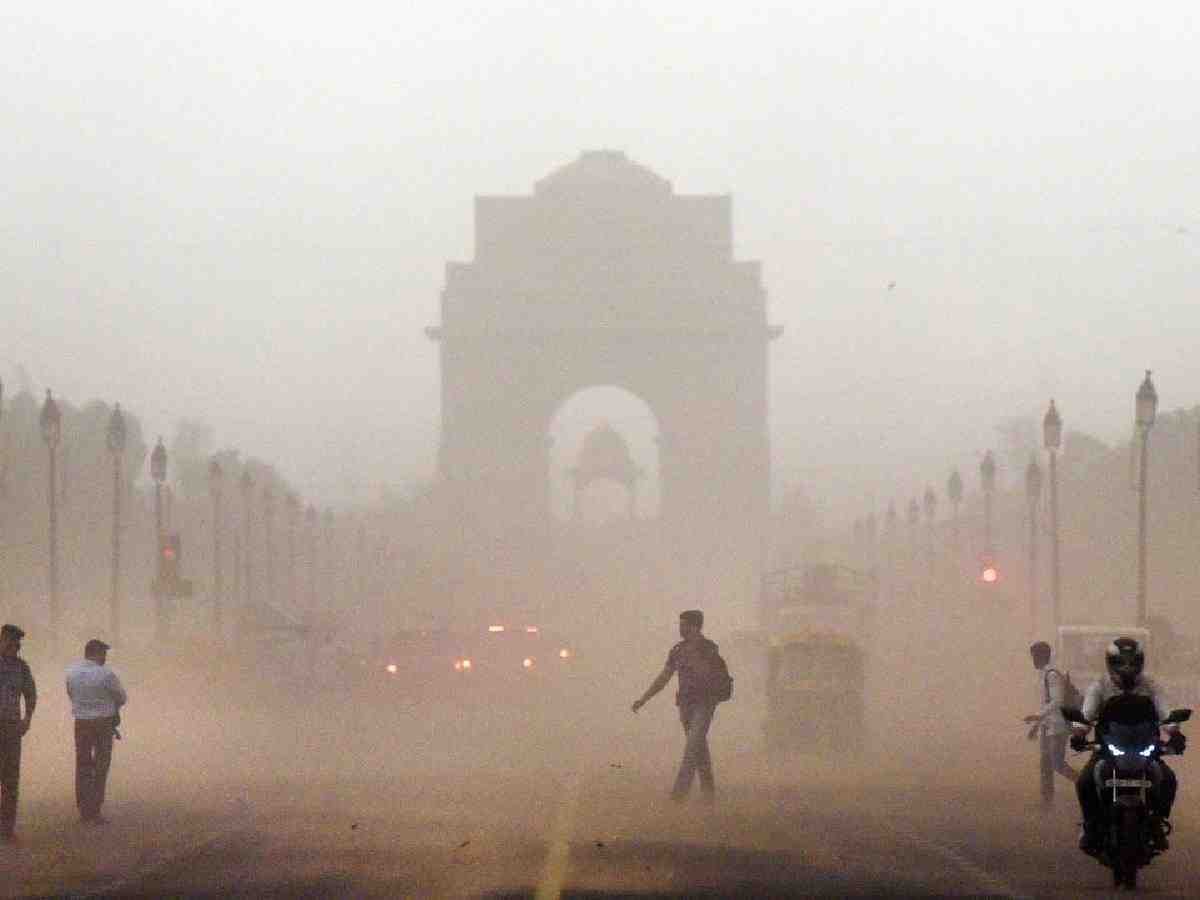
Due to a natural phenomenon known as hygroscopic growth of fine particles, the actual levels of harmful pollutants in Delhi’s air could be underestimated by as much as 20 percent, particularly during the city’s humid winter months, according to a recent study.
The study, published in Nature (NPJ Clean Air) by researcher Ying Chen from the University of Birmingham, reveals that air pollution in New Delhi — already among the world’s worst — may be far more severe than previously estimated.
As per the study, this overlooked factor could mean that thousands more lives are at risk than previously calculated. It provides a critical recalibration of how air quality is measured in the Indian capital and calls for urgent action to reassess both public health risks and mitigation strategies.
Delhi’s pollution problem: A grim reality
India’s national capital has long been recognised as the most polluted capital city in the world. With a population of more than 33 million and rapid urbanisation, Delhi’s air quality consistently ranks among the worst globally. The World Health Organization (WHO) estimates that Delhi’s annual average concentration of fine particulate matter — known as PM1 — is around 121 µg/m³, which is nearly 24 times higher than the safe limit recommended by the WHO.
According to previous estimates, air pollution in Delhi is responsible for around 10,000 premature deaths every year. However, Chen’s study suggests that the real toll could be even higher, as conventional air quality monitoring systems fail to account for the hygroscopic nature of particulate matter — the tendency of tiny airborne particles to absorb water and grow in size under humid conditions.
Are AQI measuring devices capable?
The study explains that when air sampling devices measure particulate matter, they typically rely on dry particle size thresholds. But in humid conditions, airborne particles swell due to water absorption, leading them to fall outside the collection range of the samplers. This “cut-off shift” means that a portion of the particulate mass goes unmeasured — resulting in a systematic underestimation of pollution levels.
In simple terms, Delhi’s air pollution is so severe that the instruments used to measure it are unable to fully capture the extent of contamination. “The more polluted the air, the larger the underestimation,” the report concludes.
The study found that in Delhi, PM1 concentrations could be underreported by up to 50 µg/m³ during humid winter mornings, especially during the rush hour between 8 and 9 a.m., when traffic emissions, cooking smoke, and stagnant air combine to create the perfect storm for pollution buildup.
Delhi’s winter hit worst, monsoon best
Chen’s study provides a detailed seasonal breakdown of Delhi’s pollution underestimation. During winter months (December–January), when humidity reaches nearly 90 percent in the mornings, pollution levels can be underestimated by up to 20 percent. Correcting this bias increases the average PM1 concentration from 250 µg/m³ to nearly 300 µg/m³ — far beyond acceptable health standards.
Also Read: Civic body accused of dumping construction waste in East Delhi amid pollution crisis
The spring season (February–March) also shows significant underestimation, with humidity levels of around 80 percent leading to an 8.6 percent miscalculation. Conversely, summer (April–June), the driest period of the year, records the lowest bias — less than 3 percent — because humidity is low and particle swelling is minimal.
During the monsoon season (July–September), frequent rainfall washes away many airborne particles, drastically reducing pollution levels. The study notes that chloride compounds, which increase particle hygroscopicity, are largely washed out by precipitation during this period, making the monsoon the cleanest time of the year for Delhi residents.
Science behind the discovery
The research is built upon comprehensive in-situ observations conducted at a “supersite” in New Delhi between 2017 and 2018, complemented by meteorological data from the Indira Gandhi International (IGI) Airport. The team used sophisticated thermodynamic models and the κ-Köhler theory, which calculates how particles grow by absorbing water vapour.
By simulating the real-world behaviour of particles under Delhi’s humid conditions, the study quantified how much pollution is lost in standard monitoring. The results showed a strong correlation between humidity levels and underestimation — rising exponentially when relative humidity (RH) exceeded 80 percent.
The findings also suggest that anthropogenic chloride — emitted from sources such as open biomass burning and household emissions — plays a major role in increasing the hygroscopicity of Delhi’s aerosols. These chlorine-rich particles attract moisture and grow rapidly, making them more difficult to measure accurately.
Global comparisons
A global comparison chart included in the study shows that while sampling bias due to hygroscopic growth occurs worldwide, it is especially pronounced in Delhi. In most cities, underestimation ranges between 2 and 5 percent. But in Delhi, the bias can exceed 15 to 20 percent during humid periods — a level unmatched by any other urban centre.
This finding implies that Delhi’s recorded pollution levels — already among the world’s highest — might be significantly lower than the true exposure experienced by its residents. The study suggests that previous comparisons between Delhi and cities such as Beijing may have understated the severity of the Indian capital’s pollution problem.
Public health implications
The implications of these findings are alarming. If actual particulate levels are higher than reported, public health risks are also greater. Exposure to fine particulate matter has been linked to respiratory diseases, cardiovascular problems, and even cognitive decline.
Experts say that the underestimation may also compromise early warning systems and government advisories. “Precautions during high pollution episodes may not be sufficient if the pollution itself is misrepresented,” the study cautions.
The study calls for recalibration of air quality monitoring instruments and emphasises the need for real-time correction factors that account for humidity-driven biases.
Policy and mitigation
The research highlights that tackling Delhi’s air pollution requires not only reducing emissions but also improving measurement accuracy. Controlling sources of chloride emissions — such as open burning, residential fuel use, and industrial discharges — would help mitigate both pollution and measurement bias.
The author also urges Indian authorities to expand in-situ studies of PM2.5 and PM10 (larger particle sizes) to understand the broader implications of hygroscopic effects across different pollutant categories.
“We call for more field-based studies to support better air quality management in New Delhi,” Chen concluded.
Families displaced by the Seemapuri building collapse spend another night on the streets as damaged…
Camera-based enforcement in Delhi generated around 40.6 lakh notices till September, but only about 2…
Delhi government to fast-track Rs 7,000-crore elevated Ring Road project, with two new Yamuna bridges…
Yamuna water quality deteriorated at three locations in Delhi in September, with BOD levels remaining…
Delhi liquor stores will remain shut on October 9 and 10 following police inputs to…
Strike began September 15; ESMA invoked by month-end has barred strikes for six months; drivers…
