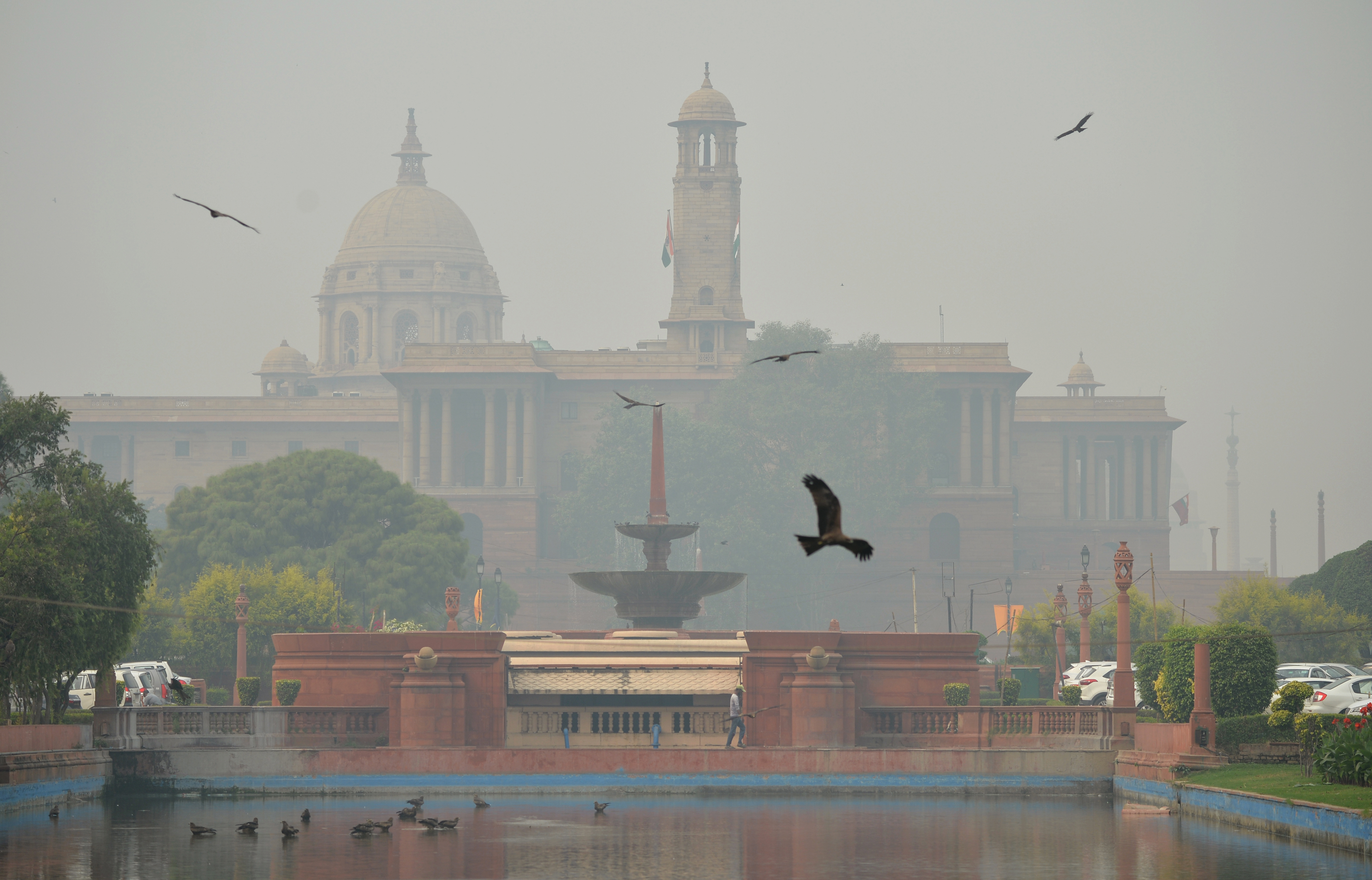
Thick air pollution is pictured around Rashtrapati Bhavan, the official residence of the president of India, and government buildings in New Delhi
Delhi and its adjoining regions were blanketed in haze on Wednesday, as the city’s air quality plunged deeper into the ‘very poor’ category. This decline was primarily due to a drop in temperature and calm winds overnight.
At 10 am, Delhi’s Air Quality Index (AQI) hit 372, marking the highest reading this season. The 24-hour average AQI stood at 359 on Tuesday, 347 on Monday, 325 on Sunday, 304 on Saturday, and 261 on Friday.
Several localities within Delhi, including Nehru Nagar, Sonia Vihar, Rohini, Wazirpur, Bawana, Mundka, Anand Vihar, and New Moti Bagh, witnessed a significant deterioration in air quality, falling into the ‘severe’ category. PM2.5 levels at these locations, known to cause respiratory problems, were six to seven times higher than the safe limit of 60 microgrammes per cubic meter.
Neighboring areas also reported poor air quality, with AQI readings of 280 in Ghaziabad, 318 in Faridabad, 254 in Gurugram, 333 in Noida, and 372 in Greater Noida.
Vehicular emissions (11% to 16%) and stubble burning (7% to 16%) were identified as major contributors to Delhi’s air pollution, according to a system developed by the Indian Institute of Tropical Meteorology (IITM) in Pune.
To tackle the situation, restrictions were imposed on vehicles operating between Delhi and cities and towns in Haryana, Uttar Pradesh, and Rajasthan within the National Capital Region (NCR). Only electric, CNG, and BS VI-compliant diesel buses were allowed, following directives from the Commission for Air Quality Management.
Efforts to combat pollution include the implementation of Bharat Stage VI (BS-VI) emission standards for vehicles sold in India since April 2020. These standards regulate air pollutants emitted by vehicles and focus on enhancing emission control, fuel efficiency, and engine design.
The IITM’s Decision Support System (DSS) revealed that pollution sources in Gautam Budh Nagar, Uttar Pradesh, contribute up to 14% to Delhi’s air pollution.
The Air Quality Early Warning System for Delhi predicted that the city’s air quality would continue to remain ‘very poor’ for the next few days. At 8:30 am, the relative humidity stood at 85%, with a minimum temperature recorded at 16.4 degrees Celsius. Clear skies were expected during the day. (With inputs from PTI)
Supreme Court advocate Abhishek Pawar alleges women were denied washroom access for seven to eight…
Each day of closure costs shops in Khan Market and Connaught Place between Rs 60,000…
Delhi generates nearly 15,000 tonnes of waste daily, prompting the government to deploy 1,000 mechanical…
Delhi Police has issued an NOC for the Congress rally at Ramlila Maidan on November…
CJP chief Abhijeet Dipke received conditional bail following his arrest for participating in a Connaught…
The DPCC has floated ₹104 crore tenders to test pilot pollution-control technologies across 40 key…
