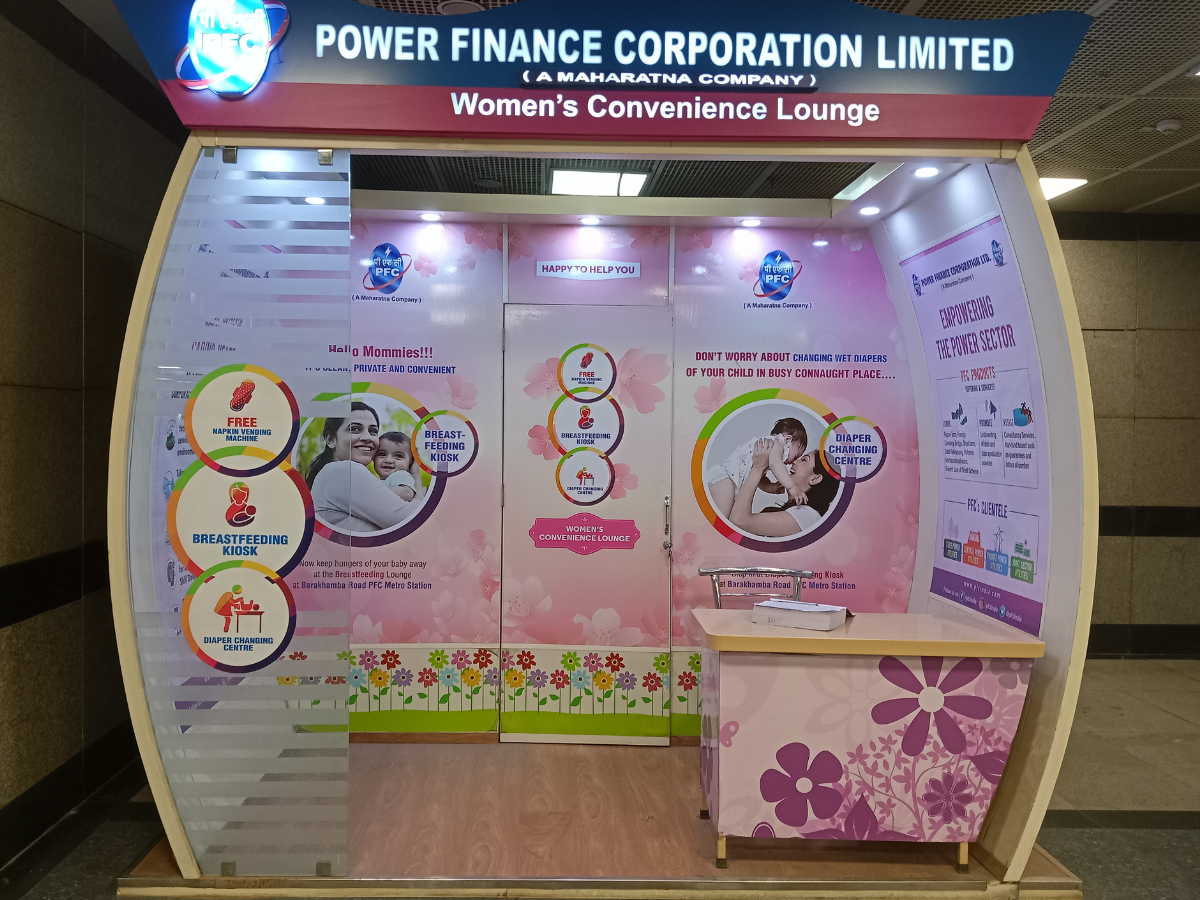
NO ONE TO VISIT: The kiosk receives little to no footfall
Back in 2020, a first-of-its-kind women’s convenience lounge was inaugurated at Barakhamba metro station on the Blue Line. Three years into its existence, there are hardly any visitors.
The lounge has a breast-feeding facility for mothers who want to feed their babies during the journey. It is also equipped with a diaper changing kiosk and also offers free sanitary pads. With a capacity to seat at least six women, the lounge has a woman helper at all times to assist commuters.
However, it hardly sees a nursing mother availing its services.
“Not too many women come here to avail the diaper-changing service. In fact, that part is largely empty throughout the day. Having said that, for sanitary napkins, the number of women differs from five to ten a day,” said Sonavar, who works at the desk of the kiosk and assists women there.
During the six hours that Patriot spent at the kiosk, only three women visited to pick sanitary napkins from the vending machine.
“Mainly because it is a corporate area and women who work in such companies don’t usually bring their children to their offices for inconvenience due to lack of creches around their workplace. Secondly, there is a serious lack of awareness about such a facility,” she said.
Women who take the Barakhamba metro to reach their workplaces or travel on that route frequently agreed with Sonavar.
“While we are happy that initiatives such as this are coming up, it becomes pointless because people cannot drop their infants at the kiosk and leave for work. There needs to be a day care centre at our offices for us to bring our toddlers to work in the first place. Since there are hardly any, women don’t travel with their children to work, so there is no question of changing diapers or feeding their children,” said Vishruti, who works at a coworking space HuntOffices.
The facility was set up by Power Finance Corporation (PFC) in a 100 square feet lounge with an aim to address multiple challenges faced by women, particularly mothers of newly-born, while commuting through public transport. It can be accessed from Gate No. 1 of the Barakhamba Road Metro Station.
“Only on special occasions such as Christmas and New Years, the number of breastfeeding mothers increases from zero to five or even 10 a day because Connaught Place is near and women hang out with their children around this area,” 22-year-old Sanovar added.
Today, the kiosk has turned to a safe space for women and a centre to build a secure community. “My colleague and I like to spend 20 minutes to half-an-hour at the kiosk on our way back home from work because it is a quiet space where we are not disturbed while we rest. Sometimes, we cannot wait for this little time that we take out for ourselves to have hearty conversations,” said 28-year-old Alisha, who gets off at the Barakhamba metro station every day to reach her workplace.
While the diaper-changing facility is hardly utilised at the kiosk, there are considerably more women who come to take sanitary napkins.
“For breastfeeding or nursing, there is hardly any woman. But for sanitary napkins, the number varies between 5 – 10 a day. If this kind of set up came up in more congested and market places such as Sarojini Nagar then it would have been more helpful for women, I believe,” said Sanovar, who joined the kiosk desk back in December 2020.
“When I joined, we used to get visitors once in two to three weeks, sometimes even more, availing the sanitary napkin vending machine because there was Covid-19 lockdown and the coronavirus scare was extreme, so people were mostly restricted to their homes. It was the same until 2022 when things slowly began to see some normalcy, especially with context to women’s commute,” she said.
Throwing some light on the supplies, Sanovar said that while there are no diapers at the kiosk and there is a diaper-changing facility, sanitary napkins are kept in bulk. “We get around 100 sanitary napkins at once and have to refill supplies in a week or 10 days,” she said.
Meanwhile, the PFC has been considering to expand its outreach programme on this front for more women to use the kiosk. “Our main purpose was sanitation and making women’s travel more and more hassle-free so that they feel safer and encouraged to take the metro. While we know that the reception is low, we are trying our best to spread awareness about it. Every year, we conduct awareness programmes around our initiatives, including the women’s convenience lounge to increase engagement. Even this year, we just hosted one on May 15 and will continue conducting similar programmes in the future as well,” said Shubham Saurav, handling the Public Relations of the PFC.
Delhi woke up to poor air quality, with the AQI at 225 and minimum temperature…
Delhi HC will rule Oct 23 on AISA chief Neha Bora’s plea against a police…
A CREA analysis shows Delhi's winter AQI has seen no steady gain since 2022, with…
DMRC will plant over 28,000 saplings across 991 MCD parks in 3 months to offset…
Delhi HC quashed an FIR against an SSC aspirant, ruling mere presence at a protest…
CJP leaders Saurav Das and Ashutosh Ranka sought more time to join the Delhi Police…

