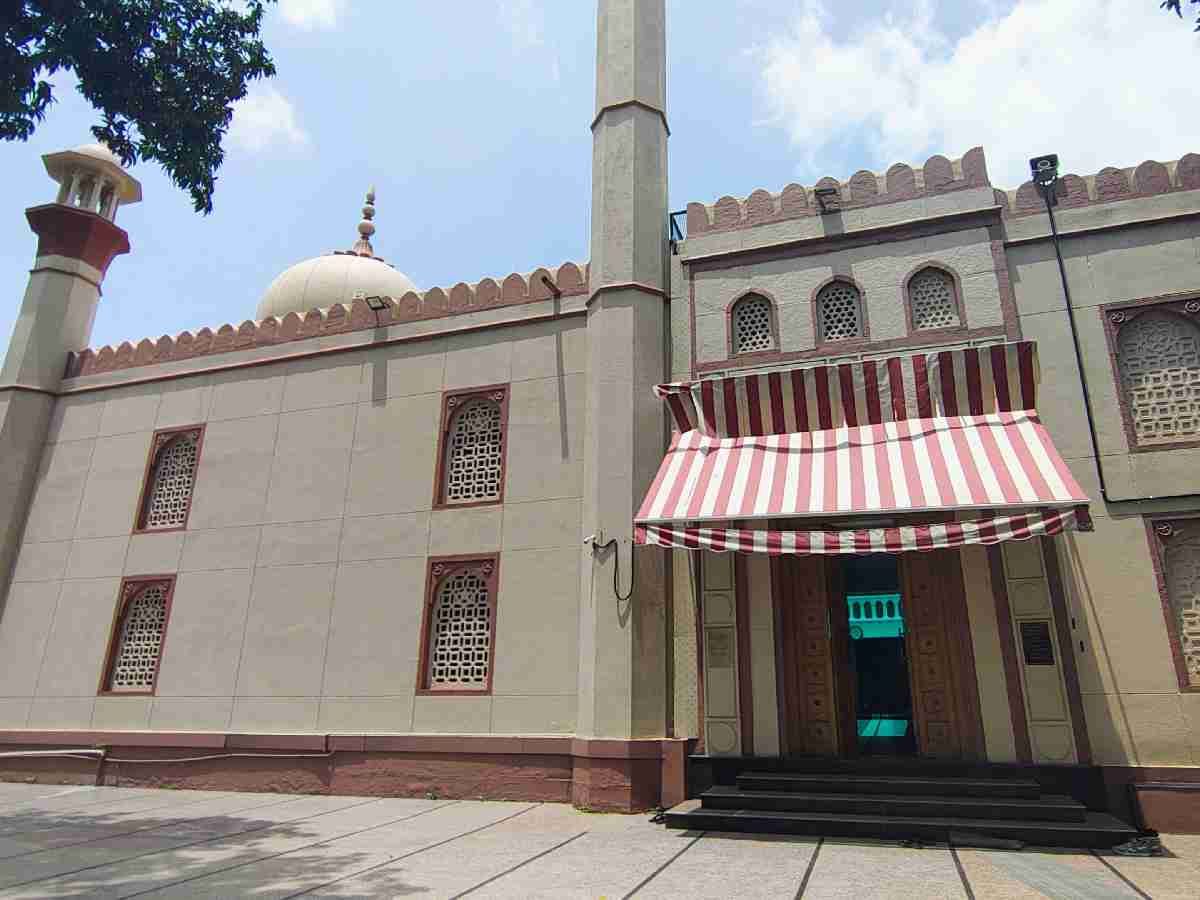
Parliament Mosque
Located near the North Gate of the new Parliament House, the 300-year-old mosque in New Delhi stands as a quiet but significant symbol of India’s journey from colonial rule to its emergence as a modern democracy. While it may lack the grandeur of its counterpart in Old Delhi, its role in the spiritual and political lives of India’s leaders has been profound.
A witness to the nation’s political evolution
The mosque has silently observed the arc of Indian political history—from the colonial era to the independence struggle, and through to the modern republic. Maulana Abul Kalam Azad, India’s first education minister and a prominent freedom fighter, regularly prayed at the mosque. Other key political figures, including former Presidents Zakir Hussain, Fakhruddin Ali Ahmed, and APJ Abdul Kalam, also frequented the mosque, particularly for Friday prayers (Jumu’ah).
Even today, many Muslim Members of Parliament and political leaders, especially those residing in central Delhi, continue to offer their daily prayers here.
As Imam Mohibullah Nadvi, who has led prayers at the mosque for the past 21 years, told Patriot, “Leaders coming here is not a new phenomenon; great political leaders irrespective of political parties have visited the mosque and its nearby tombs for years.” He added, “It’s not just a mosque; it has been part of our national life for decades.”
Uncertain origins and architectural evolution
The exact date of the mosque’s establishment remains unknown, though historians estimate it to be between 300 and 350 years old. Nadvi noted, “The early history of the mosque is still unclear. We are researching the matter, going through old letters and documents. But one thing is clear, the mosque has been at the very centre of New Delhi ever since it became the political capital of India.”
The first major renovation of the mosque took place in 1946, carried out by Bharat Chemical Works of Calcutta. This made the mosque more accessible to the growing political class of independent India. It soon became a key spiritual site for political leaders—a role it continues to play today.
Over the years, however, the mosque showed signs of structural distress. Sections of its roof collapsed, and its walls and gates fell into disrepair. A major renovation completed last month, funded by Padma Shri recipient MA Yousuf Ali—a Kerala-based businessman—restored the mosque to its former glory.
A symbol of unity and democratic values
While strolling near the tomb of former President Fakhruddin Ali Ahmed, Imam Nadvi reflected on the mosque’s inclusive character. “Everyone, irrespective of religion or beliefs, is welcome here. Muslims of different communities come here to pray,” he said.
The mosque’s design reinforces this modern inclusivity. Renovations undertaken in 2014 added a contemporary touch while preserving its historic character. Importantly, the mosque features a dedicated prayer space for women at the back, accessible from the main entrance—signifying its commitment to inclusivity and accessibility for all worshippers.
Diplomacy and spiritual symbolism
The mosque’s location adjacent to Parliament has made it a site of diplomatic interest as well. Nadvi shared, “Whenever the head of state of an Islamic country comes to India, they come to the mosque. The mosque has become a vital part of India’s democratic rise.”
In this way, the mosque stands not only as a spiritual anchor but also as a symbolic extension of India’s global and interfaith engagements.
An oasis of calm in political Delhi
Beyond politics and diplomacy, the mosque is a haven of tranquillity. Its boundary walls enclose a quiet, sacred space—a stark contrast to the bustling corridors of power surrounding it. At the back lies a small park, housing the tomb of Fakhruddin Ali Ahmed, further deepening the mosque’s serene aura.
Capable of accommodating around 1,000 worshippers at once, the mosque sees thousands more during the month of Ramadan, particularly at Iftar. It draws not only local residents but also visitors and dignitaries seeking a moment of reflection amid the hectic pace of the Capital.
What’s in a name?
Historian and heritage conservationist Sohail Hashmi offered a nuanced view on the mosque’s name and legacy. “I don’t think this mosque has that much heritage significance as people sometimes assume because of the name ‘Jama Masjid of New Delhi.’ In the late ’90s, some people started calling it that, but every city has only one Jama Masjid, and that one is already there in Delhi.”
Hashmi continued, “Since we can’t find the actual name anywhere, we can say that after Lutyens’ Delhi was developed around Raisina Hills, the Red Cross Society was built near the mosque, so the mosque also got that name—‘Red Cross Mosque.’ Similarly, now people call it the ‘Parliament Mosque.’ The name and the dates are unclear, but the significance of the place is quite notable.”
A forgotten heritage of everyday lives
Historian S Irfan Habib placed the mosque in a broader historical context. “All these mosques in Lutyens’ Delhi or near India Gate are centuries old and hold history and legacy, but historians, ASI, or authors never gave them much attention because they were not associated with historical figures and tales,” he said.
“Still, Shahi Masjid Zabta Ganj, Sunehri Bagh Masjid, and the Parliament Mosque have all witnessed British colonial rule, the freedom struggle, the pre-independence phase, and the post-independence era to this date.”
He gave the example of freedom fighter and Urdu poet Hasrat Mohani, who often visited the Sunehri Bagh Mosque. “He used to pray there, spend time, and even lived there,” Habib said.
“Similarly, the mosque near Parliament House welcomed Prime Ministers, Presidents, MPs, and many others who played a pivotal role in shaping post-independence India.”
Also Read: Sheesh Mahal reopens, but restoration exercise yet to be concluded
He added, “These mosques were not associated with kings and Mughals, but before Lutyens’ Delhi, many small villages and settlements were scattered across the area. The Muslim community obviously built these mosques back then, but we have no record of their actual construction dates. Still, they are all at least 150 to 300 years old.”
Rooted in the past, reaching into the future
The Parliament Mosque stands as a bridge between the old and the new, the past and the present, the political and the spiritual. It continues to serve as a vital spiritual anchor for the Muslim community in the heart of India’s capital.
Delhi Police says permission for the INDIA bloc’s November 1 rally at Ramlila Maidan remains…
Delhi’s AQI stood at 197 on Tuesday, remaining in the moderate category, while 27 of…
CPI general secretary D Raja leads a protest in Delhi, demanding the withdrawal of SIR…
From November 1, non-BS-VI vehicles registered outside Delhi will be restricted; workers who cross at…
Jamia Millia Islamia extends online classes and mid-term exams until Nov 8 following campus protests,…
The proposed Nov 1 Congress rally at Ramlila Maidan could severely disrupt peak festive business…


