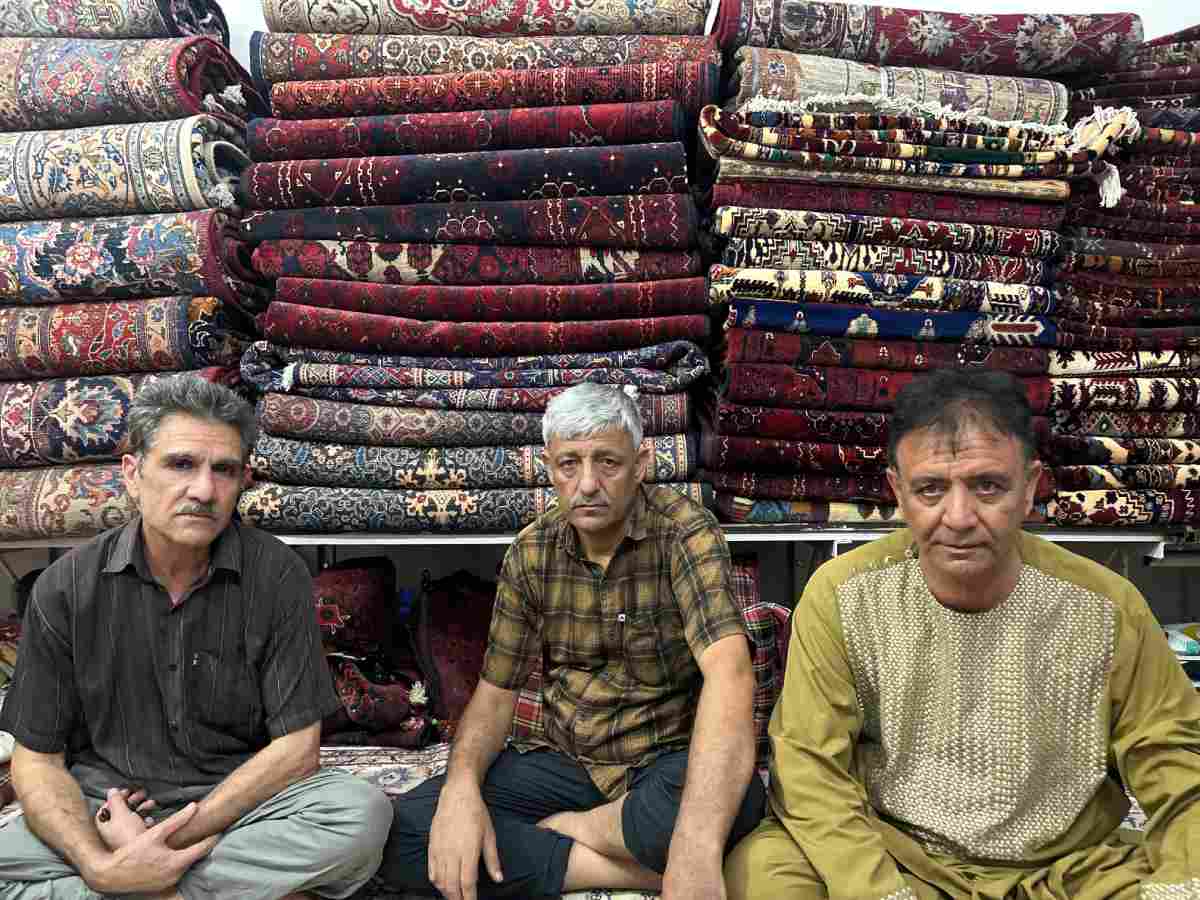
From left_ Abdul Hadi Faraz, Khwaja Qureshi and Abdul Saboor Arub, Afghan refugees living in Delhi
Abdul Saboor Arub once worked as an ophthalmologist in Kabul. In Delhi, the 60-year-old sells carpets. His wife, formerly a bank employee, has been unable to find work in India for more than a decade. Their three children were born here and consider themselves Indian, but the family still does not know where its future lies.
Five years after the Taliban returned to power in Afghanistan on August 15, 2021, the anniversary holds a different meaning for Afghans living in Delhi. For many, it is a reminder of the families, careers and lives they left behind. Some have not seen their parents in years, while their children are growing up away from their birthplace. They must also contend with the uncertainty of renewing their stay in India year after year.
In neighbourhoods such as Bhogal and Lajpat Nagar, where many Afghan families have spent years rebuilding their lives, Afghanistan remains a constant presence.
Careers left behind
Arub came to India in 2012 after, he said, the Taliban threatened him and demanded that he work for them as a medical professional. He now works in the carpet trade.
His wife left Afghanistan about a year after their marriage and has not seen her parents or siblings since. Their two daughters, aged 11 and 12, and nine-year-old son were born and brought up in Delhi. They have never visited Afghanistan and consider themselves Indian.
“Just allowing us to live in your country is not enough,” Arub’s wife said. “You see, my husband is a doctor, but he is selling carpets now. Do you think that is right?”
She said that she, too, was a banker but had no work. “We have been here for more than 10 years. The rent is high, food is costly, everything is expensive. But we have to stay here because we have nowhere to go.”
The family has repeatedly sought resettlement in Canada and the United States, where they have relatives. They said they had been told to wait and had now been waiting for more than three months for a response from the United Nations refugee agency (UNHCR).
Relatives in Canada, the United States and Australia have told them that they lead better and more dignified lives there. Arub’s wife said what mattered was not merely money or comfort, but the opportunity to work, earn and live independently.
Return remains out of reach Arub said the Taliban approached him in Afghanistan and asked him to provide medical assistance to their members.
“The Taliban told me, ‘Come with us and help us with medical needs. If someone is injured or sick, give them medicines and treatment.’ I told them I was an ophthalmologist, an eye doctor,” he said.
According to Arub, they told him that even an eye specialist could administer injections, dress wounds and give medicines to injured or sick people. When he refused, the Taliban threatened him and his family, especially the women in his family. He then fled Afghanistan and took refuge in India.
Some of the carpets he now sells come from Afghanistan. Despite being forced to abandon his profession, he continues to think about returning.
“Every moment, my mind says I want to go back, but I cannot,” he said.
Although Arub left Afghanistan years before the Taliban’s 2021 takeover, he has watched the country change from India. He said the restrictions imposed by the Taliban had transformed everyday life, particularly for women.
“Women’s education has been stopped. Girls can study only up to Class 6. After that, they are not allowed to study. They are not even allowed to work. The problems are very serious,” he said.
He remembers women who studied at universities, taught in schools or worked in government offices.
“Women who were studying in schools and universities, women who had jobs, teachers and people working in government ministries, all of them are sitting at home now,” he said.
Earlier, he added, women could study, work, run businesses and hold government jobs alongside men.
After more than a decade in India, Arub’s family still has no certainty about where it can settle permanently. The children attend school here, and the family earns its livelihood in Delhi, but it does not consider India a permanent destination. At the same time, the family does not believe Afghanistan is safe enough for it to return.
“If they give us the visa to go back to Afghanistan, they say we cannot come back to India again. That is why we are afraid,” Arub said.
The family, therefore, stays. The children attend a government school, his wife remains out of work and Arub sells carpets as they wait for an opportunity to resettle elsewhere.
A family divided between two countries
Abdul Hadi Faraz, 57, came to India in 2019 after his daughter Ramzia Faraz was diagnosed with cancer and required treatment.
Faraz had been managing his family’s business in Afghanistan. He stayed in India, and when the Taliban returned to power in August 2021, he did not go back. His other daughter, Aadia Faraz, remained in Afghanistan with her uncle. His wife also stayed there and died in 2025.
Faraz does not have regular employment in India. Relatives in Canada sometimes send him around $150–200 a month, which helps him meet his expenses. He has explored possibilities in Canada, the United States and Australia but has been unable to secure a visa or another route out for his family.
“If we go back to Afghanistan, we cannot come back here,” he said. “Every year, they give us the visa. We are able to stay here, but if we return, we don’t know whether we will be allowed to come back.”
His daughter Ramzia lives with him in India, while Aadia remains in Afghanistan with her uncle. He wants Aadia to join them, but that has not yet been possible.
“I want my daughter to come here, but she cannot. I am worried about her. I don’t know what will happen,” he said.
Growing up away from Afghanistan
Zia Ziaee, 18, was still a child when he came to India in 2018. His memories of Afghanistan centre on his school, his friends and the places where he grew up.
He has not spoken to those friends for years. When he left, he did not own a phone, and the friendships had depended on meeting face to face.
“I miss them a lot,” he said.
Ziaee still wants to visit Afghanistan one day. He remembers the country’s landscape and his school most fondly.
In Delhi, he studies while working at a dry-fruit shop, where he earns around Rs 12,000 a month. He helps support his parents, and his sister attends the same school.
Asked whether he had any expectations from the Taliban government, Ziaee said, “I have no expectations from this government. I don’t expect anything. Whatever you expect from them is not going to happen because they are against education.”
What he wants instead is simple: “We want everyone to have independence and better education. That has always been our hope.”
Rebuilding livelihoods in Delhi
Meer Agha, 40, has spent around 10–11 years in India. Originally from Badakhshan, he now works as a chef at Mazar Restaurant, preparing seekh kebabs, chicken kebabs, mutton kebabs and other dishes.
His family lives near Malviya Nagar. His father died in Delhi, while his mother remains with the family.
Agha left Afghanistan before the Taliban’s 2021 takeover, but the difficulties that drove him away had begun much earlier.
“There was a lot of hardship in Afghanistan. There was hunger, a lack of basic necessities and a lot of fear,” he said.
He added that there were few jobs and not enough schools, making life extremely difficult.
Khwaja Qureshi left Afghanistan for a different reason. He had worked with a non-governmental organisation affiliated with the previous Afghan government and said the Taliban threatened him because of his work.
Qureshi eventually fled Afghanistan with his family and came to India. He now depends partly on financial support from his brother abroad.
Five years later, the waiting continues
Five years after the Taliban returned to power, the consequences continue to be felt beyond Afghanistan.
The Taliban have consolidated control and brought relative security to many parts of the country after decades of war. At the same time, they have imposed sweeping restrictions on women and girls.
The Afghans interviewed in Delhi continue to wait for visa renewals, resettlement, employment and the chance to see their families and homeland again. They remain caught between a country they do not consider safe enough to return to and one where their future remains uncertain.
After 12 years in theatre, the actor makes his international film debut with a role…
Protester alleges Delhi Police assaulted detainees, deleted phone videos, and detained minors during anti-CEC protest…
Shifting protests away from Jantar Mantar weakens democratic visibility and access to political power, an…
CM Rekha Gupta defends SIR and EC integrity, saying democracy can't be held hostage to…
AISA students march to Supreme Court over 'vote chori' claims against CEC, as police barricade…
DMRC extends closure of six central Delhi metro station gates until 5 pm citing security…

