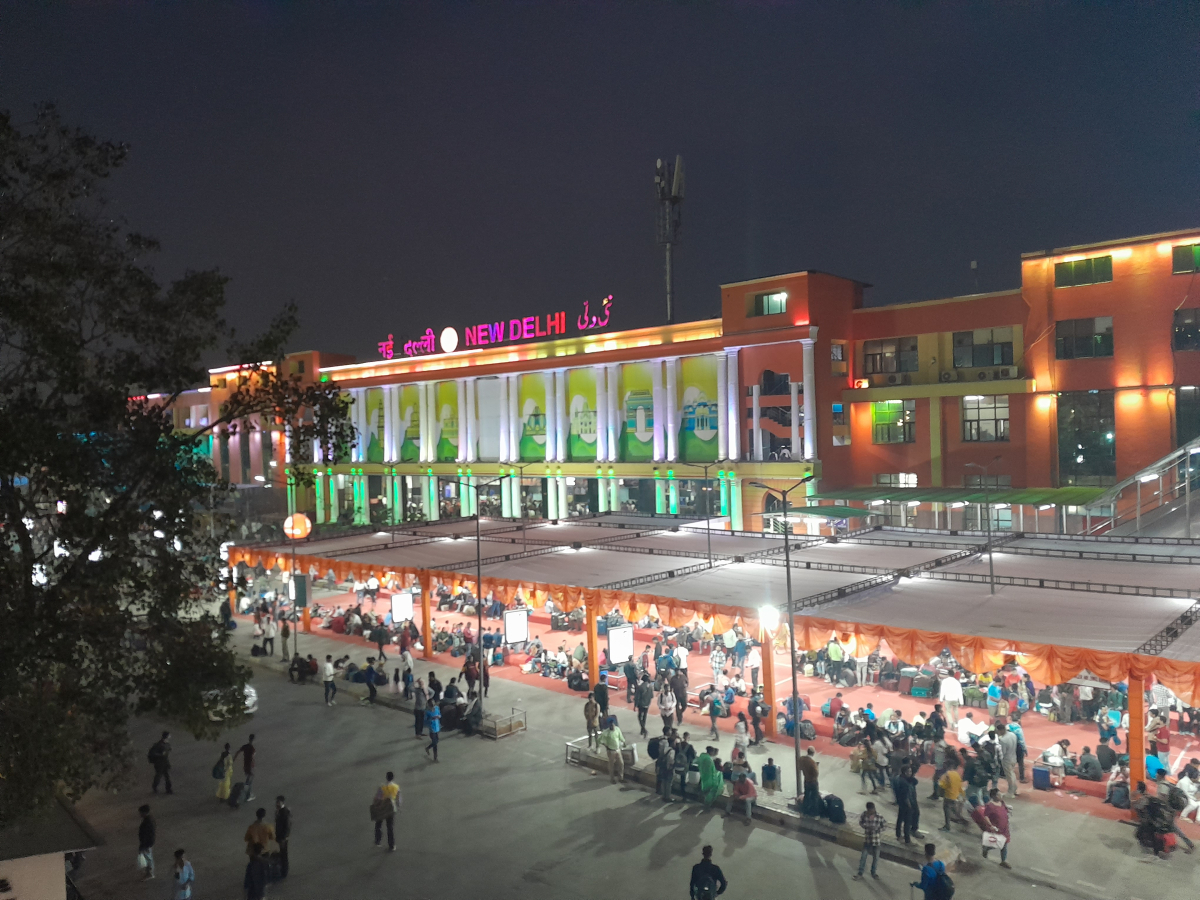
New Delhi Railway Station
It is not difficult to understand the significance of New Delhi Railway Station (NDLS), the very place from where the urns containing the ashes of Mahatma Gandhi and Pandit Jawaharlal Nehru were carried across the country. In the nearly one century since its establishment, it is hard to find any prominent figure in India who has not travelled through here. Established in 1926, New Delhi Railway Station is completing its 100-year journey this year.
This is one of Indian Railways’ busiest and the most revenue-generating station. Approximately 300–350 trains originate, terminate or pass through here daily — including over 250 originating or terminating services — and an estimated four to five lakh passengers pass through it every day, with numbers surging to seven lakh during peak festival seasons.
Imperial design
In reality, New Delhi Railway Station was fully completed in 1931, alongside the inauguration of the city of New Delhi. The chief architect of the capital, Edwin Lutyens, contributed to its design, blending colonial and Indian architectural styles. The construction was not merely for transportation convenience but also served as a demonstration of British imperial power, as Delhi had become the empire’s capital.
After Independence, the station underwent expansion in the 1950s, was fully developed by 1956, and inaugurated by the then President of India, Dr Rajendra Prasad.
Regal entry
While most commuters are familiar with the Paharganj and Ajmeri Gate sides of the station, fewer know that State Entry Road is an integral part of New Delhi Railway Station. Its history dates back to the British era, when Delhi was declared the capital in 1911 and the city was formally planned.
This road was specially constructed for the Viceroy and other high officials to make their ceremonial state entry into the city upon arriving at the new station. The name “State Entry” commemorates this event, when British rulers would enter the city from the station.
“During British India, this road was reserved exclusively for state officials and their guests; it was off-limits to the common public. It starts near the Plaza Theatre and leads to the Paharganj side of the station. After Independence, in the 1950s, it was opened to ordinary passengers, though initially it continued to be used mainly as a VIP entry. In 2012, the Railway Ministry planned to make it more accessible to general passengers, facilitating easier entry from the Paharganj side,” says Dr Ravinder Kumar, former Railway Board member.
Today, it serves as one of the station’s main gateways, allowing travellers smoother access to the platforms. The road stands as a symbol of Delhi’s colonial heritage and planned development.
Historic departures
The farewell train for former President Rajendra Prasad to Patna also departed from this station. The Ajmeri Gate side of the station was constructed in 1982, necessitating the demolition of a dense Christian cemetery located towards Thomson Road, though it was not in active use at the time.
A royal protest
Begum Wilayat Mahal, who claimed to be a descendant of the last Nawab of Awadh, occupied a VIP/first-class waiting room at New Delhi Railway Station for approximately nine years, beginning in the mid-1970s (around 1975).
She and her family turned it into a makeshift royal residence, living there in protest and demanding compensation for ancestral properties in Awadh, seized by the British following the annexation of the kingdom in 1856 under the Doctrine of Lapse. They arrived with Persian carpets, antiques, silver tea sets, servants — often reported as around seven — and a pack of dogs, commonly cited as 13, including Dobermans and Great Danes.
The protest attracted widespread media attention in India and abroad, with headlines such as “Princess living in rail station”.
In 1984–85, the family was allotted Malcha Mahal, a dilapidated 14th-century Tughlaq-era hunting lodge in Delhi’s Ridge area, as alternative accommodation.
Later investigations, including a 2019 New York Times story, revealed that the family’s claimed royal lineage was largely fabricated.
Sporting echoes
A short distance from the station stands Karnail Singh Stadium, built by the Railways in 1954. It was here that Pan Singh Tomar set a national record in the steeplechase in 1964. Circumstances later turned him into a rebel who took up arms.
Before filming Pan Singh Tomar, actor Irrfan Khan visited the stadium to familiarise himself with the setting. The venue has also hosted important cricket matches, including the Ranji Trophy final in 2002. In an earlier era, legendary cricketer Lala Amarnath lived in nearby railway officers’ quarters and regularly attended matches at the ground.
A landmark train
The Rajdhani Express holds special significance for the station. The first Rajdhani Express arrived at New Delhi Railway Station on March 4, 1969, having been flagged off from Howrah Station on March 1, 1969. This was India’s first Rajdhani Express.
On its inaugural run, the train covered the 1,450-km distance between Howrah and Delhi in 17 hours and 20 minutes. Today, the journey takes around 16–17 hours. Initially, the train had only AC First Class coaches; AC Second Class and AC Third Class (now AC 3-tier) were added later. Over time, several improvements have been made to enhance comfort and cleanliness.
Still evolving
New Delhi Railway Station remains one of India’s most significant rail hubs, classified under the NSG-1 category. It has 16 platforms with 18–20 tracks, handles over 250 trains daily, and serves around five lakh passengers a day. Under the Amrit Bharat Station Scheme, redevelopment aims to raise capacity to seven lakh passengers daily, with new infrastructure and amenities targeted for completion by 2029.
The station also boasts the world’s largest route interlocking system, enabling complex train operations. Major services such as the Rajdhani, Shatabdi, Duronto and Vande Bharat Express trains originate here, connecting Delhi with cities across the country.
A hundred years on, the station continues to evolve — a living testament to India’s journey from its colonial past to a modern, connected future.
Delhi Police says permission for the INDIA bloc’s November 1 rally at Ramlila Maidan remains…
Delhi’s AQI stood at 197 on Tuesday, remaining in the moderate category, while 27 of…
CPI general secretary D Raja leads a protest in Delhi, demanding the withdrawal of SIR…
From November 1, non-BS-VI vehicles registered outside Delhi will be restricted; workers who cross at…
Jamia Millia Islamia extends online classes and mid-term exams until Nov 8 following campus protests,…
The proposed Nov 1 Congress rally at Ramlila Maidan could severely disrupt peak festive business…

