animals too feel the brunt of winter. Pictures on social media posts showing street dogs in smart warm jackets suggest Delhi does have a heart. But this sensitivity is not universal.
Turns out, the city collectively is not so generous through the year, and our stray animals are treated with negligence and cruelty more often than not. Not only stray dogs and cats, unproductive dairy cows, ponies, donkeys and calves are at the receiving end of inhuman treatment by the ‘dominant species’.
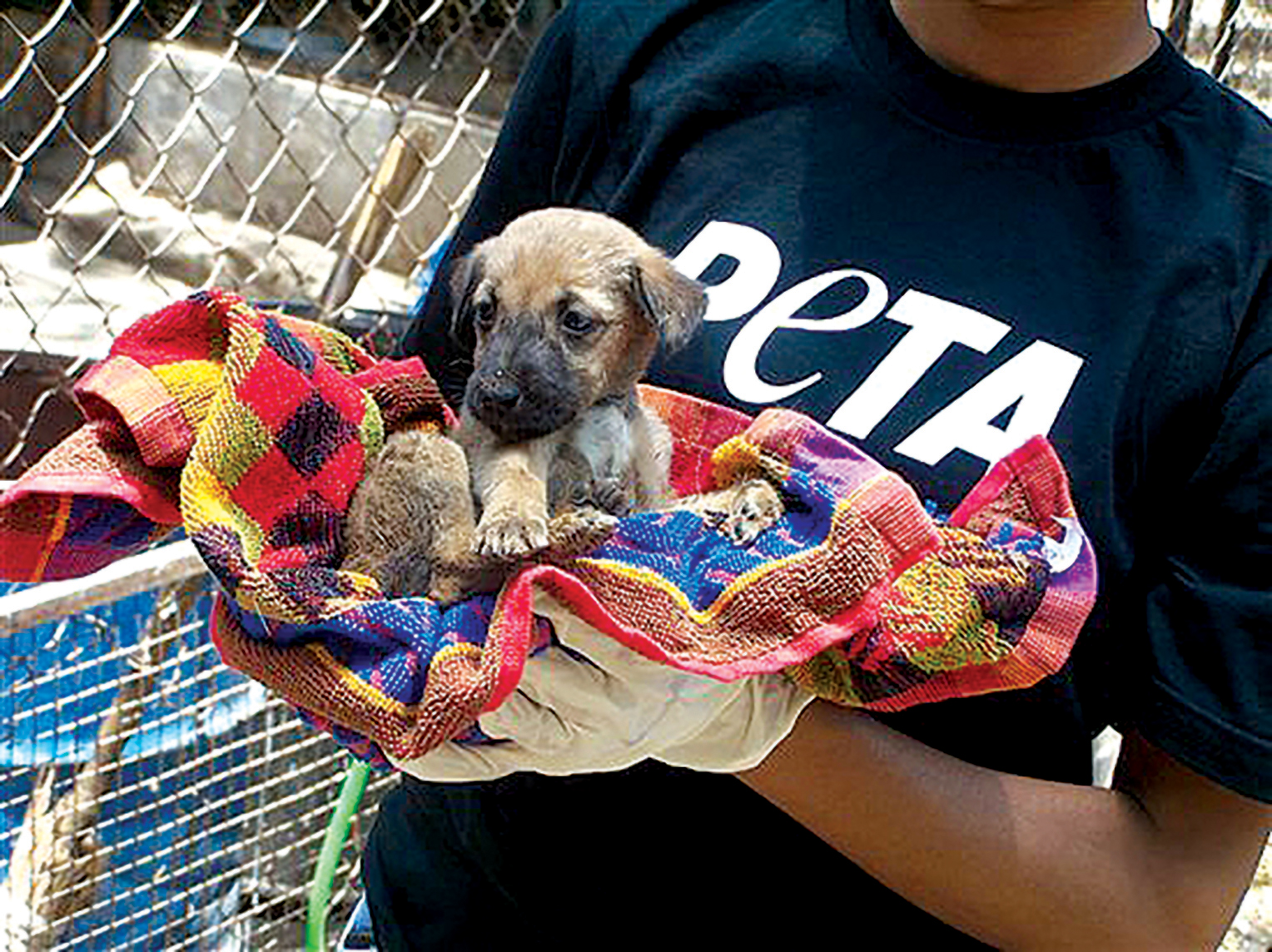
Deepak Chaudhury, Emergency Response Coor-dinator of PETA (People for the Ethical Treatment of Animals) says, “Unlike crimes against people, cases on animal abuse are not compiled and documented by State or Central law enforcement agencies, making it difficult to project an accurate statistic. Animal abuse is not the result of a minor personality flaw in the abuser, but rather a symptom of deep mental disturbance.”
However, as per the first Animal Welfare Policy issued by the government recently, electronic chips will be used to identify pets, and initiatives for sterilisation and birth control of dogs and monkeys in the capital city. This policy also recommends renaming of the ‘Animal Husbandry’ unit of Development Department to ‘Animal Health and Welfare Department.’
According to the data collated by PETA, at least 60 cases of animal cruelty occur daily in cities like Delhi and Mumbai. Neha Chaturvedi, one of the PETA emergency response assistants, says she gets a minimum of 60-80 calls in a matter of 24 hours, and 70-110 on weekends.
A multitude of atrocities are committed on stray animals. Dogs are poisoned, elephants beaten into tameness, cows burnt with acid. In 2018, the emergency response team at PETA entertained approximately 25,000 distress calls from all over India, and handled over 800 cruelty cases. In the past year, 7,000 stray animals were injured in road accidents.
Another form of animal abuse that has been on a marked rise is people abandoning pets when they become inconvenient. The reasons for this range from lack of money and relocation to simply a loss of interest in the pets. Chaudhury observes that the leading cause of abandonment is the birth of a child in the family, when the pet is no longer a temporary filler, or is viewed as a threat to the child.
Most of these abandoned pets die when released into an unknown environment. In a domestic setting, birds, reptiles, and other animals are all restricted to a certain kind of lifestyle. They become habituated with minimal space and a certain kind of diet. Thereafter, when they are abandoned thoughtlessly to fend for themselves, it tends to take a heavy toll on their health.
With the large number of stray and abandoned animals on the streets, they are sometimes viewed as insignificant, unimportant, and perhaps dispensable. And evidently, the biggest present danger to these strays is humans. Organisations like PETA India, PAWS, Sanjay Gandhi Animal Care Centre and a few others that take in these animals and look after and care for them until they are adopted, which admittedly is not all that often.
Tulika, 21, and a previously self proclaimed dog person, has two adopted cats named Dora and Dexter, and couldn’t imagine life without them now. “I doubt there’s an animal more entertaining than a cat,” she says. “Adopting Dexter and Dora was the best decision my sister has taken. It has made me more sensitive towards shelter animals, and I would never consider purchasing one instead of adopting.”
Most animal lovers and animal welfare organisations promote the adoption of street animals. Rather than buying pets from stores or breeders, they advise that people adopt an animal that already needs a home. PETA India has been responsible for treating about 9,000 injured animals on the spot in the last year, and also sterilised and vaccinated 400 stray cats and dogs, before releasing them back into their habitats.
The fact to be noted remains that the responsibility of respecting and taking care of the strays in the city are not exclusive to these animal welfare organisations. While those meting out cruelty towards these animals may be beyond help, as conscientious citizens, being an innocent bystander is not enough. These animals are in need of empathy from humans, now more than ever.
“Animals deserve rights, regardless of how tasty they are or how convenient it is to experiment on them,” says Chaudhury.
Each day of closure costs shops in Khan Market and Connaught Place between Rs 60,000…
Delhi generates nearly 15,000 tonnes of waste daily, prompting the government to deploy 1,000 mechanical…
Delhi Police has issued an NOC for the Congress rally at Ramlila Maidan on November…
CJP chief Abhijeet Dipke received conditional bail following his arrest for participating in a Connaught…
The DPCC has floated ₹104 crore tenders to test pilot pollution-control technologies across 40 key…
MCD pushes Bhalswa cleanup to Feb 2027 due to agency transition, leaving over 10 lakh…
