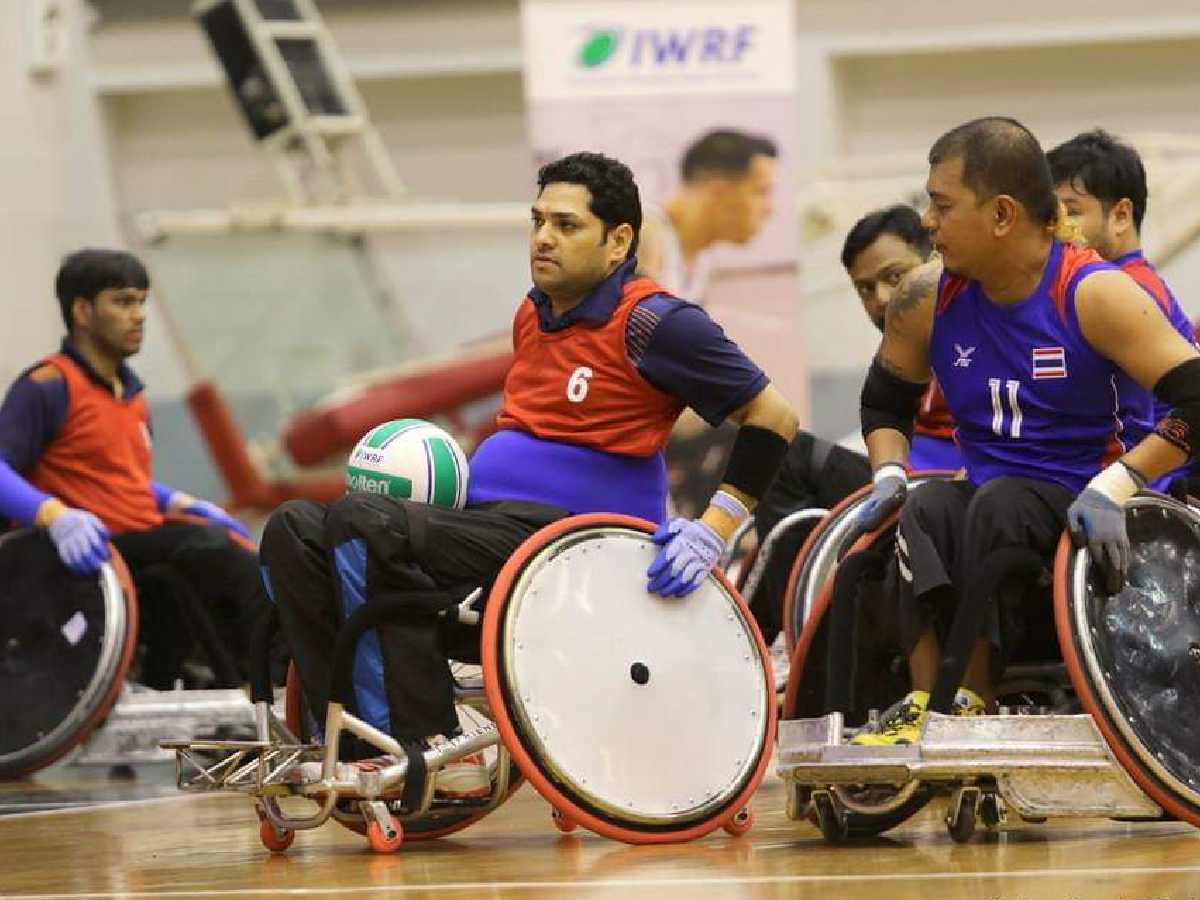
Wheelchair Rugby: When 25‑year‑old software engineer Nikhil Kumar Gupta dove headfirst into a shallow resort pool on a warm March night in 2008, he expected nothing more than laughter and an evening swim. Instead, a head‑on collision with the pool’s bottom severed his C5–C6 spinal cord and left him paralysed from the chest down.
“I opened my eyes underwater and my hands and legs were folded like a frog’s—I couldn’t move a muscle,” he recalls.
Rushed to Apollo Hospital in Bangalore in an auto‑rickshaw—an ambulance never even considered—Nikhil was unconscious as his friends performed CPR, believing he had inhaled water.
“They did everything they could, but nothing worked,” he says. One of them called an auto and took him to the hospital. When he regained consciousness, he remembers, “I was crying with pain—there was so much pain in my neck—and I couldn’t feel my hands and legs. I asked why my legs were floating in the air. They said, ‘No, nothing like that,’ but I thought my legs were flying because I had no sensation.”
Twenty‑four hours later, surgeons operated on his fractured spine after his sister—who worked in Bangalore—gave consent. His parents, then in Ghaziabad, reached only after the surgery had begun. When Nikhil awoke in the ICU at the Indian Spinal Injuries Centre (ISIC) in Delhi, he had no memory of the procedure or the preceding day.
“For almost 24 hours I was unconscious,” he says. “When I opened my eyes in ICCU, I didn’t know what had happened.”
A doctor explained that the injury at C5–C6 had completely paralysed his body below the chest. “There is no treatment to make you walk,” the doctor said, “but we will give you rehabilitation so you can manage by yourself.”
Initially, Nikhil assumed it was “a kind of fracture” and expected to recover in a few months. It was only when his sister, a doctor, told him that it might take six months to a year—“maybe more than enough”—that the reality began to sink in.
Also read: Women wrestlers’ recent good show raises hopes for 2028 Olympic Games
‘I forgot I had an injury’
After fifteen days in ICU, he was moved to a private room at ISIC where physiotherapists and occupational therapists began working with him.
“At first I was not able to lift my arms or hold a spoon,” he says. Nurses taught him how to shift pressure to avoid bed sores and suggested hiring an attendant so his father could return to work. Two months later, they brought in an attendant and arranged for his transfer to their ground‑floor flat, which eliminated stair transfers.
A month after discharge, during a routine ISIC visit, Nikhil saw five rugby wheelchairs donated from the US. A sports therapy doctor invited him to try one. “The first time I sat in that chair and tried to propel it, it was very tough,” he admits. “After three or four days of practice, I was so excited—I forgot I had an injury. I was just laughing when I scored a goal.” That moment rekindled his will to pursue something challenging again.
At the time, wheelchair rugby was virtually unknown in India. Jonathan Sigworth—a quadriplegic injured in Mussoorie who had undergone rehabilitation in the US—returned to India and challenged the notion that quadriplegics “couldn’t do anything.” Demonstrating his abilities by transferring himself from the floor back into his chair, he proved sceptics wrong.
Inspired, Nikhil joined Jonathan, along with Nuruddin, Riya, and Deepak, for weekly Sunday practices at ISIC. The five of them would become the founding members of what would grow into a national movement.
Founding a movement from a rented house
In 2010, Nikhil and Jonathan co‑founded the Empowering Spinal‑Cord‑Injured Persons initiative (ESCIP). Operating out of a small rented house in Kailash Colony, they devoted Sunday mornings to life skills—transfers, bed sore prevention, finger‑strength exercises, typing drills—and Sunday afternoons to rugby: bump‑and‑spin techniques, ball handling, scrimmages.
Within a year, Nikhil dismissed his paid attendant. “I told my family, ‘I’d rather struggle on my own than depend on someone else,’” he says.
To reduce costs and foster self‑reliance, he arranged for a Ghaziabad workshop to reverse‑engineer rugby wheelchairs using locally sourced steel tubing and bicycle wheels. “Our homemade chairs were heavier, but they worked—and cost one‑tenth as much,” he explains. Camps even included metal‑working lessons so athletes and family members could learn to repair bent frames and true wheels.
He also tackled rugby rules and classification. International classifiers were brought in to train Indian physiotherapists in the 0.5–3.5‑point functional classification system. They marked boundaries on borrowed basketball courts, used PVC pipes for goalposts, and conducted “rule bootcamps” so players, coaches, and referees could communicate effectively.
“We needed that common understanding; otherwise it would be chaos,” Nikhil says.
First competitions, first federation
In 2011, the Prava Foundation selected ESCIP for its Changerooms incubator, awarding seed funding and mentorship. That summer, ESCIP held its first multi‑day camp in Mohali at the Army’s Physical Rehabilitation Training Centre.
“We graduated 15 quadriplegic athletes who went home believing they could live—and play—independently,” Nikhil says.
Soon, camps followed in Mumbai, Bihar, and Ghaziabad. ESCIP opened “Independence House” in Delhi to provide free accommodation to outstation athletes.
“We had four players in 2010; by 2013 we were training twenty every weekend,” he notes.
Peer mentors—graduates of earlier camps—became assistant coaches, demonstrating chair transfers, bump‑and‑spin moves, and self‑care routines. “When a newly injured patient sees a mentor scoot across the floor, their eyes light up,” Nikhil says.
From Delhi to the international stage
ESCIP’s first international exposure came in 2009 when ISIC patients took part in an IWAS demonstration match in Bangalore against Brazil’s national team. In 2010, Nikhil donned India’s makeshift T‑shirt and rugby wheelchair for his first official match.
“I was terrified, but scoring that first try erased every fear,” he recalls.
By 2014, ESCIP had fielded India’s first quadriplegic squad—Nikhil, Jonathan, Riya, and Deepak—at the Asian Wheelchair Rugby Championship in South Korea.
“No attendants, no safety net,” Nikhil emphasises. Though a teammate’s in‑flight injury forced India to forfeit, he was awarded Best Player in the 1.5‑point classification.
“That trophy belonged to every spinal‑injury survivor in India,” he says.
In October 2015, an eight‑member Team India—clad in sponsored tracksuits from Indigo Airlines and funded by a Rs 1 lakh Facebook campaign—competed in the Asia‑Oceania Championship in Jakarta, finishing fourth.
“Standing for our anthem in full kit was unforgettable,” Nikhil remembers.
Institutionalising the game
Back in Delhi, Nikhil sought formal recognition. In 2016, he and Jonathan met Dr Shivaji Kumar, Secretary General of the Paralympic Committee of India.
“He said, ‘Your grassroots movement needs structure—let’s build a federation,’” Nikhil recalls.
ESCIP formally became the Wheelchair Rugby Federation of India, with Nikhil as General Secretary.
Under the aegis of the PCI and with support from Rugby India, ESCIP launched its first national championship in Mohali, with 12 teams from four states. Uttar Pradesh took the inaugural title.
Simultaneously, ESCIP revived the Jonathan Cup exclusively for quadriplegic athletes. The event featured four mixed teams—two paraplegics and two quadriplegics each—drawing eight teams and validating the format.
“Watching those quad athletes compete, I thought, ‘We’ve come so far,’” Nikhil says.
Between 2016 and 2024, ESCIP hosted seven national championships and three Jonathan Cups, growing from four Delhi‑based players to 18 state teams and 170 athletes, including 30 quadriplegics.
Each event improved logistics—standardised match schedules, certified referees and classifiers, on‑site medical support—and attracted media attention. A 2023 coaches’ clinic in Mumbai trained 20 new referees and 15 classifiers, seeding technical expertise nationwide.
Future goals, funding challenges
ESCIP’s Peer Mentor Programme places trained graduates in hospitals across Delhi, Ghaziabad, and Mohali. They help newly injured patients with transfers, self‑care routines, and initial wheelchair mobility.
“That spark of hope in their eyes—that’s why we do this,” says Nikhil.
Despite growing success, funding remains a challenge.
“To send 15 members abroad costs Rs 30 lakh. Sponsors want medals first—a catch‑22,” he laments.
Unlike individual Paralympic events, team sports attract less attention and money. ESCIP currently relies on CSR grants, crowdfunding, and in‑kind donations.
Infrastructure is also lacking. Most indoor arenas in Delhi cater to basketball or badminton, not rugby chairs. ESCIP still trains on borrowed courts at dawn, chalking boundaries and erecting makeshift PVC goals.
Nikhil is now negotiating to convert a vacant warehouse into India’s first adaptive‑sports arena with padded walls and adjustable goals.
“Imagine a court built for our chairs—that would transform training,” he says.
Looking ahead to 2028, he has approached the Ministry of Youth Affairs and Sports for dedicated funding and urging state governments—Bihar recently recognised the sport—to build wheelchair‑rugby facilities.
He dreams of seeing wheelchair rugby in school and university adaptive‑sports programmes.
“Opportunity is scarce; talent is everywhere,” he asserts.
Also read: Rain and thundershower may mar DPL T20 as DDCA declares fixtures
‘Your will is unbreakable’
Asked what he would say to someone newly paralysed, Nikhil’s response is steady:
“Your spinal cord may be damaged, but your will is unbreakable. You will face pain, frustration, doubt—but those are the days you build strength. Find your ‘why,’ push that chair, and the world will shift beneath your wheels.”
From a hospital bed in Delhi to international stadiums, Nikhil Kumar Gupta’s journey embodies sport’s power to transform trauma into triumph—rewriting India’s disability narrative, one determined push at a time.
Police probe all angles, including a suspected breakup and CCTV footage, after a Class 12…
Two terror attacks, eight years apart, struck ordinary shoppers and changed festive celebrations in the…
NDMC to build a larger tulip garden with parking at Nehru Park, featuring seasonal blooms,…
A 17-year-old student was found burnt at an east Delhi school, with police probing a…
Delhi's temperature fell to 17°C following overnight rain and thunderstorms, with an AQI of 167…
Coforge opened its first library in Noida in February 2024; it now claims a combined…

