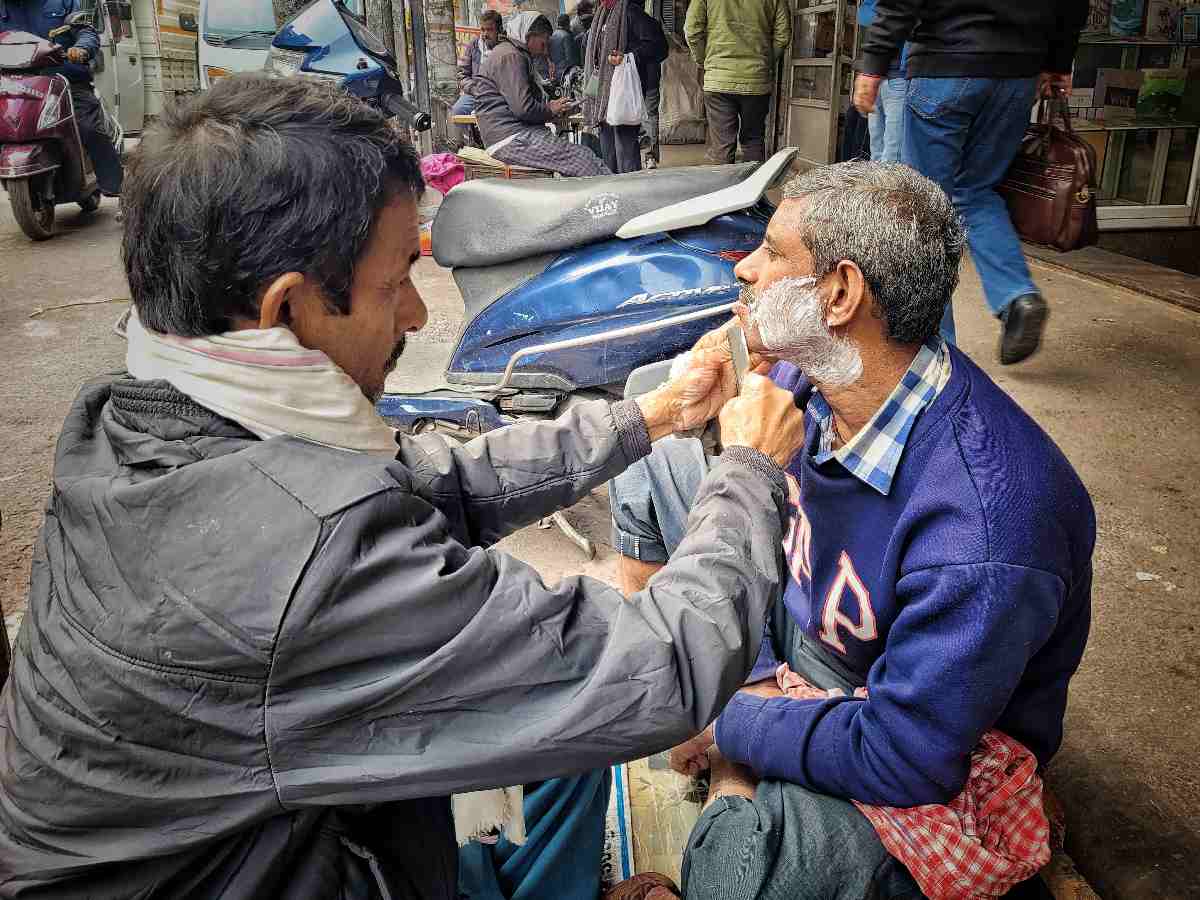
Rehmat Ali, a street barber in Old Delhi, carefully shaves a customer's beard on the roadside
Delhi’s street barbers, once a hallmark of the city’s vibrant streetscape, are now a vanishing tradition. These makeshift salons, often set up under the shade of trees or along bustling sidewalks, have catered to the working class for decades, offering affordable grooming services to those who couldn’t afford modern salons. However, as the city races towards modernisation, this humble craft struggles to survive.
A veteran with scissors and stories
Chandra Bhushan, a 72-year-old street barber who migrated from Ayodhya to Delhi in 1973, has spent more than four decades plying his trade on the streets. Despite his age, he still practises his craft, though less frequently now.
“Today’s generation looks at me and thinks, ‘he’s too old, he might cut our throat,’” he says with a laugh. “But the older generation knows my 40 years of experience.”
Chandra Bhushan recalls the days when his clientele included Delhi Police personnel who valued his expertise. Now, much of the business has been taken over by his son, but he cherishes the memories of his once-thriving enterprise.
Struggles of adapting to change
For others like Satyanarayan Thakur, also a barber with 40 years of experience, the challenges are daunting. “I can’t afford a proper shop,” he says. “On the streets, I don’t have to pay rent, but customers are fewer these days—barely four or five a day.”
Satyanarayan sets up near coaching centres, hoping to attract students for quick haircuts. He reminisces about the once-popular “Katora Cut,” a style where a bowl was placed on the head to guide the trim. “Now it’s evolved into the ‘Mushroom Cut,’ done with machines,” he says. Once assisted by helpers, he now works alone, adapting to the changing times.
A vanishing trade in Old Delhi
In the historic lanes of Old Delhi, Rehmat Ali, another street barber, paints a grim picture of the future. “This profession is fading away day by day,” he laments. His clientele consists mostly of labourers and workers who come for quick shaves or haircuts. Charging Rs 20 for a shave and Rs 40 for a haircut, Rehmat struggles to make ends meet.
“Even here, where I have my stall in Old Delhi, I pay Rs 500 a month to the Delhi Police. My earnings are too low to afford a proper shop,” he says.
Urbanisation versus tradition
The challenges faced by Delhi’s street barbers reflect the broader socio-economic changes sweeping through the city.
Also Read: Delhi’s early risers: The unsung architects of the city’s mornings
Rising rents, dwindling customers, and competition from modern salons have pushed this once-thriving profession to the brink. Yet, their stories are not just about struggle; they also highlight resilience and dedication.
These barbers, many of whom have been practising their craft for decades, continue to serve their loyal customers with pride and skill. They are not just professionals; they are custodians of a tradition that once defined Delhi’s streets.
As urbanisation accelerates, these street barbers stand as a testament to a simpler time—a reminder of a Delhi that thrived on its rich tapestry of diverse livelihoods. Their fading presence is a poignant symbol of the city’s relentless transformation.
Delhi recorded its first 'poor' air day of the season on Wednesday as AQI hit…
Stage I of GRAP was invoked later this year in Delhi due to govt's preventive…
DDA plans to resume tethered hot air balloon rides at Baanseera park from Nov 14,…
NDMC is consulting RWAs and traders on draft 2026 property tax bye-laws, seeking feedback on…
Delhi HC will hear AISA leader Neha Bora's plea against a police peace bond notice…
CJP leaders Saurav Das and Ashutosh Ranka withdrew their HC plea challenging the extension of…

